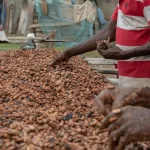
GLOBAL cocoa prices have tumbled to around $5,000 per ton, down 45% since January and more than 50% from their December 2024 peak of nearly $12,000, as improved harvest forecasts from major West African producers ease supply concerns ahead of the festive season.
The dramatic price correction follows two years of market tension driven by production challenges in Côte d’Ivoire and Ghana, which together account for 60% of global cocoa output—rising to 70% when other West African nations are included.
“After two years of tension, the current correction is bringing cocoa prices back to more rational levels. But it would be illusory to talk about normalisation: the sector remains fragile due to structural constraints and a very high geographical concentration of bean production,” said Simon Lacoume, a sector economist.
The price decline stems from optimistic harvest projections in Côte d’Ivoire and the unwinding of speculative positions that fueled 2024’s price surge. However, current prices remain double the 2012-2022 average of $2,525 per ton.
Relief for African Manufacturers
The price drop offers potential relief to South African and African chocolate manufacturers and retailers facing record-high costs last year, with the possibility of more affordable products for consumers during the festive season. However, industry observers warn that structural vulnerabilities persist.
Despite reduced impacts from El Niño weather patterns and swollen shoot virus outbreaks, the sector continues to grapple with ageing plantations, insufficient investment, and extreme geographical concentration of production. This concentration leaves global supply chains vulnerable to any disruption in West Africa.
Value Chain Imbalances Persist
Europe, particularly Germany and the Netherlands, dominates cocoa processing, with four companies controlling two-thirds of global grinding capacity. This concentration reinforces the North-South divide in the value chain and creates barriers for new market entrants.
Côte d’Ivoire and Ghana have introduced Reference Price for a Decent Income mechanisms, setting minimum producer prices at $3,408 per ton in Ghana and $2,650 per ton in Côte d’Ivoire, as part of efforts to capture more value domestically and increase local grinding capacity.
Regional Competition Intensifies
Latin America is positioning itself as an alternative source, with Ecuador targeting 650,000 tons of annual production to overtake Ghana by 2027. The shift comes as EU traceability requirements and sustainability initiatives increase pressure for transparent supply chains.
Global chocolate consumption continues growing, driven by Asian markets and premium segments including ethical, organic, and low-sugar products. Certified cocoa from Fairtrade and Rainforest Alliance schemes is gaining market share.
Environmental Pressures Mount
The industry faces long-term environmental challenges linked to cocoa plantation life cycles of 25 to 30 years. Peak productivity occurs after five years, followed by declining yields after 15 years, forcing farmers to choose between lower incomes, costly replanting requiring five-year gaps in harvests, or converting land to palm or rubber cultivation.
This dynamic drives deforestation as farmers clear virgin forest areas to finance new plantations, despite increasingly strict forest protection regulations. The difficulty of tracing cocoa beyond the grinding stage exacerbates the challenge of preventing forest clearance.