A $10 billion energy deal struck between Ethiopia and Djibouti is reverberating across boardrooms, government corridors, and development finance circles from Nairobi to Lagos – and for very good reason. This is not a story about a foreign company extracting African resources. This is Africa building for Africa, financing its own future, and writing the terms.
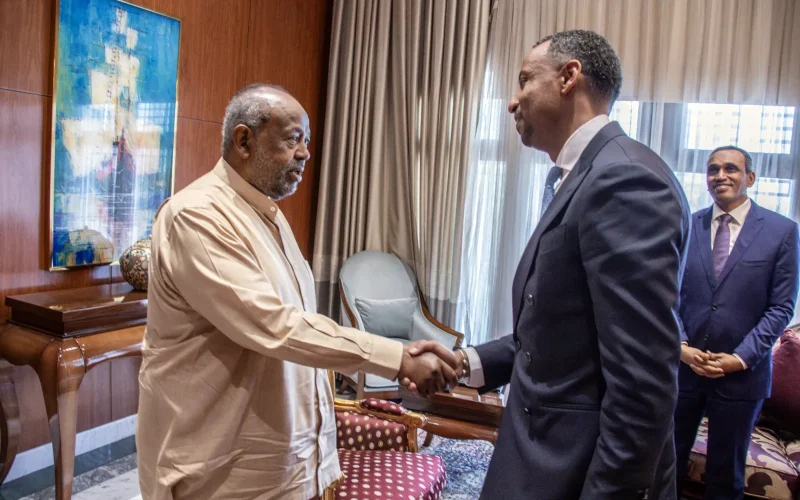
Ethiopian Investment Holdings chief executive Dr. Brook Taye presented Djibouti’s President Ismail Omar Guelleh with a visionary two-phase infrastructure blueprint that would transform the twin economies into the engine room of a new East African energy corridor. President Guelleh has accepted the plan, according to Djibouti’s state news agency ADI. The handshake that followed may well be remembered as the beginning of one of the most consequential economic partnerships on the continent.
| “This is not a story about a foreign company extracting African resources. This is Africa building for Africa, financing its own future, and writing the terms.” |
Phase One: A Lifeline in Steel — The Refined Oil Pipeline
The first phase of the agreement involves the construction of a refined petroleum pipeline stretching approximately 113 kilometres from the Port of Djibouti to Dewele, the bustling crossing point on the Ethiopia-Djibouti border. This artery would carry imported refined petroleum products from Djibouti directly into Ethiopia’s heartland — a practical and commercially elegant solution to landlocked Ethiopia’s chronic dependence on costly, logistically complex overland fuel transport.
For a country of 130 million people with one of Africa’s fastest-growing economies, reliable and affordable fuel supply is not a convenience — it is the oxygen of development. Factories, farms, freight networks, and a booming urban middle class all depend on petroleum supply chains that, for too long, have been dictated by port bottlenecks, currency fluctuations, and the goodwill of transit countries. A dedicated pipeline changes the calculation fundamentally.
Phase One footprint: 113 km | Port of Djibouti to Dewele, Ethiopia-Djibouti border | Refined petroleum imports.
Phase Two: The Big Play — Gas and Crude from the Ogaden
Phase Two is where ambition scales to history. A 760-kilometre gas and crude oil pipeline would connect the Ogaden Basin — Ethiopia’s Somali State, one of the most resource-rich yet underdeveloped corners of the continent — all the way to the Port of Djibouti, unlocking export routes to global markets that Ethiopian hydrocarbons have never previously been able to access at a commercial scale.
The Ogaden Basin has long been known to hold substantial reserves of both natural gas and crude oil. Decades of underinvestment, conflict, and infrastructure deficits kept those reserves locked underground while the region’s people bore the costs of poverty and neglect. This pipeline is not merely an energy project — it is a statement of intent: that the resources of eastern Ethiopia will now serve the people of Ethiopia and their continental neighbours, on African terms.
| “760 kilometres of pipeline from the Ogaden to the sea — turning one of Africa’s most underinvested regions into the launch pad for an continental energy revolution.” |
Dangote in the Mix: Africa’s Biggest Name Enters the Frame
Perhaps the most compelling signal that this deal is built to succeed is the involvement of the Dangote Investment Group. The Aliko Dangote-led conglomerate — which has already demonstrated with its Lagos refinery that African capital can build world-class energy infrastructure independently — is expected to deepen its strategic role as both phases progress. Its participation elevates this from a bilateral government agreement into a fully commercial, bankable enterprise with the institutional credibility that international bond markets and development finance institutions require.
Dangote’s track record matters. When sceptics doubted whether Africa could finance and build its own refinery, Dangote’s 650,000-barrel-per-day Lagos facility proved them wrong. That same ethos — African capital, African execution, African benefit — is now being brought to the Horn of Africa. The synergies are obvious: Ethiopian gas feeding Dangote downstream capacity, Djibouti’s strategic port position acting as the global gateway, and a new model of South-South investment writing itself in steel and pipeline.
The Strategic Logic: Why This Deal is Bigger Than the Sum of Its Pipelines
Taken together, the two pipelines solve three distinct strategic problems simultaneously.
First, they provide Ethiopia with energy security. As an energy importer at scale, Ethiopia’s industrial ambitions — its textile parks, its agro-processing boom, its exploding urban construction sector — require a guaranteed, affordable petroleum supply. The Phase One pipeline delivers exactly that.
Second, they create a new export platform for Ethiopian hydrocarbons. The Ogaden’s gas and crude reserves have a global market value. The Phase Two pipeline converts that value from a geological fact into a commercial reality, generating foreign currency revenues that can fund schools, hospitals, roads, and the kind of state capacity that drives long-term development.
Third, and perhaps most profoundly, they transform Djibouti’s economic model. Already one of Africa’s most dynamic transit economies — its ports handle the vast majority of Ethiopian trade — Djibouti now becomes the physical gateway for a major energy export corridor. Port revenues, infrastructure tolls, processing fees, and the downstream economic activity that energy corridors generate will compound across decades.
| “The Horn of Africa is not waiting for the world to come to it. It is building the infrastructure to go to the world — on its own terms.” |
A Model for Intra-African Investment
What makes the Ethiopia-Djibouti pact genuinely instructive is its architecture. This is a government-to-government agreement that has already secured executive-level endorsement from both heads of state and which incorporates major private African capital through the Dangote group. It is precisely the kind of public-private, pan-African investment model that the African Continental Free Trade Area (AfCFTA) was designed to catalyse — but which has, in too many sectors, remained more aspiration than transaction.
Here, the aspiration is becoming concrete. Steel will go in the ground. Gas will flow through pipes. Crude will reach tankers in Djibouti harbour. And the revenues will circulate within African economies rather than flowing to foreign shareholders in London or Houston.
The total project cost exceeds $10 billion. That is not a small number — but contextualised against the economic value of what it unlocks, it is a bargain. And critically, it is a number that African institutions, African development finance, and African private capital are increasingly capable of mobilising. That capability is the real story.
What Comes Next
Both governments have signalled their commitment. Dr. Taye’s presentation and President Guelleh’s acceptance create the political mandate for the detailed engineering, financing, and regulatory work to begin in earnest. Construction timelines, financing structures, and the precise contours of the Dangote partnership will now take shape in the negotiations ahead.
The African Mirror will continue to report on this deal as it develops. What is already clear is its significance: an intra-African energy transaction of this scale and ambition, anchored by African capital and executed through African institutions, is precisely the kind of story this publication was created to tell — and that the continent deserves to celebrate.
The Horn of Africa is not waiting for the world to come to it. It is building the infrastructure to go to the world — on its own terms.
| DEAL AT A GLANCE Total estimated cost: Exceeds $10 billion Phase One: 113 km refined petroleum pipeline — Port of Djibouti to Dewele border crossing Phase Two: 760 km gas and crude oil pipeline — Ogaden Basin (Ethiopia’s Somali State) to Port of Djibouti Parties: Federal Democratic Republic of Ethiopia | Republic of Djibouti | Dangote Investment Group Lead presenter: Dr. Brook Taye, CEO, Ethiopian Investment Holdings |