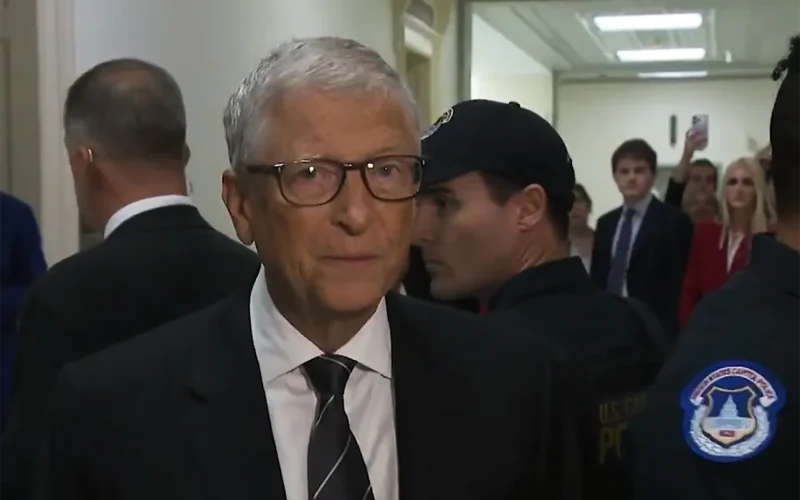
HE built hospitals in sub-Saharan Africa. He funded vaccine programmes that saved millions of lives. He recast himself, in the decades after Microsoft, as the most consequential philanthropist of his generation. But on Wednesday, Bill Gates – with a net worth estimated at over $100 billion and a foundation bearing his name – sat in a closed-door chamber on Capitol Hill and offered testimony that stripped away the carefully curated image of the world’s most benevolent billionaire.
The testimony before the House Oversight and Government Reform Committee was private. But the opening statement was not. And what Gates said — that Jeffrey Epstein, the convicted sex offender who trafficked young women and girls for decades before his 2019 death in a Manhattan federal detention cell, had used knowledge of his extramarital affairs to pressure him — was an extraordinary admission from one of the most powerful men alive.
“Epstein was working to use information about my infidelities — in addition to many lies that he layered on top — to pressure me to re-engage with him.”
These are not the words of a man on the periphery. These are the words of a man who knew Epstein well enough to be blackmailed by him.
A RELATIONSHIP THAT OUTLASTED EPSTEIN’S CONVICTION
The critical facts, now established by documents released this year by the United States Department of Justice, are damning in their detail. Gates and Epstein met repeatedly after Epstein’s 2008 conviction on a Florida state felony prostitution charge — a conviction that, as would later emerge, was itself a profoundly compromised exercise of prosecutorial discretion. Epstein served just 13 months in jail, benefiting from a sweetheart deal arranged with federal prosecutors that his victims were not even told about.
Gates has said previously that his dealings with Epstein were confined to philanthropy. That framing, always strained, has now been formally complicated by his own testimony. The DOJ documents also show photographs of Gates alongside young women whose faces are redacted, and emails between Epstein and senior staff at the Bill and Melinda Gates Foundation — not incidental contact, but institutional engagement.
In February of this year, Gates reportedly stood before his own Foundation employees at a town hall and ‘took responsibility for his actions’. The Foundation, for its part, announced in April that it had launched an external review into its engagement with Epstein. These are the actions of an institution that has been caught, not one that came clean.
THE ARCHITECTURE OF IMPUNITY
To understand what Gates’ testimony means, you must first understand what Epstein represented — not merely as a sex offender, but as a system. Epstein was not an outlier in the circles he inhabited. He was, by every credible account, a broker of influence, a collector of secrets, and an enabler of abuse for the powerful. His client list was not accidental. It was the point.
The House Oversight Committee’s investigation goes far beyond Bill Gates. It encompasses the Justice Department’s chronic mismanagement of the Epstein case — the original 2008 plea deal that let him walk, the 2019 federal charges, his death in custody ruled a suicide that many have never accepted, and the extraordinary delays in releasing government files about his network. It is an investigation into whether the American justice system, at its highest levels, protected Epstein and those around him.
Epstein was not an outlier in the circles he inhabited. He was a broker of influence, a collector of secrets, and an enabler of abuse for the powerful. His client list was not accidental. It was the point.
The files, when they eventually came, were explosive. They revealed Epstein’s ties to figures in politics, finance, academia and business — including President Donald Trump, who socialised extensively with Epstein in the 1990s and 2000s. Former Attorney General Pam Bondi, fired by Trump in April, faced accusations of attempting to shield the president from scrutiny. Trump himself opposed the release of the files until Congress overwhelmingly passed a law compelling their disclosure — a striking act of legislative defiance against a president who commands near-total fealty from his party.
THE PECULIAR IRONY OF PHILANTHROPY AS SHIELD
There is a specific and troubling dynamic at work in the Gates story that goes beyond personal moral failure. The Gates Foundation is one of the most powerful private institutions in global health and development. It shapes vaccine policy. It influences what African children are taught and what diseases their governments prioritise. Its reach into the Global South is enormous — and largely unaccountable to the populations it claims to serve.
That this institution’s founder and leader maintained a relationship with a man who systematically abused young women from economically vulnerable backgrounds — the very demographic Gates Foundation programmes are meant to protect — is not a footnote. It is a direct challenge to the moral authority on which the entire philanthropic project rests. Philanthropy, at the scale Gates operates, is power. And power, as Epstein understood better than most, can be bought, leveraged, and weaponised.
Gates hired a former chief investigative official of the very oversight panel investigating him to help prepare his testimony — a detail that speaks to how the powerful navigate accountability in Washington. The revolving door between congressional oversight and private legal preparation for the powerful is its own story, one that deserves scrutiny.
WHAT ACCOUNTABILITY ACTUALLY LOOKS LIKE
The survivors of Epstein’s abuse — the young women trafficked, coerced, and violated over decades — have watched as a parade of prominent men have offered variations of the same story: they didn’t know the full extent of it; they were deceived; their contact was limited. They have watched powerful institutions announce internal reviews and external audits. They have watched justice move at the pace that power allows.
Gates’ testimony on Wednesday is one chapter in a saga that has exposed, with brutal clarity, how wealth and influence function as insulation against accountability — until they don’t. Documents can be delayed but not permanently suppressed. Survivors can be silenced for a time but not forever. And eventually, even the most carefully managed reputation must meet the facts as they are.
Philanthropy, at the scale Gates operates, is power. And power, as Epstein understood better than most, can be bought, leveraged, and weaponised.
That Gates was blackmailed — assuming his account is accurate — does not exonerate him. The question is not only whether he was a victim of Epstein’s manipulation. The question is why, knowing what Epstein was, he continued the relationship. Why the Foundation continued the relationship. And what those choices say about how wealthy men calculate the acceptable cost of doing business with the indefensible.
THE BIGGER PICTURE: POWER, COMPLICITY AND THE LONG ARC
What the Epstein files have confirmed, document by document, hearing by hearing, is something that many people — particularly women, particularly those without wealth or status — have known for a very long time: that there is a class of powerful men who operate by different rules, protected by their access, their money, their lawyers, and the reluctance of institutions to pursue them.
Bill Gates is not the worst actor in this story. But he is, this week, the most prominent one facing a public accounting. And that matters. Not because a private congressional interview constitutes justice. Not because an opening statement constitutes full disclosure. But because accountability, when it comes for the powerful, is rarely total and is almost always partial, contested, and late.
The late Jeffrey Epstein — predator, manipulator, and creature of elite privilege — is dead. The young women he abused are not. The network that enabled and protected him for decades is still, in many ways, intact. The House Oversight Committee’s investigation is one mechanism, imperfect and politically charged, for forcing a reckoning. Bill Gates’ testimony is one data point. There will be others.
The question is not whether the powerful will eventually be held to account. History suggests they sometimes are. The question is whether the accounting, when it comes, will be sufficient — not for the reputations of the men involved, but for the dignity and justice owed to those they failed.