
AFRICA’S next race for climate finance is increasingly being shaped not by the size of countries’ renewable resources but by the strength of the institutions that can turn those resources into investable opportunities.
A growing body of evidence suggests that trust, built through credible policies, project preparation, risk-sharing mechanisms, and transparent markets, is becoming one of the continent’s most valuable climate assets.
“Trust is the currency that will fund this future. Trust in people. Trust in markets. Trust in outcomes. Trust in impact.”
That observation by Africa’s Green Economy Summit (AGES) chairman Iain Banner captures a shift emerging across African climate finance. Investors are not walking away because Africa lacks opportunity. Increasingly, they are looking for stronger investment systems capable of converting climate ambition into commercially viable projects.
The opportunity remains enormous.
According to the African Development Bank, African countries require approximately US$277 billion every year through 2030 to implement their climate commitments, yet current climate finance flows remain only a fraction of that amount, leaving an annual financing gap of roughly US$247 billion.
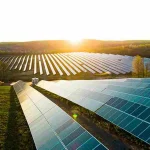
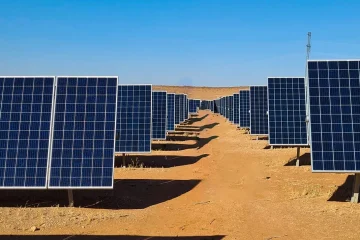
The gap exists despite Africa possessing around 60% of the world’s best solar resources, while continuing to attract only a small share of global clean energy investment. The contradiction is increasingly understood not as a shortage of capital, but as a shortage of investable projects.
According to Africa’s Green Economy Summit Impact Report 2023–2026, the summit has facilitated more than 1,500 curated investor meetings, attracted over 500 investors, and built a project pipeline worth more than US$12 billion across four editions.
The figures suggest investor appetite already exists.
The challenge is converting interest into transactions.
That distinction is becoming one of the defining themes of Africa’s green economy.
Governments, development finance institutions, and private investors are increasingly directing attention toward the systems that make climate projects bankable, rather than focusing solely on raising additional capital.
Rather than mobilizing ever larger pools of finance, African countries are investing in what could increasingly be described as the continent’s trust infrastructure, the financial, institutional, and technical systems that reduce risk, improve transparency, and increase investor confidence.
The objective is becoming clear. Build confidence before capital.
Project preparation facilities, competitive procurement frameworks, blended finance structures, guarantee instruments, carbon market verification systems, and investment platforms are increasingly forming the backbone of Africa’s emerging climate finance architecture.
Together, they address one of the continent’s most persistent investment constraints.
High financing costs and perceived risk continue to discourage private investors, even where renewable energy projects are commercially attractive. Building institutions that reduce those risks before projects reach financial close is therefore becoming just as important as developing the projects themselves.
Development executive Benedictor Cheronoh Mwaura argues that blended finance has struggled to scale because “the policy, regulatory, institutional, and market infrastructure beneath the deals” was never fully built.
Africa is now attempting to build exactly that infrastructure.
One of the continent’s largest initiatives is the Alliance for Green Infrastructure in Africa (AGIA), launched by Africa50 and partners in 2024. The platform aims to mobilize US$10 billion for climate-resilient infrastructure by supporting projects during the critical period between feasibility studies and financial close, where many African investments have traditionally stalled.
The World Bank Group is pursuing a similar strategy.
Its expanded guarantee platform aims to deploy around US$6.4 billion annually in political and commercial risk guarantees by 2030. The institution estimates those guarantees could mobilize approximately US$23 billion in additional private investment by reducing risks that commercial lenders are often unwilling to absorb.
National governments are following the same path.
In 2026, Ghana launched a National Green Project Preparation Facility with support from the UK’s Foreign, Commonwealth, and Development Office. Rather than financing projects directly, the initiative focuses on feasibility studies, transaction advisory services, and financial structuring, recognizing that many climate investments fail long before investors assess them.
According to Nana Dwemoh Benneh, Chief Executive Officer of the Ghana Infrastructure Investment Fund, the facility is designed to strengthen Ghana’s pipeline of bankable climate projects.
“It presents a significant opportunity to collaborate in developing a robust pipeline of bankable, climate-resilient, and investment-ready infrastructure projects.”
“The facility has the potential to unlock much-needed climate and infrastructure finance, crowd in private capital, and accelerate Ghana’s transition towards a more resilient, low-carbon, and sustainable economy.”
Blended finance has become another pillar of this emerging architecture.
According to Convergence, climate-focused blended finance continues to represent one of the fastest-growing areas of blended finance globally, with Africa remaining one of its most active destinations as concessional and commercial capital are increasingly combined to reduce investment risk.
Together, these institutions are quietly changing what determines where climate investment flows.
The pattern becomes even clearer when viewed country by country.
South Africa’s Renewable Energy Independent Power Producer Procurement Programme has become one of Africa’s strongest demonstrations that institutional credibility can attract large-scale investment. Competitive auctions, standardized power purchase agreements, and transparent procurement processes have helped mobilize more than US$20 billion in private investment while supporting the procurement of more than 7 gigawatts of renewable energy.
Investors consistently point to confidence in the procurement framework and contractual certainty as major reasons for participating.
Morocco has pursued a similar strategy through policy consistency.
Since establishing MASEN and introducing reforms that opened renewable electricity generation to private investment, the country has built one of Africa’s most predictable renewable energy markets. The Noor Ouarzazate Solar Complex alone attracted around US$2.5 billion in financing from multilateral development banks and commercial lenders, demonstrating how institutional stability can unlock complex infrastructure finance.
Namibia is applying the same principle to an entirely new industry.
Its green hydrogen programme has combined transparent bidding processes, long-term policy commitments, and public sector participation to position the country as one of Africa’s leading destinations for green hydrogen investment. Rather than relying solely on abundant renewable resources, Namibia has concentrated on building governance structures capable of giving investors confidence in long-term project delivery.
The same shift is emerging in carbon markets.
Africa possesses some of the world’s largest opportunities in nature-based carbon credits, ecosystem restoration, and renewable energy certificates. Yet international buyers increasingly demand robust measurement, reporting, and verification systems before committing capital.
Initiatives such as the Africa Carbon Markets Initiative are therefore investing as much in market integrity as in carbon production itself, recognizing that confidence has become a prerequisite for market growth.
The implications extend well beyond climate finance.
Countries investing in transparent procurement, credible regulation, project preparation facilities, guarantee instruments, and trusted carbon market institutions are positioning themselves to capture a growing share of global green investment over the coming decades.
Africa’s next battle for climate finance may therefore be won less by countries with the biggest renewable resources than by those building the strongest investment systems.