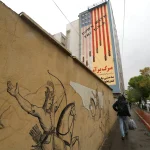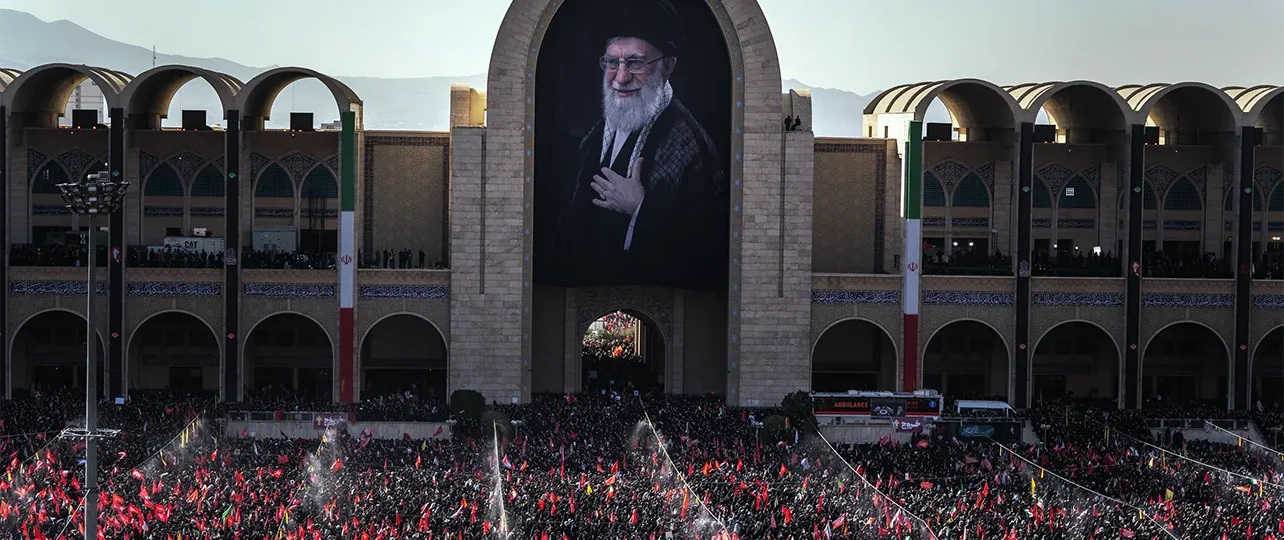

THE banners went up before the body did. Across a capital that had spent four months rehearsing its grief in private, giant portraits of Ayatollah Ali Khamenei began climbing the sides of buildings in late June, his clenched fist rendered in gold against a sky the colour of mourning cloth. By the time the coffins reached the Imam Khomeini Grand Mosalla on the morning of 3 July, Tehran had already told the story it wanted the world to hear: this was not a burial. It was a resurrection of resolve.
For four months, Khamenei’s body had waited. He was killed at 08:10 on 28 February, in the opening minutes of the war Israel and the United States launched against Iran, struck at his residence alongside four members of his own family — his son-in-law Mesbah al-Hoda Bagheri-Kani, his daughter Boshra Hosseini Khamenei, his daughter-in-law Zahra Haddad Adel, and his 14-month-old granddaughter, Zahra Mohammadi Golpayegani. The Islamic Republic did not announce his death for almost twenty-one hours. It would take a further eighteen weeks before it dared to bury him.
That delay is itself the first headline. A state that built its entire founding myth on martyrdom — that turned Qasem Soleimani’s 2020 funeral into a river of humanity so vast it crushed dozens of mourners to death in Kerman — could not, for four months, safely gather its own people to mourn its own Supreme Leader. Security services feared a second strike on the funeral itself; Iran’s Khatam al-Anbiya commander, Ali Abdollahi, felt compelled to warn Washington against attacking during the processions. Hardliners occupied the mosalla for three days in June to protest the ceasefire memorandum reached with the Americans. Even grief, in this Iran, had to be war-gamed.
A city turned to stone and slogan
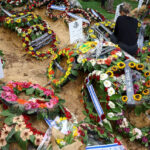
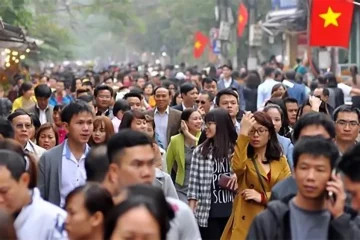
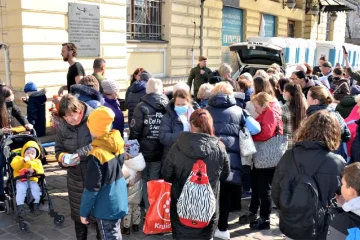
Walk into the Mosalla complex on the opening day and the first thing that hits is not sound but colour — black cloth over every surface, broken by the gold of funeral script and the red of vengeance flags. Five caskets lay in state: Khamenei’s, draped in the Islamic Republic’s colours, and the four smaller coffins beside it, a domestic tragedy dressed as state theatre. Women struck their heads with open palms. Men beat their chests in the old Shia rhythm of mourning. Above them, a banner in Arabic, English and Farsi carried three words: “We must rise.” A giant statue of Khamenei’s fist rose over Enghelab Square, framed by sculpted missiles arcing through the air — grief reimagined as armament.
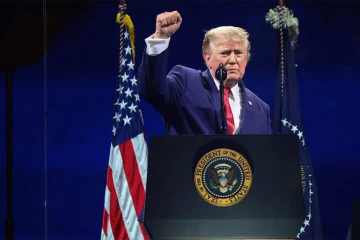
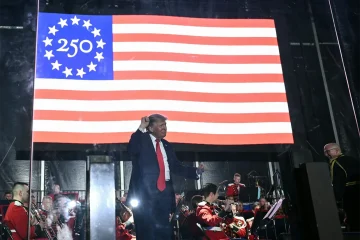
The chants told their own story: “Death to America,” “Death to Israel,” “Our word is one — revenge, revenge.” Crude placards calling for the American president’s death circulated among the crowd. This was, as more than one analyst watching from outside put it, a political rally wearing the vestments of a religious rite — engineered to project strength at home and defiance abroad, timed with deliberate provocation to overlap with the United States’ own 250th independence celebrations.
The son who wasn’t there
But the most telling absence in Tehran this week was not American. It was familial.
Khamenei left four sons — Mostafa, Mojtaba, Masoud and Meysam. It is Mojtaba, the second son, long the power behind his father’s throne inside the Revolutionary Guard’s clerical networks, who was elevated to the Supreme Leadership itself after the assassination. And it is Mojtaba who, according to Iranian officials and diplomats briefed on the arrangements, was not expected to walk behind his own father’s coffin.
The official explanation is injury and continuing recovery. The unofficial reading, circulating in every foreign chancellery watching Tehran this week, is starker: a Supreme Leader who has not been seen in public since the day he inherited the title cannot risk being seen in public now, whether for reasons of health, security, or the simple political arithmetic of a regime unsure of what a damaged, untested leader looks like next to a dead legend. Mojtaba’s only public presence at his father’s funeral was textual — a message read by a state broadcaster describing how he found his father’s body, fist still clenched even in death. A leader defined, for now, by a sentence read on his behalf rather than a body in the frame.
That vacancy matters enormously. Iran had, for thirty-seven years, one template for how power moves: Khomeini to Khamenei, cleric to cleric, legitimacy transferred in daylight before a weeping nation. This funeral was supposed to be that template’s second performance. Instead, Tehran buried its second Supreme Leader while its third stayed hidden, and the cameras that might have captured a symbolic passing of authority captured, instead, a general — Revolutionary Guard commander Ahmad Vahidi, emerging for the first time in months — sitting beside the casket in his place.
A funeral with a ceasefire attached
None of this is unfolding in a vacuum. Iran and the United States are, at the moment of burial, mid-negotiation — bound since mid-June by a memorandum of understanding that bought sixty days of quiet in exchange for talks on Iran’s nuclear stockpile, the reopening of the Strait of Hormuz, and the release of billions of dollars in frozen Iranian assets. Washington and Tehran, through Qatari mediation in Doha, agreed to a week-long de-escalation specifically so that this funeral — and America’s own July 4 festivities — could pass without either side handing the other a pretext to reignite the war. Talks paused, but officials on both sides insisted progress continued quietly beneath the mourning.
It is a strange, uneasy choreography: a regime burying the man killed by the very adversary it is simultaneously negotiating with over the terms of a fragile peace, using the funeral itself as a stage to signal that negotiation is not surrender. “This is basically a political event portrayed as a religious one,” Middle East Institute analyst Alex Vatanka observed of the proceedings — a verdict that captures, better than any government statement could, what Tehran is attempting: to bury its founding generation’s second patriarch, reassure a restive population still scarred by the bloody crackdown on the December 2025 protests, and warn Washington, all inside the same six days of processions.
Mashhad waits
The body now begins its final journey — from Tehran to Qom’s Fatima Masumeh shrine, on to the Shia holy cities of Najaf and Karbala across the Iraqi border, before burial in Mashhad, Khamenei’s birthplace, beside the shrine of Imam Reza. Iraq’s president and senior clergy are expected among the mourners; Russia sent former president Dmitry Medvedev, Pakistan its prime minister, and a Hamas delegation is among the foreign guests threading through the crowds — a reminder of how far this funeral’s audience extends beyond Iran’s own borders.
For a continent watching from Africa, where the Global South Media Network tracks how conflict in the Gulf ripples into oil prices, shipping lanes and diplomatic alignments from Lagos to Nairobi, the burial of Ali Khamenei is more than Persian theatre. It is a hinge moment for a ceasefire African economies have quietly been counting on to hold, and a case study in how a state manages the optics of continuity when the man meant to inherit its authority cannot, or will not, be seen to hold it.
Khamenei ruled for thirty-seven years on the strength of an image: implacable, permanent, untouchable. He is buried this week as a martyr the state cannot stop invoking — and succeeded, at least for now, by a son the state cannot yet show.