THE SEOUL PIVOT: FROM AID TO ARCHITECTURE
KEY FIGURES AT A GLANCE
| Indicator | Figure | Context |
| Intra-African trade (2025) | $210bn | Afreximbank 2026 Outlook |
| Intra-African trade forecast (2026) | $230bn | +10% year-on-year |
| Share of continental total (2026) | ~16% | Up from <10% two decades ago |
| AfCFTA market population | 1.4 billion | Largest free trade area by membership |
| African GDP (combined) | $3+ trillion | Combined AU member state GDP |
| Korea-Africa trade share (pre-summit) | 1.9% | Of South Korea’s total trade |
| African countries at Seoul meeting | 50 of 54 | June 2, 2026 ministerial |
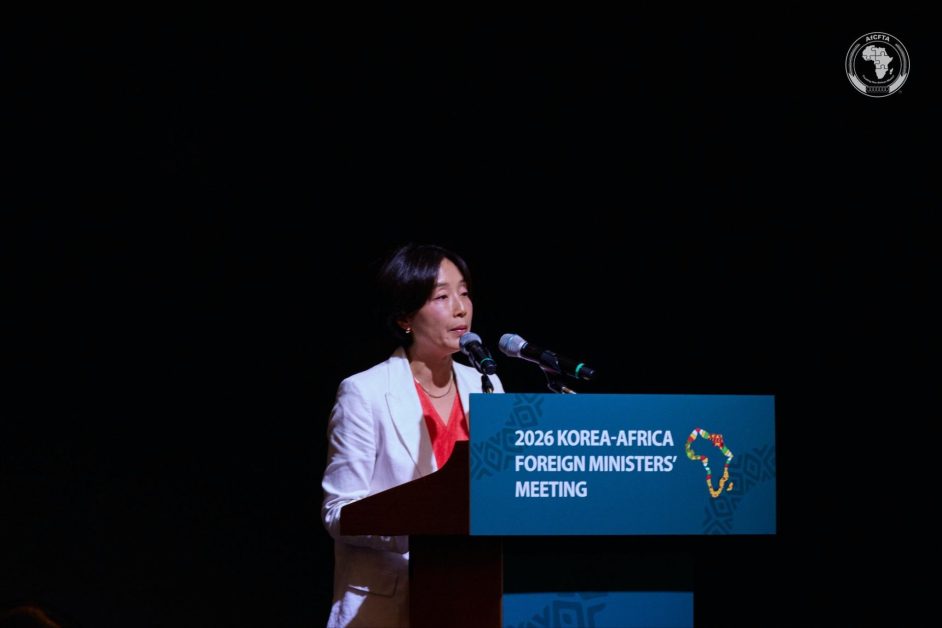
On the eve of the most significant Korea-Africa ministerial gathering ever convened, the AfCFTA Secretariat on Sunday wrapped preparatory discussions at the Senior Officials Meeting in Seoul that signal a qualitative shift in how Africa is engaging its non-traditional economic partners. The headline diplomacy — 50 African foreign ministers descending on Seoul for Monday’s ministerial under the theme ‘Partnership for Joint Responses to Global Challenges’ — is only the visible layer. Beneath it lies a dense lattice of institutional agreements, technology partnerships, and financing mechanisms that collectively represent Africa’s most sophisticated multilateral economic outreach to an Asian industrial power.
The Secretariat’s participation in Seoul was built around five specific institutional partnerships: collaboration with KTNet on an Origin Management System; startup acceleration through the Korea-Africa Foundation; Single Window development with CUPIA (Korea Customs Service’s trade facilitation arm); trade and transport facilitation research with KAIST; and private sector engagement through KITA, the Korea International Trade Association. Taken together, these partnerships represent an attempt to shortcut decades of customs modernisation and digital trade infrastructure development — borrowing directly from South Korea’s own compressed economic development experience.
“Africa is no longer seeking only loans and development assistance. It is seeking the institutional blueprints that transformed South Korea from a war-ravaged economy in 1953 into a USD 1.7 trillion industrial powerhouse by the late 2020s.”
THE CUSTOMS MODERNISATION IMPERATIVE
Central to the Seoul outcomes was strong support for the establishment of a One-Stop Origin Management System — a digital platform that would allow exporters across AfCFTA’s 54 member states to prove the origin of goods with a single, harmonised process rather than navigating 54 different national customs regimes. This matters enormously for a free trade area whose commercial logic depends on preferential tariff rates that are only available to goods originating within the continent.
CUPIA’s role is pivotal here. The Korea Customs and Trade Development Institute has already signed an implementation agreement with the AfCFTA Secretariat for a pilot customs cooperation project funded through the Korea-AfCFTA Cooperation Fund — a financing vehicle established by Seoul’s Ministry of Foreign Affairs earlier this year specifically to channel Korea’s institutional expertise to AfCFTA’s operational needs. CUPIA brings decades of experience building South Korea’s UNI-PASS customs clearance system, which processes millions of declarations annually and is regarded as one of the most efficient in the world.
The Single Window development component — also involving CUPIA — addresses the related challenge of trade documentation fragmentation. Currently, African traders crossing borders face multiple interfaces: border agencies, port authorities, health and phytosanitary inspectors, and revenue services each run separate systems. A single window consolidates these into one digital gateway, dramatically reducing time and cost at the border. The World Bank estimates that each additional day of delay in trade reduces the probability of export by 1.5 percent — a compounding penalty that has historically suppressed intra-African commerce.
Korea’s own Free Trade Agreement expertise — cited specifically by the Secretariat in Seoul — adds another dimension. Seoul has negotiated FTAs with 58 countries covering approximately 85 percent of its total trade volume. The AfCFTA Secretariat is effectively seeking to internalise the institutional learning that enabled Korea to negotiate, implement, and extract value from such a complex web of trade agreements — knowledge directly applicable to AfCFTA’s own challenge of converting ratified protocols into live commerce.

THE DIGITAL TRADE FRONTIER
The KTNet collaboration on the Origin Management System represents perhaps the most technically specific of the five partnerships. KTNet — Korea Trade Network — operates the electronic trade document exchange system underpinning Korea’s export economy, handling electronic bills of lading, certificates of origin, and customs declarations at scale. An AfCFTA-adapted version of this infrastructure would directly attack one of the most persistent bottlenecks in intra-African trade: the inability to verify the origin of goods efficiently across borders.
AfCFTA’s rules of origin framework, which determines which goods qualify for preferential treatment under the agreement, is only as effective as the systems used to administer it. Without a reliable, tamper-resistant digital trail documenting where goods were produced, the risk of origin fraud undermines the entire preferential tariff architecture. Korea’s experience building such systems over three decades offers a practical model that Africa — with its heterogeneous customs administration landscape — is right to seek.
“The Korea-AfCFTA partnership is ultimately an argument that Africa’s integration deficit is as much a technology and institutional deficit as it is a political will deficit — and that it can be addressed through structured South-South knowledge transfer.”
STARTUP ECOSYSTEMS AND INDUSTRIAL DEVELOPMENT
The KAIST partnership on trade and transport facilitation brings one of Asia’s most prestigious technical universities directly into AfCFTA’s implementation orbit. KAIST — Korea Advanced Institute of Science and Technology — has been instrumental in developing the modelling and logistics systems underpinning Korea’s trade infrastructure. Its involvement suggests the AfCFTA Secretariat is not just seeking off-the-shelf technology transfer but research-grade applied work tailored to Africa’s corridor and logistics realities.
The Korea-Africa Foundation’s startup acceleration programme adds a private sector dimension that distinguishes the Seoul engagement from previous African-Asian diplomatic encounters, which have tended to focus on state-to-state infrastructure finance. The AfCFTA Startup Acceleration and Partnership Programme 2026 — operated in collaboration with KAF — targets African startups in fintech, e-commerce, logistics, agri-tech, manufacturing, and digital platforms: precisely the sectors AfCFTA’s commercial protocols are designed to stimulate. By connecting African entrepreneurs directly with Korean investors and corporates, the programme seeks to create the business-level flows that give an FTA its economic substance.
KITA’s involvement in private sector collaboration completes the institutional picture. The Korea International Trade Association, with a membership of over 70,000 Korean firms, represents the commercial interface through which macro-level trade agreements translate into actual buying and selling relationships. Its engagement signals that the Korea-AfCFTA partnership is moving beyond memoranda of understanding into operational commercial activity — the true test of whether a trade relationship has depth.
THE ECONOMIC STAKES: WHY THE NUMBERS DEMAND URGENCY
The backdrop to all of this is a set of figures that simultaneously demonstrate how much progress AfCFTA has made and how much further it has to travel. Intra-African trade reached an estimated $220 billion in 2024 — a 12.4 percent rebound after a contraction in 2023 — and Afreximbank projects it will reach $230 billion in 2026, representing approximately 16 percent of the continent’s total trade. That figure, while historically high, remains dramatically below the levels achieved by comparably integrated regional blocs: intra-EU trade accounts for roughly 60 percent of member states’ total trade; ASEAN’s intra-regional share exceeds 20 percent.
The UN Economic Commission for Africa projects that AfCFTA’s full implementation could increase intra-African exports by over 400 percent by 2045 — but only if the agreement is fully operationalised. The barriers are well-documented: weak transport and logistics infrastructure, complex and non-harmonised customs procedures, slow ratification of key protocols, persistent non-tariff barriers, and uneven digital adoption. Korea’s institutional partnerships with the Secretariat are targeted precisely at the customs and digital trade components of this barrier matrix.
For South Korea, the strategic logic is equally compelling. Seoul’s trade with Africa accounted for just 1.9 percent of its total trade before the summit era — a figure that reflects not a lack of interest but a lack of structured access to a fragmented market. A better-integrated Africa, with harmonised customs procedures and a functioning continental trade regime, is a far more tractable commercial destination for Korean goods, services, and investment than 54 separate national markets each requiring bespoke trade terms.
GEOPOLITICAL CONTEXT: KOREA’S AFRICA PIVOT
The Seoul ministerial is not taking place in a geopolitical vacuum. South Korean Foreign Minister Cho Hyun’s statement that ‘closer cooperation between Korea and Africa is more important than ever’ reflects a wider strategic recalibration in Seoul. Global supply chain disruptions — accelerated by the US-China technology war, the Middle East crisis, and the continued volatility in European energy markets — have sent middle-income industrial powers like South Korea scrambling to diversify their resource and market dependencies. Africa, with its extraordinary mineral endowments, its young and growing consumer base, and its accelerating regional integration, has moved from the periphery to the centre of Korean strategic economic thinking.
The staging of the ministerial itself is telling. This is the first time South Korea has independently hosted a gathering of African foreign ministers — distinct from the 2024 Korea-Africa Summit, which Seoul also organised. The Korea-Africa Critical Minerals Dialogue launched in February, Seoul’s accession as an observer to the Indian Ocean Commission in April, and the creation of the Korea-AfCFTA Cooperation Fund in May together constitute a sustained institutional investment that goes well beyond the episodic Africa engagement that has characterised many Asian powers’ approach to the continent.
Africa, for its part, appears to have calibrated its Seoul engagement with unusual sophistication. The AfCFTA Secretariat’s Secretary-General Wamkele Keabetswe Mene was scheduled to deliver a keynote at the accompanying business forum alongside Sung Kim, President of Hyundai Motor Company — a pairing that captures the dual register of the week’s diplomacy: continental trade architecture on one track, corporate investment on the other.
“The presence of the AfCFTA Secretariat, the AU, the AfDB, and the AU-CDC in Seoul underscores that Africa’s multilateral institutions have matured into serious diplomatic actors — not as supplicants seeking assistance, but as partners offering structured market access to a continent on the move.”
WHAT SUCCESS LOOKS LIKE
The joint statement expected at the close of the Foreign Ministers’ Meeting will be closely parsed for commitments that move beyond diplomatic language. The practical outcomes to watch: the capitalisation and deployment timeline of the Korea-AfCFTA Cooperation Fund; the rollout schedule for the One-Stop Origin Management System pilot; the selection of countries for the CUPIA Single Window demonstration projects; and the number and quality of startups progressing through the Korea-Africa Foundation acceleration pipeline.
Enhanced capacity-building for customs authorities — flagged explicitly in the Seoul preparatory discussions — is particularly consequential. Customs capacity is the unglamorous engine of trade facilitation: a well-staffed, well-equipped, digitally-connected customs service can cut border crossing times from days to hours, transforming the economics of cross-border commerce for small and medium enterprises who make up the bulk of Africa’s trading population.
The deeper question is whether the institutional momentum generated in Seoul can survive the transition from diplomatic calendar to implementation reality — the graveyard of many previous Africa-focused trade and investment frameworks. AfCFTA’s own history offers cautionary context: the agreement entered into force in 2019 but only commenced official trading in 2021, and five years on, AU officials openly acknowledge that implementation lags ambition. The Seoul framework’s value will ultimately be measured not in agreements signed but in containers cleared, startups funded, and tariff preferences actually claimed.
THE AFRICAN MIRROR ANALYSIS
What Seoul represents, viewed through a pan-African analytical lens, is a moment of institutional maturation. The AfCFTA Secretariat is no longer merely a custodian of a landmark legal text — it is functioning as an economic diplomacy actor, identifying specific operational gaps in Africa’s trade infrastructure and sourcing targeted international partnerships to close them. That is qualitatively different from the aid-seeking relationship that characterised many previous Africa-Korea encounters.
South Korea’s development trajectory — from post-war devastation to an OECD industrial power within a generation — via deliberate technology absorption, export-led growth, and strategic FTA diplomacy, offers Africa a more directly applicable model than the Western development finance orthodoxy that has dominated the continent’s external economic relationships for decades. The AfCFTA Secretariat’s choice to structure its Korea partnership around technology transfer, institutional learning, and private sector activation rather than project financing alone reflects this understanding.
The challenge is scale and speed. AfCFTA’s 1.4 billion-person market, if functioning, would be transformative not only for Africa but for the global trading system. The Seoul partnerships are necessary but not sufficient. They must be accompanied by the political will of member states to ratify outstanding protocols, invest in logistics and energy infrastructure, reduce non-tariff barriers, and give their customs authorities the resources and mandate to implement digital trade systems at speed. Korea can provide the blueprints. Africa must build the buildings.
| THE SEOUL INSTITUTIONAL ECOSYSTEM: KEY PARTNERS KTNet (Korea Trade Network) — Electronic trade document exchange; Origin Management System development for AfCFTA. CUPIA (Korea Customs and Trade Development Institute) — UNI-PASS customs clearance; Single Window development; Korea-AfCFTA pilot project lead. KAIST (Korea Advanced Institute of Science and Technology) — Trade and transport facilitation research; logistics systems modelling. Korea-Africa Foundation (KAF) — Startup acceleration programme; AfCFTA Startup & Partnership Programme 2026. KITA (Korea International Trade Association) — Private sector engagement; 70,000+ Korean firms; commercial facilitation. Korea-AfCFTA Cooperation Fund — Established May 2026 by South Korea’s Ministry of Foreign Affairs to finance institutional knowledge transfer projects. |