Our website use cookies to improve and personalize your experience and to display advertisements (if any). Our website may also include cookies from third parties like Google Adsense, Google Analytics, and Youtube. By using the website, you consent to the use of cookies.

Nations strike deal at COP28 to transition away from fossil fuels

Nations strike deal at COP28 to transition away from fossil fuels

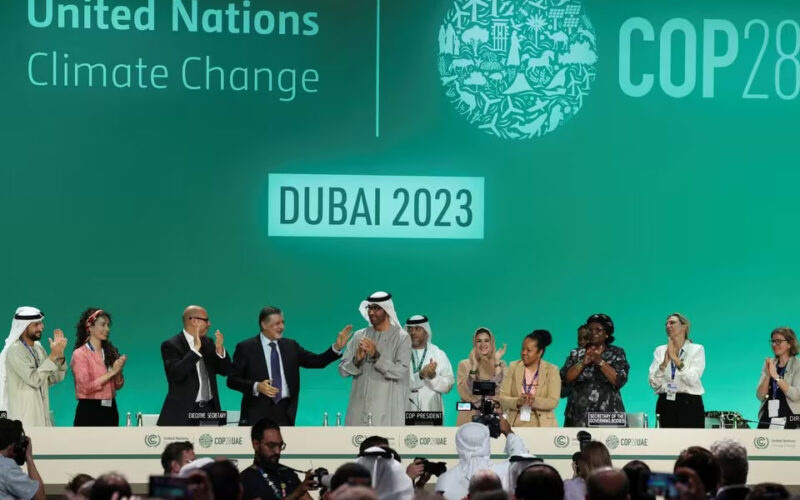
REPRESENTATIVES from nearly 200 countries agreed at the COP28 climate summit to begin reducing global consumption of fossil fuels to avert the worst of climate change, signalling the eventual end of the oil age. The deal struck in Dubai after two weeks of hard-fought negotiations was meant to send a powerful message to investors and policy-makers that the world is united in its desire to break with fossil fuels, something scientists say is the last best hope to stave off climate catastrophe. COP28 President Sultan al-Jaber called the deal "historic" but added that its true success would be in its…
Read More
COP28: South Africa pioneered plans to transition to renewable energy – what went wrong

COP28: South Africa pioneered plans to transition to renewable energy – what went wrong

SOUTH Africa’s experience in piloting a new type of climate finance vehicle can inform debates about how to fund a just transition from fossil fuels to renewable energy. Two years ago at COP26, South Africa piloted the first Just Energy Transition Partnership, where rich countries help developing countries move faster towards renewable energy. A year later, the South African government unveiled its Just Energy Transition Investment Plan. This set out how it intended to build on and use the partnership funds. ALEX LENFERNA, Postdoctoral Research Fellow, Nelson Mandela University. General Secretary, Climate Justice Coalition, Nelson Mandela University The plan detailed…
Read More
Climate action for Africa in 2023: three big developments

Climate action for Africa in 2023: three big developments

2023 is highly likely to be the hottest year ever recorded. And climate change is to blame for one-quarter of the global population being exposed to dangerous levels of extreme heat. We need signs that countries are taking steps to address this. Specifically, we need climate action that helps us adapt and that cuts greenhouse gas emissions, if we want to minimise the escalating losses and damages from climate change. NICHOLAS P. SIMPSON, Senior Research Fellow, Climate and Sustainability, ODI, Overseas Development Institute This year, there were three developments across Africa which highlight a mix of progress, priorities and potential…
Read More
Faith communities are rallying to check climate change – their size and influence counts

Faith communities are rallying to check climate change – their size and influence counts

ACCORDING to the United Nations Environment Programme (UNEP), more than 80% of the global population is motivated by faith or spirituality. Faced with the triple planetary crises of pollution, biodiversity loss and climate change, what role can faith communities play in saving the planet? RACHEL MASH, Research Associate of the University of Pretoria, Faculty of Theology and Religion, Department of Practical Theology and Mission Studies, University of Pretoria In a recent publication, we looked at the role of two faith-based organisations – the Green Anglicans movement, which is present in 13 African countries, and UNEP’s Faith for Earth Initiative, a…
Read More
Climate adaptation funds are not reaching frontline communities: what needs to be done about it

Climate adaptation funds are not reaching frontline communities: what needs to be done about it

COMMUNITIES around the world face increasingly severe and frequent impacts from climate change. They are on the “frontlines” of droughts, flooding, desertification and sea level rise. International climate finance is supposed to help. In the 2015 Paris Agreement, the world’s wealthiest countries pledged US$50 billion annually to support climate adaptation among those “particularly vulnerable” to climate change. Climate adaptation is the adjustments humans make to reduce exposure to climate risk. KATHERINE BROWNE, Research Fellow, Stockholm Environment Institute Eight years later, it is clear that this money is failing to reach vulnerable “frontline communities”, especially in sub-Saharan Africa. Recently, Mozambique, Zimbabwe,…
Read More
Egypt climate envoy sees international funds helping developing industries decarbonise

Egypt climate envoy sees international funds helping developing industries decarbonise

A financing scheme that draws on funding from Western donors to help developing countries shift to cleaner power generation could be mirrored for heavy industries and other hard-to-abate sectors, Egypt's climate champion said. Extending a Just Energy Transition Partnership (JETP) structure to sectors including steel, aluminium, cement and fertilisers made sense because of new European Union rules that would otherwise penalise developing world exporters, U.N. Climate Change High-Level Champion Mahmoud Mohieldin said in an interview. The rules, under the EU's Carbon Border Adjustment Mechanism (CBAM), would have "serious implications" for countries exporting to Europe, said Mohieldin. "I'm checking countries including…
Read More
Climate change and farming: economists warn more needs to be done to adapt in sub-Saharan Africa

Climate change and farming: economists warn more needs to be done to adapt in sub-Saharan Africa

SUB-SAHARAN African countries strongly rely on the agricultural and forestry sectors. Agriculture contributes up to 60% of some countries’ gross domestic product. But the sector is highly vulnerable to climate change because it relies heavily on climatic factors. This vulnerability is particularly marked in the region because of its slow rate of technological advancement. ABEEB BABATUNDE OMOTOSO, Postdoctoral research associate, North-West University ABIODUN OLUSOLA OMOTAYO, Senior lecturer/researcher, North-West University As agricultural economists we carried out a review of the literature on the climate change challenge for agriculture in sub-Saharan Africa. We explored the distribution of various climatic factors (like rainfall,…
Read More
Tanzania pushes East Africa into an era of gas-fueled vehicles. But can it last?

Tanzania pushes East Africa into an era of gas-fueled vehicles. But can it last?

TANZANIA has pushed East Africa into a new era of gas-powered mobility with the commissioning of the country's first integrated compressed natural gas (CNG) filling station and conversion centre. TAQA Dalbit, a joint venture of Egyptian energy company TAQA Arabia and JCG Oil &Gas announced the inauguration of the facility branded as "Master Gas" on November 11. A press statement by TAQA Arabia indicated the facility would serve up to 800 vehicles daily. This is the first of 12 similar facilities planned for the East African country. "The new CNG Filling Station and Conversion Centre is a monumental achievement that…
Read More
Tourists are returning to South Africa – but the sector will need to go green to deal with the country’s electricity crisis

Tourists are returning to South Africa – but the sector will need to go green to deal with the country’s electricity crisis

FOR the past 16 years South Africans have dreaded rolling power cuts euphemistically dubbed “load-shedding”. These are caused by the ailing state power entity Eskom’s crumbling infrastructure and its over-reliance on ageing and poorly maintained coal-fired power stations. Load-shedding has worsened in 2023, with some areas experiencing power cuts for up to 10 hours a day. This crisis affects every aspect of the country’s economy, including its vibrant tourism sector. Tourism is a vital contributor to the South African economy. In 2019 the country welcomed over 10 million foreign visitors. The sector contributed up to 6.4% of the gross domestic…
Read More
Giraffes could go extinct – the 5 biggest threats they face

Giraffes could go extinct – the 5 biggest threats they face

GIRAFFES are the world’s tallest mammals and an African icon, but they are also vulnerable to extinction. Giraffe populations have declined by 40% in the last 30 years, and there are now fewer than 70,000 mature individuals left in the wild. What are the causes of this alarming decline, and what can be done to protect these gentle giants? DEREK E. LEE, Associate Research Professor of Biology, Penn State The five biggest threats to giraffes are habitat loss, insufficient law enforcement, ecological changes, climate change, and lack of awareness. Below, I will tell you about these threats and what is…
Read More