Our website use cookies to improve and personalize your experience and to display advertisements (if any). Our website may also include cookies from third parties like Google Adsense, Google Analytics, and Youtube. By using the website, you consent to the use of cookies.

Why bother voting?

Why bother voting?

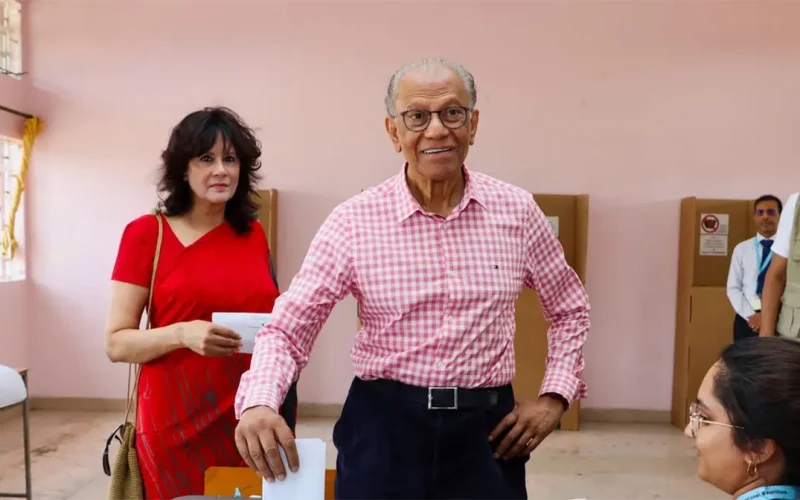
YEARS ago, I was invited to speak to a group of young schoolgirls from a township inJohannesburg. A little way into the talk, I realised that they weren’t terribly engaged. It took me a moment to understand why. English wasn’t their first language and as a Nigerian woman, educated in England with a very British accent, I just wasn’t relatable to this young group of South Africans. It was clear, the organisers didn’t understand what their audience wanted. It’s the same with elections. Let me explain. Tunisia went to the polls on Sunday, October 6th and Mozambique on October 9.Botswana,…
Read More
South Africa’s unity government is being tested – the toppling of a mayor in a key city exposes faultlines

South Africa’s unity government is being tested – the toppling of a mayor in a key city exposes faultlines

SOUTH Africa’s long-governing party, the African National Congress (ANC), performed disastrously in the country’s May 2024 elections. Its electoral fortunes are now tied to regaining support in Gauteng, the most populous and economically important province, which it had governed with outright majorities since 1994. In 2024 the ANC’s Gauteng result of 34.8%, along with its 17% in KwaZulu-Natal, sealed the party’s loss of its national outright majority. We asked political scientist Susan Booysen for her perspective on the ANC’s battle for Tshwane, a metropolitan municipality in Gauteng. It’s also the administrative seat of the national government, where the party used…
Read More
‘The situation in the Middle East threatens to plunge the region into a war in which civilians will inevitably bear the greatest, most cruel brunt’

‘The situation in the Middle East threatens to plunge the region into a war in which civilians will inevitably bear the greatest, most cruel brunt’

OCTOBER 7 marks one year since the start of an onslaught against the Palestinian people that has thus far claimed more than 43,000 lives. The violence that has been committed by Israel against Palestinians over many decades intensified after an attack on Israel by Hamas and other Palestinian armed groups on 7 October last year.  As South Africa, we have condemned the atrocities committed against civilians in Israel on 7 October 2023, as we have denounced the killing of civilians in any context. The majority of those killed over the past year are Palestinian civilians, largely women and children in…
Read More
“We do not seek your approval for our path. Our path is our own, chosen by our people and guided by our sovereign laws”

“We do not seek your approval for our path. Our path is our own, chosen by our people and guided by our sovereign laws”

FROM the outset, let me extend congratulations to the United States on assuming the G20 Presidency. We offer our sincere wishes for a successful term, one that we hope will serve the cause of global unity and inclusive progress. Your words, however, compel me to speak - not merely as a representative of a government, but as a voice from a nation whose very existence is a testament to a profound truth: that the deepest divides can be bridged. Not through dictation, but through dialogue, not through power alone, but through unwavering principle, not through unilateral action but global solidarity.…
Read More
Five trends to watch after UNGA

Five trends to watch after UNGA

This story was originally published by The New Humanitarian.By Irwin Loy THE pageantry of the UN General Assembly’s high-level week is over for another year. What happens next? Politicos and civil society floated solutions to long-standing problems. Countries promised to save multilateralism in a broad pact for the future. Gaza was conspicuously sparse on official agendas but cast a shadow as tensions escalated around Israel, Lebanon, Iran, and fears of an even wider war. Here are five trends, with humanitarian implications, that picked up steam at UNGA: Mia Mottley’s Bridgetown pitch The Barbados-led plan to overhaul global governance has been…
Read More
UN Security Council needs major changes – permanent seats for African countries is just one

UN Security Council needs major changes – permanent seats for African countries is just one

RECENTLY, the US ambassador to the United Nations announced America’s support for the creation of two new permanent UN Security Council seats for African states. Gary Wilson, a scholar of international law and relations – specifically issues related to the United Nations – argues that although Africa’s time may have come, there are still hurdles to overcome. What’s wrong with the way the UN Security Council is currently constructed? One of the most damning criticisms continuously levelled at the United Nations security council concerns its perceived lack of legitimacy. Its composition is increasingly seen as unrepresentative of the international community.…
Read More
Western media outlets are trying to fix their racist, stereotypical coverage of Africa. Is it time African media did the same?

Western media outlets are trying to fix their racist, stereotypical coverage of Africa. Is it time African media did the same?

QUICK question: what do these titles have in common? A Dark Continent Seeking Light; Sure, Ebola is Bad. Africa has Worse, or; Magic and Cannibalism in the African Jungle. You guessed it – they’re all about Africa. But the most correct answer is they’re all headlines that have appeared in the prestigious New York Times newspaper. These are just some examples of the ways that many traditional news outlets in the West have historically reported about Africa. Today news reporting that reinforces negative perceptions, stereotyping and racial misrepresentation is declining. But the harms inflicted on the continent and its communities…
Read More
Calls to restructure Nigeria’s federal system are missing the point: the country needs good governance, not reform

Calls to restructure Nigeria’s federal system are missing the point: the country needs good governance, not reform

IN Nigeria, a range of voices have called for the review of the federal system of government. They include former president Olusegun Obasanjo; an academic and former electoral agency chief, Mahmud Jega; and a coalition of ethnic nationalities. Nigeria’s federal system currently consists of a central government headed by a president, 36 states headed by governors, and 774 local governments. The Supreme Court recently granted autonomy to the local governments. They were previously under the control of state governments. Some of the political restructuring arguments have an ethnic colouration founded on grievances over perceived domination or marginalisation. The ethno-regional groupings…
Read More
Lasting peace in Ethiopia? More needs to be done to stop Tigray conflict from flaring up again

Lasting peace in Ethiopia? More needs to be done to stop Tigray conflict from flaring up again

IT has been nearly two years since the African Union brokered a peace deal that put an end to the war between the Ethiopian state and the Tigray regional government. The signing of the Cessation of Hostilities Agreement in November 2022 brought an end to a deadly two-year conflict. The agreement has achieved a number of outcomes. These include: an end to the fighting between Tigrayan and Ethiopian armed forces the creation of a transitional government in Tigray, run by the Tigray People’s Liberation Front the demobilisation of 50,000 Tigrayan troops the Tigray People’s Liberation Front regaining its legal status…
Read More
Growing links with the diaspora – an interview with Almaz Negash

Growing links with the diaspora – an interview with Almaz Negash

WITH Africa experiencing rapid economic growth and technological advancement, and its cultural dynamism increasingly exposed to the world, the African diaspora is becoming increasingly important. Through investment, knowledge transfer and advocacy, the diaspora is helping to shape a new narrative for Africa - one characterised by innovation, creativity and resilience. Contributing to this powerful movement is Almaz Negash, the hard-charging founder and CEO of the African Diaspora Network, one of the leading organisations working to support and invest in Africa’s development. With nearly 15 years at the helm, Negash and the organisation have made significant strides in connecting and empowering…
Read More