Our website use cookies to improve and personalize your experience and to display advertisements (if any). Our website may also include cookies from third parties like Google Adsense, Google Analytics, and Youtube. By using the website, you consent to the use of cookies.

A job fair for a joint China-SA future

A job fair for a joint China-SA future

CHEN XIAODONG PRESIDENT Xi Jinping observed that jobs are the most fundamental livelihood projects. Jobs are key to social stability.  COVID-19 brought a major impact on the world economy, as well as South Africa’s economy. The unemployment rate here remains high.  President Cyril Ramaphosa attaches great importance to jobs. He always makes job creation a priority of the government. The South African President also actively launched an employment stimulus plan. As a good brother, friend and partner of South Africa, when we work with South Africa against COVID, we also actively support your economic recovery.  At the same time, Chinese…
Read More
Tanzania’s Hassan has put out positive signals: deeper change is yet to come

Tanzania’s Hassan has put out positive signals: deeper change is yet to come

AFTER the death of President John Magufuli on 17 March 2021, Vice-President Samia Suluhu Hassan became Tanzania’s sixth president and the first woman in the office. She may have been an “accidental president” but she seems to have set Tanzania on a change of course compared to the approach taken by her predecessor. Her government has enhanced diplomatic relations, approached the COVID-19 pandemic differently and increased the number of women in high political office. The extent to which this will bring institutional rather than merely rhetorical change is unclear. Detractors will point to her lack of commitment to broader constitutional…
Read More
Fight crime, not migrants – Ramaphosa

Fight crime, not migrants – Ramaphosa

CYRIL RAMAPHOSA TWENTY-five years ago, our new democratic Constitution came into effect. In adopting this Constitution, we affirmed our commitment to a society based on democratic values, social justice and human rights. We were also making a complete break with our past. This was a past of race-based social engineering that manifested itself through influx control, job reservation, group areas and the dreaded dompas. When our forebears drafted the Freedom Charter in 1955, whose principles have been incorporated in our constitution, and declared that South Africa belongs to all who live in it, they were seeking a society free from…
Read More
Nkrumah and football: how Ghana’s top players ended up in North America

Nkrumah and football: how Ghana’s top players ended up in North America

AFRICAN footballers have been migrating overseas since the 1920s when French leagues attracted some West African players. The migration of African talent to Europe intensified from the 1980s to the 2000s as football became more globalised and economically viable. Thousands of African footballers have since found their way to Europe. Many have succeeded in carving a niche for themselves, like Abedi Pele, Didier Drogba, George Weah and Samuel Eto'o. The performances of these stars have reinforced the perception that the African continent has some of the best football talent. Author ERNEST YEBOAH ACHEAMPONG, Lecturer/Researcher, University of Education, Winneba Less is…
Read More
Running blind folded

Running blind folded

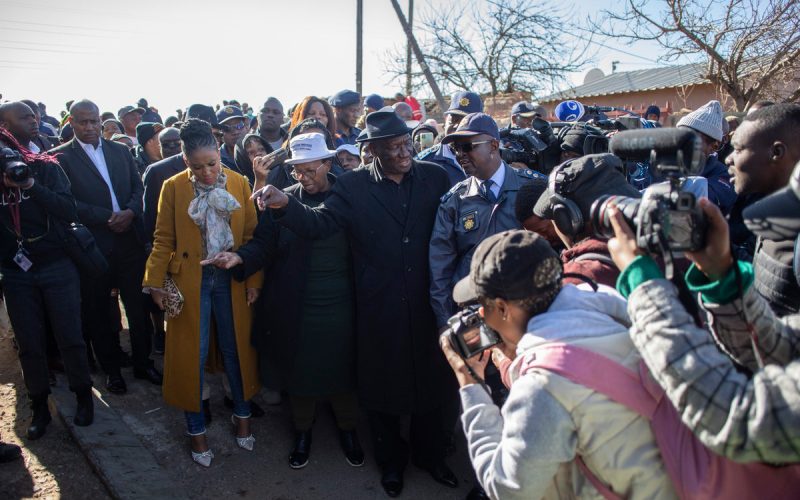
MOSIBUDI MANGENA A Cuban mathematics and science tutor who was part of a group I was working within the Department of Education, was bemused by the tendency of South Africans to call big meetings to attend to issues that should be dealt with routinely and administratively. Her observations came to mind when we saw ministers with large entourages of police running helter-skelter in Diepsloot trying to solve the problem of crime and illegal immigration.  Frankly, it was embarrassing. It exposed an alarming collapse of systems and processes. That should be a routine and ongoing activity of the police and immigration…
Read More
Why Tunisians are still out on the streets — a decade after the ‘Dignity Revolution’

Why Tunisians are still out on the streets — a decade after the ‘Dignity Revolution’

IT has been 10 years since nation-wide protests in Tunisia led to the ousting of Tunisian President Zine El Abidine Ben Ali and his regime. Ben Ali led Tunisia for 23 years. Tunisia’s “Dignity Revolution” marked the first time a long-standing Arab autocrat was removed by a mass uprising. SAEROM HAN, Honorary Research Fellow, University of Aberdeen ANDREA TETI, Senior Lecturer in International Relations, University of Aberdeen PAMELA ABBOTT, Director of the Centre for Global Development and Professor in the School of Education, University of Aberdeen The protests were driven by unemployment, food inflation, corruption, lack of political freedom and…
Read More
Why Eritrean refugees choose the risky migration to Europe

Why Eritrean refugees choose the risky migration to Europe

IN November 2020, fighting in the Tigray region of Ethiopia destroyed a secondary school which opened in 2018 in the Hitsats refugee camp. The school was attended by both refugees and Ethiopians. AMANDA POOLE, Professor of Anthropology, Indiana University of Pennsylvania JENNIFER RIGGAN, Associate Professor of International Studies, Arcadia University Hitsats was opened in 2013 to accommodate Eritrean refugees. In 2018, it housed over 15,000 refugees, nearly half under the age of 18. It was closed in February 2021. Ethiopia has a reputation for hosting long-term refugees. It’s the second largest host country in Africa with a hosting history that…
Read More
The Pan-Africanist Magufuli was a simple man

The Pan-Africanist Magufuli was a simple man

KHULU MBATHA THE Tanzanian politician who served as the fifth president of Tanzania, from 2015 to 2021, was a very controversial leader and so was his presidency and now his death too.  John Pombe Joseph Magufuli was born in Chato, one of the five districts in the Geita Region of north-western Tanzania and he was a Sukuma (Northerners), the largest Bantu ethnic group in the country and the south-eastern African Great Lakes region. His weapon was service delivery and for that matter, delivery had a fixed time and not endless promises.  There was no hiding behind policies or budgets that…
Read More
OBITUARY-Tanzania’s ‘Bulldozer’ president and a COVID-19 sceptic

OBITUARY-Tanzania’s ‘Bulldozer’ president and a COVID-19 sceptic

TANZANIA’S late President John Magufuli, was admired by followers for his hostility to corruption and waste but regarded by foes as an irascible authoritarian intolerant of dissent and sceptical about COVID-19. He was nicknamed "The Bulldozer" for his fondness for massive public works and a reputation for pushing through policies despite opposition - a hard-charging leadership style that won support from many Tanzanians. But he also attracted criticism at home and abroad for what opponents saw as his eccentric handling of the coronavirus pandemic. Vice President Samia Suluhu Hassan announced that he had died of heart illness, days after officials…
Read More
APRM celebrates 18 years of promoting good governance on the African continent

APRM celebrates 18 years of promoting good governance on the African continent

SENZO MCHUNU   THE year 2003 marked a historic turn on the African continent as Member States of the African Union (AU) voluntarily acceded to a mutually agreed self-monitoring mechanism called the African Peer Review Mechanism (APRM). This mechanism is aimed at fostering good governance in the continent through systematic peer learning and self-assessment. The APRM was adopted by African Heads of State and Government as a systematic peer learning and self-assessment mechanism originating from the NEPAD foundational document, “The Declaration on Democracy, Political, Economic and Corporate Governance” which was adopted in Durban, South Africa in July 2002. The primary purpose …
Read More