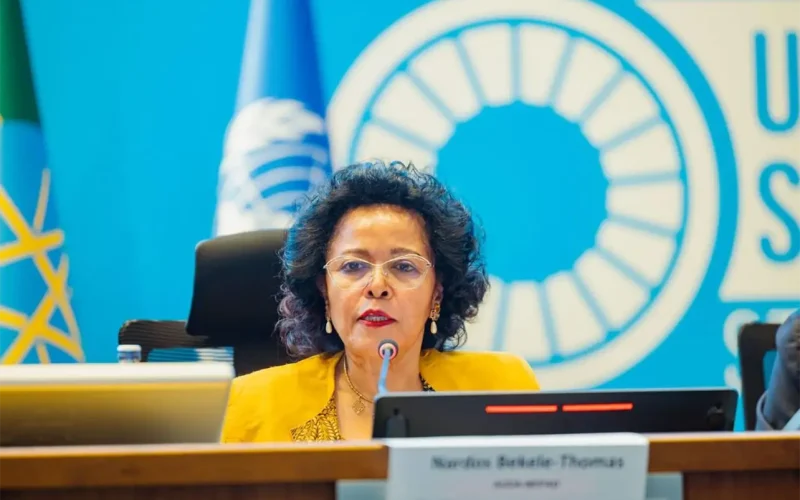
IN a move that signals growing recognition of the inextricable link between climate adaptation and health security, the Global Centre on Adaptation (GCA) has appointed Nardos Bekele-Thomas, Chief Executive Officer of the African Union Development Agency-NEPAD (AUDA-NEPAD), to its Supervisory Board.
The appointment places one of Africa’s most influential health and development leaders at the decision-making table of global climate governance – a strategic positioning that could reshape how adaptation financing addresses the continent’s escalating health vulnerabilities.
Bekele-Thomas joins a distinguished board chaired by H.E. Macky Sall, former President of Senegal, alongside Rodger Voorhies, President of the Global Growth & Opportunity Division at the Gates Foundation, and Miami Mayor Francis X. Suarez.
“As we face accelerating climate impacts that disproportionately affect our continent, Africa’s voice must be central to global adaptation governance,” Bekele-Thomas said in accepting the appointment. “Through this platform, we will ensure that our implementation priorities, development pathways, and proven solutions shape the decisions and financing that will determine our collective climate future.”
The appointment comes as Africa confronts a devastating climate-health convergence. Rising temperatures are expanding the geographic range of vector-borne diseases like malaria and dengue fever. Extreme weather events are disrupting pharmaceutical supply chains and destroying health infrastructure. Droughts and floods are triggering malnutrition and waterborne disease outbreaks across the continent.
For Bekele-Thomas, who has spent her tenure at AUDA-NEPAD championing pharmaceutical self-sufficiency and health systems strengthening, the GCA role represents a natural extension of her mandate. Climate adaptation, she has consistently argued, is not separate from health security – it is fundamental to it.
Africa bears the most severe climate impacts despite contributing least to the crisis, accounting for less than 4% of global carbon emissions while experiencing disproportionate consequences, including crop failures, water scarcity, and health system strain.
Leveraging climate finance for health infrastructure
Health experts say Bekele-Thomas’s appointment could unlock critical synergies between climate adaptation funding and health infrastructure development – two streams of financing that have historically operated in silos.
Under her leadership, AUDA-NEPAD has advanced the 24 Priority Medical Products Initiative and leveraged the African Continental Free Trade Area (AfCFTA) to scale pharmaceutical manufacturing across the continent. These efforts to reduce Africa’s 61% dependency on imported medicines gain new urgency in a climate-disrupted world where global supply chains face increasing fragility.
“Climate-resilient health systems require local pharmaceutical production, distributed manufacturing capacity, and robust regional supply chains – precisely the infrastructure Bekele-Thomas has been building,” noted one public health analyst familiar with her work.
Her proven track record in translating policy into action and advancing intergovernmental coordination positions her to ensure that adaptation financing flows toward strengthening health security architecture, not just traditional climate mitigation projects.
The appointment arrives at a pivotal moment. As GCA enters the Africa Adaptation Acceleration Program (AAAP) 2.0 phase and the world approaches COP30 in Belém, Brazil, Bekele-Thomas’s influence on the Supervisory Board could prove decisive in centring health priorities within climate negotiations.
“As GCA enters the next phase of the Africa Adaptation Acceleration Program (AAAP) 2.0, Bekele-Thomas’s leadership will ensure that Africa’s resilience-building agenda remains at the forefront – particularly in the lead-up to COP30 in Belém and the decisive decade of climate action ahead,” said GCA President and CEO Prof. Patrick Verkooijen.
Under her stewardship, AUDA-NEPAD has championed locally led adaptation and institutional capacity building for climate-resilient development – approaches that contrast sharply with top-down donor-driven models that have dominated international development.
Building climate-proof health systems
Bekele-Thomas has consistently emphasised that Africa’s health transformation cannot succeed without addressing climate vulnerabilities. Pharmaceutical manufacturing requires reliable electricity – increasingly challenged by climate-driven energy disruptions. Cold chain logistics for vaccines and medicines depend on stable infrastructure that extreme weather threatens. Agriculturally based pharmaceutical inputs face climate-induced volatility.
Her dual mandate – leading AUDA-NEPAD’s health industrialisation agenda while shaping global adaptation governance – positions her uniquely to ensure these interconnections receive the political leadership, coordination, and financing they demand.
The appointment reinforces Africa’s position as a driving force in shaping the global adaptation agenda from a position of strength rather than supplication. Rather than simply receiving adaptation support, the continent is now positioned to define what climate resilience must look like for the 1.4 billion people depending on African health systems.
Bekele-Thomas made history in May 2022 as the first woman to lead AUDA-NEPAD, overseeing more than 200 experts across 50+ transformative programs spanning health, energy, biotechnology, and development. Her leadership has secured major international partnerships, including a landmark memorandum of understanding between the African Union and the Global Fund to Fight AIDS, Tuberculosis and Malaria.
Her appointment to the GCA Supervisory Board extends this pattern of elevating African voices in global governance structures – ensuring that when decisions are made about adaptation financing, pharmaceutical resilience, and health security, African priorities and solutions shape the outcomes.
As climate impacts accelerate and health challenges intensify, Bekele-Thomas now commands influence across two of the most critical domains determining Africa’s future – a convergence that could prove transformative for the continent’s 1.4 billion people confronting the intertwined crises of climate disruption and health vulnerability.