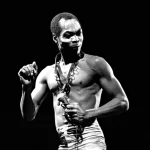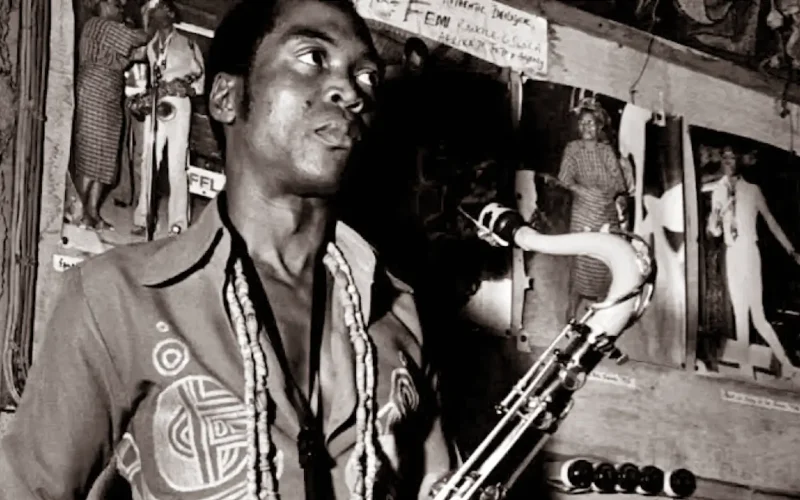
SOME musicians entertain. Some educate. Fela Anikulapo Kuti? He declared war—armed only with a saxophone, a relentless groove, and the kind of audacity that made military dictators break out in nervous sweats.
Nigeria’s most flamboyant revolutionary didn’t need grenades when he had a groove. While others whispered dissent in backrooms, Fela was broadcasting his contempt for corrupt authority through thundering horns, hypnotic drums, and lyrics so sharp they could slice through propaganda like a hot knife through butter. His weapon of choice? Afrobeat—that intoxicating fusion of jazz, funk, soul, and Yoruba rhythms that he didn’t just create, he unleashed upon the world.
Picture this: Lagos, 1970s. The Shrine – Fela’s legendary nightclub – a sweaty, pulsating cathedral of resistance where political manifestos met polyrhythmic percussion. This wasn’t your average nightspot. This was ground zero for a musical revolution, where Stevie Wonder and Paul McCartney made pilgrimages to witness genius in its most unbridled form. Even McCartney caught the bug, recording “Band on the Run” in Lagos, inspired by the sonic electricity crackling through the city’s air.
The Shrine became more than a venue; it was a statement, a middle finger to military oppression wrapped in irresistible rhythm.
But speaking truth to power in military-ruled Nigeria wasn’t a game. When Fela organised his own counter-festival in 1977 – because who needs government approval when you’ve got international stars on speed dial? – the authorities responded with characteristic brutality. Soldiers torched his home and threw his mother from a first-floor window. She died a year later from her injuries.
Most would have crumbled. Fela? He turned his pain into more music, more defiance, more life.
Fast forward to 2025, and Fela’s spirit refuses to rest quietly. An immersive exhibition – born in Paris, now triumphantly home in Lagos – celebrates the man who proved that resistance could have a backbeat. The Lagos iteration is three times larger than its French predecessor, featuring 440 items of memorabilia, including (naturally) replicas of his signature colourful underwear. Because if you’re going to rebel, you might as well do it in style.
His son Femi, now 60 and a formidable musician in his own right, understands the weight of his father’s legacy: “Afrobeat was the basic element of hip-hop, it’s where hip-hop got its sauce from.” Miles Davis sang his praises. Beyoncé and Jay-Z sample him. Fela from Red Hot Chili Peppers name-checks him. The man who fought military dictators with a saxophone has become the godfather to generations of artists worldwide.
Perhaps most remarkably, Fela’s political fire hasn’t dimmed. When Black Lives Matter erupted globally, curators found eerie resonance with battles Fela waged in the 1970s and ’80s. His question remains hauntingly relevant: “Are there still people who can speak like Fela? Are there people who can fight like Fela?”
The answer? Probably not. Because Fela Anikulapo Kuti wasn’t just a musician—he was a force of nature dressed in psychedelic prints, a man who proved that sometimes the most powerful revolution comes not from the barrel of a gun, but from the bell of a saxophone.
And the beat- oh, that glorious, defiant, irrepressible beat – goes on.
The “Afrobeat Rebellion” exhibition runs at the Ecobank Pan African Centre in Lagos, reminding us all that some voices are simply too powerful to silence, even decades after they’ve fallen silent.