DAWN had not yet broken over the lagoon villages of southern Ivory Coast when the drum spoke. Its voice – a low, rolling thunder that radiated outward through the tall grass, through sleeping households, through the morning mist – was not music. It was an alarm. It was a command. It was, depending on the moment, a matter of life and death.
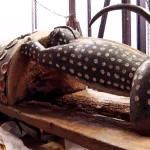
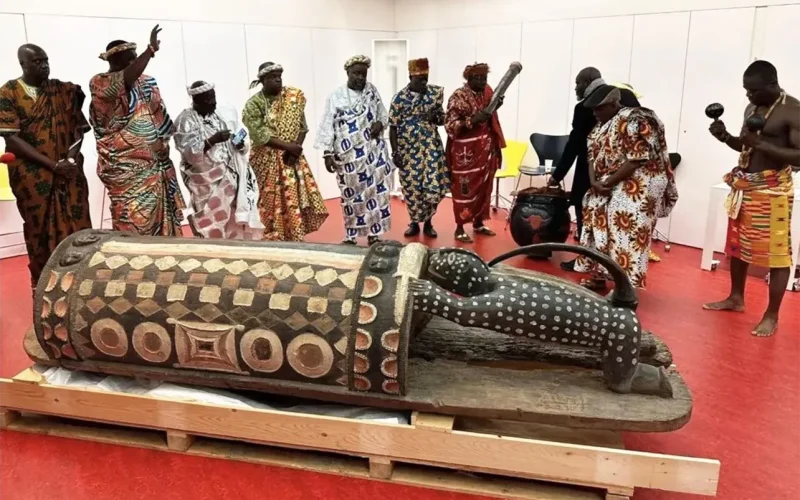
For the Atchan people, indigenous to what the French would later name Côte d’Ivoire, the Djidji Ayokwè – the Panther-Lion – was never merely an instrument. Stretching more than three metres in length and weighing nearly 400 kilograms, it was a sovereign intelligence carved from a single trunk, a living archive of the community’s memory, a communication network that operated long before any telegraph or telephone. When the drum pulsed its coded messages into the humid air, entire villages moved.
“We are reclaiming our identity. Psychologically, something had been taken from us.”
Chief Gervais Djoman, Atchan village
And move they did – especially in the dark years of French colonial rule. When conscription gangs fanned out across the countryside to drag men into forced labour on roads, railways, and plantations, it was the Djidji Ayokwè that gave the villages time to scatter. Its tones carried news of soldiers on the march; its rhythms translated into warnings, coordinates, instructions. In the colonial register, it was sedition. In the Atchan register, it was survival.
THE SILENCING — 1916
In 1916, two years into the First World War, with French authorities stretched thin and sensitive to any hint of resistance, colonial administrators arrived at the drum’s home and confiscated it. The act was strategic and symbolic in equal measure. Seize the voice, and you silence the network. The Panther-Lion was gone.
For fourteen years, it sat in the governor’s palace in Abidjan, a trophy behind administrative walls, its tongue stilled by bureaucratic custody. Then, in 1930, it was shipped to France – folded into the vast apparatus of colonial collection that was stripping the continent of its most sacred objects and depositing them in Parisian institutions as curiosities of empire.
The Djidji Ayokwè came to rest eventually at the Quai Branly Museum in Paris, an institution built on the banks of the Seine to house tens of thousands of artefacts from Africa, Asia, and the Americas. In its new setting, rendered inert under glass and ambient lighting, the drum became an exhibit: a ‘masterwork of African musical heritage’, labelled, catalogued, and explained to European visitors who had no idea — and were never invited to ask — what it had cost the people it was taken from.
Seize the voice, and you silence the network. The Panther-Lion was gone.
THE LONG CAMPAIGN FOR RETURN
The push to bring it home did not begin with a single moment or a single champion, but with a slow accumulation of pressure that grew louder over the decades. Pan-African scholars, cultural activists, and postcolonial governments had long argued that the removal of sacred and historically significant objects from Africa was not simply a question of property — it was an act of epistemic violence, the deliberate severing of communities from the tools of their own self-understanding.
That argument gained new institutional force in 2018, when Senegalese economist Felwine Sarr and French art historian Bénédicte Savoy published their landmark report for the French government recommending the large-scale restitution of African artefacts. France, the report argued, could not claim to champion human rights and cultural dignity while its museums held the memory of a continent hostage. The report named 46,000 objects held in France that had been taken from sub-Saharan Africa under colonial conditions.
Ivory Coast’s culture ministry moved decisively. It compiled a formal list of 148 artefacts held by French institutions and began the diplomatic groundwork for their return. The Djidji Ayokwè — given its size, its symbolism, and the particular brutality of the circumstances of its removal — was placed first on the list.
THE HOMECOMING — MARCH 2025
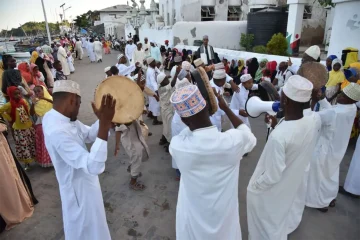
When the aircraft touched down at Félix-Houphouët-Boigny International Airport in Abidjan on that Friday, the welcome that met it was not a diplomatic formality. It was a ceremony in the deepest sense — the kind that marks not a transaction but a restoration. Traditional chiefs were there in their crowns and gold chains, embodiments of the authority and continuity that the drum had once protected. War dances were performed. Songs carried on the coastal air that had not been heard in this context for more than a century.
Françoise Remarck, the Ivory Coast’s minister of culture, stood before the gathering, visibly moved. The moment, she said, was historic. Around her, the Atchan community — the direct descendants of those who had once moved at the drum’s command — watched the crate containing their ancestor’s voice cross the tarmac and return to the soil from which it had been taken 109 years before.
Chief Gervais Djoman, dressed in the traditional loincloth of his position, gave the crowd and the waiting journalists the words that cut through every layer of diplomacy and institutional language. ‘We are reclaiming our identity,’ he said. ‘Psychologically, something had been taken from us.’
“This is a historic day, and I am deeply moved.” — Françoise Remarck, Minister of Culture and Francophonie, Ivory Coast
WHAT IT MEANS FORWARD
The return of the Djidji Ayokwè is, in one sense, an ending — the conclusion of a 109-year odyssey for an object that was never meant to leave. But in the frame of African cultural restitution, it is more importantly a beginning.
It is the first of 148 artefacts that the Ivory Coast is seeking from France alone. Across the continent, similar negotiations are unfolding: between Nigeria and Britain over the Benin Bronzes; between Ethiopia and various European museums; between Egypt and institutions from London to New York. The principle being established, slowly and often painfully, is that the looting of cultural heritage was not a neutral act of collection but an extension of colonial violence — and that the reversal of that violence is part of what decolonisation actually means in practice.
For the youngest generation of Atchan children — those who were born into a world where their community’s most powerful voice existed only as a photograph in a museum catalogue on a Parisian website — the drum’s homecoming carries particular weight. It tells them something about who they are that no textbook narrated by others can fully convey. It tells them that their ancestors were not passive victims of history but active resisters, people who used every tool available to them to protect one another. And it tells them that the fight for what belongs to Africa did not end with independence. It continued. And sometimes, it is won.
The Djidji Ayokwè has come home. After 109 years of imposed silence, the Panther-Lion roars once more.