IN the heart of Addis Ababa, as the Ethiopian sun cast long shadows across the conference hall, a powerful truth emerged that would echo across the continent: Africa’s greatest economic opportunity in generations would not be won in a day, but through the steady march of determination and strategic vision.
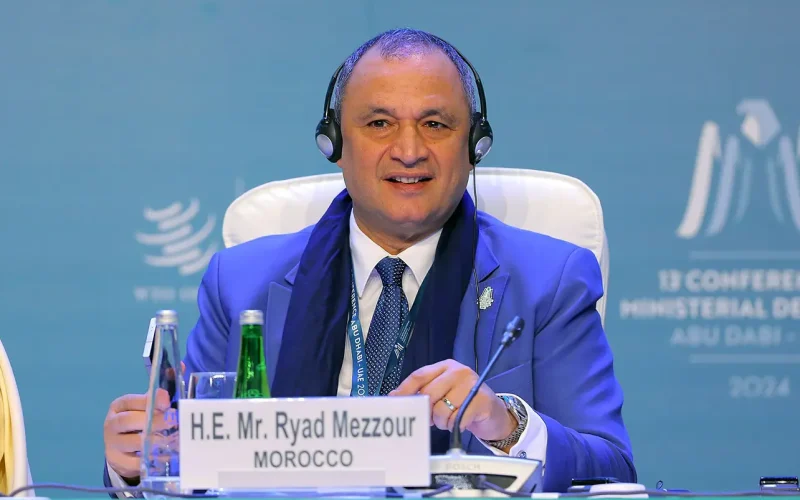
“The path we walk is not a sprint, but a journey of a thousand steps,” declared Ryad Mezzour, his voice resonating with conviction as cameras flashed before him. As Chair of the Bureau of African Ministers of Finance and Economic Planning and Morocco’s Minister of Industry and Trade, Mezzour stood at the nexus of a historic transformation. “The African Continental Free Trade Area demands our patience, our strategic thinking, and our unwavering commitment.”
The fifty-seventh session of the Economic Commission for Africa had just concluded – seven days of intense deliberation that would shape the economic destiny of over a billion people across 54 nations. The theme had been clear and purposeful: “Advancing the Implementation of the Agreement Establishing the African Continental Free Trade Area: Proposing Transformative Strategic Actions.”
Behind Mezzour’s words lay a vision of an Africa transformed – a continent where goods and services flowed freely across borders that had too long divided people with shared histories and futures. But his message carried a vital caution: true transformation required patience.
“We cannot harvest what we have not yet sown,” he explained, as delegates from across the continent nodded in agreement. “Regional value chains must be carefully constructed. Trade barriers that have stood for decades must be dismantled with precision, not haste.”
The air in the room seemed charged with possibility as he outlined the interconnected challenges: digitizing a continent of vast disparities, empowering youth across regions with wildly different educational systems, and balancing economic growth with environmental stewardship in an era of climate crisis.
“These are not merely policy positions,” Mezzour emphasised, his gaze sweeping across the assembled journalists. “They require strong political will. They demand effective decision-making and collaboration that transcends old rivalries and new tensions.”
Claver Gatete, Executive Secretary of the ECA, painted a stark picture of the global reality facing African nations. “The world is changing,” he stated, his voice carrying the weight of urgent truth. “Investment flows are shifting. Aid is diminishing. Now, more than ever, Africa must look inward to find its strength.”
Gatete’s vision was not of an Africa isolated but of one interdependent – nations investing in each other, trading with each other, and building resilience together in a world of uncertainty. “The ECA is not merely advocating for the AfCFTA,” he explained. “We are actively creating tailored national strategies that recognize each country’s unique strengths and potential contributions.”
The story of African economic integration has long been one of grand visions and limited implementation. But something felt different now – a new pragmatism tempered the idealism, a recognition that patience did not mean passivity.
Professor Nthuli Ncube, Zimbabwe’s Finance Minister, embodied this new approach as he spoke of concrete, actionable steps. “An African credit rating organisation is not merely desirable – it is essential,” he declared. “Too long have our nations been undervalued by external assessments that fail to understand our unique contexts and potential.”
As the press conference concluded and officials dispersed into the warm Ethiopian evening, the message lingered: The AfCFTA represented not just a trade agreement but Africa’s declaration of economic independence – a transformation that would unfold not in dramatic flourishes but in the patient, determined work of building systems, harmonizing standards, and fostering trust between nations.
The journey had begun. The destination – an Africa united in trade, strengthened by cooperation, and empowered by its own vast potential – remained on the horizon, visible but requiring many more steps before it could be reached.
The path forward would demand patience, but a continent that had endured centuries of external exploitation was no stranger to perseverance. This time, however, the patience was not passive waiting, but the active, strategic patience of builders who understand that the most enduring structures rise brick by careful brick.