AS Russia’s war on Ukraine marks its thousandth day, a devastating wave of attacks on civilian areas has left at least 30 dead in the past 48 hours, highlighting the continuing toll of a conflict that shows no signs of abating.
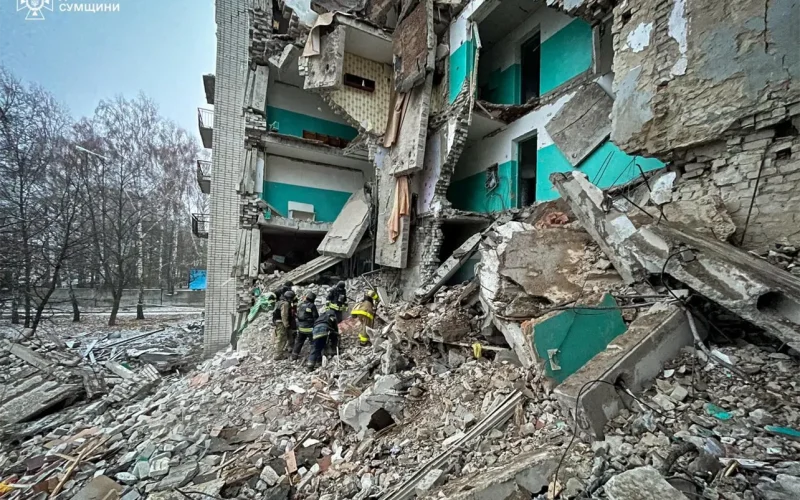
In the northeastern city of Hlukhiv, a late-night strike killed nine civilians, including a child, and wounded 11 others, with rescue workers still searching through rubble. This attack follows deadly strikes in Sumy City and Odesa, marking one of the bloodiest periods in recent months.
The UN Human Rights Monitoring Mission in Ukraine has documented a pattern of attacks targeting civilian infrastructure. Mission head Danielle Bell’s recent visit to Zaporizhzhia revealed the devastating impact of Russian glide bombs – weapons carrying massive explosive payloads that have wreaked havoc in urban areas.
“These weapons, when deployed in populated areas, cause catastrophic damage to civilian lives and property,” says UN spokesperson Jeremy Laurence. One particularly troubling incident involved an oncology centre struck during active chemotherapy sessions, forcing the facility to suspend critical cancer treatments while undergoing repairs.
In the same city, a single glide bomb destroyed half an apartment building, claiming ten lives. The human cost of these attacks extends beyond the immediate casualties. One resident lost his home when vehicles, propelled by the blast wave, crashed into his house. In a neighbouring property, a family’s tragedy unfolded as their 20-year-old son was killed and his mother severely injured, their two-story home reduced to rubble.
As the conflict reaches this grim milestone, the UN High Commissioner for Human Rights emphasizes that these “1,000 days of senseless pain and suffering” have been marked by widespread human rights violations, both in combat zones and occupied territories.
The international body has renewed its calls for Russia to cease its attack and withdraw all military forces from Ukraine, citing obligations under the UN Charter and the International Court of Justice’s orders. However, with continued strikes on civilian targets, including medical facilities and residential areas, the immediate prospects for peace remain dim.
The war’s thousand-day mark finds Ukraine facing an intensifying humanitarian crisis, with civilian infrastructure bearing the brunt of sophisticated weaponry designed to maximize destruction. As winter approaches, these attacks on civilian areas pose an additional threat to a population already struggling with the consequences of prolonged conflict.
“The violence must stop – for the sake of the people of Ukraine, the people of Russia, and the world,” Laurence emphasized, calling for thorough investigations into credible allegations of violations and immediate measures to protect civilian lives.