HE had spent six decades telling the world that every human being is somebody. And when the Reverend Jesse Louis Jackson Sr. was finally laid to rest in the rich black earth of Chicago’s Oak Woods Cemetery on the afternoon of Saturday, 7 March 2026, the world made plain that he – above most – had been somebody extraordinary.
Over a two-day crescendo of remembrance that will be counted among the great public funerals of the American century, Chicago’s South Side became a pilgrimage ground. Heads of state flew in from Africa. Three former presidents took to the pulpit. Jennifer Hudson made the rafters shake. Stevie Wonder played. And above it all, through the tears and the thunder and the tambourines, the crowd rose again and again to chant the words he had taught them: I am! Somebody!
“Belonging is not determined by the soil on which you were born. Belonging is determined by the soil on which you choose to join the fight.” — President Cyril Ramaphosa
THE PEOPLE’S CELEBRATION: FRIDAY AT THE HOUSE OF HOPE
The public homegoing – formally titled The People’s Celebration – was held on Friday, 6 March, at the House of Hope Convention and Event Centre, a megachurch in Chicago’s historic Pullman neighbourhood on the city’s Far South Side. The venue, with approximately 10,000 seats, was chosen precisely because no single hall in Chicago was big enough to hold the love that had accumulated for this man across eight decades of living and fighting.
Thousands of ordinary Chicagoans lined up before dawn. By the time the gold-and-black hearse bearing Jackson’s casket rolled into the forecourt – carrying the civil rights icon in a vehicle that Spencer Leak Jr. of Chicago’s legendary Leak and Sons Funeral Homes noted was being used for the first time — the congregation inside was already electric.
Former Presidents Barack Obama, Joe Biden and Bill Clinton were seated together in a row that would have been unimaginable in the fractured political climate of 2026, their presence itself a statement about the singular unifying power of the man being honoured. Alongside them sat former Vice President Kamala Harris and former Secretary of State Hillary Clinton.
The service began with a mass choir that flooded the arena with sound. Chicago Mayor Brandon Johnson and Illinois Governor J.B. Pritzker both delivered tributes. Rep. Maxine Waters spoke with the full authority of someone who had marched alongside Jackson for fifty years. But it was the three former presidents – and one NBA Hall of Famer – who provided the moments that would be replayed for generations.
“He paved the road. And the message he sent to a 22-year-old child of a single mother with a funny name was that there wasn’t any place, any room, where we didn’t belong.” — President Barack Obama
OBAMA, BIDEN, CLINTON: A PRESIDENTIAL REQUIEM
Barack Obama, who has never made a secret of how deeply Jackson’s two presidential campaigns in the 1980s shaped his own improbable journey to the White House, delivered a eulogy of sustained eloquence. Obama traced the arc from Jackson’s activism to Harold Washington’s election as Chicago’s first Black mayor, and then to his own presidency — a chain of possibilities that Jackson had forged link by painstaking link.
Yet Obama’s address was not nostalgic. It was urgent. In language that made no effort to avoid the shadow of the Trump administration, Obama spoke of waking each morning to what he described as things that just didn’t seem possible – a nation being told to fear one another, to turn on one another, to accept that some Americans count more than others. Jackson, he said, had given people the tools to resist exactly this. Hope, Obama insisted, was not passive sentiment. It was the decision to fight.
Bill Clinton, who had honoured Jackson with the Presidential Medal of Freedom in 2000, recalled the 1999 Kosovo hostage crisis in which Jackson had led an interfaith delegation – against the explicit advice of the Clinton administration – to negotiate the release of three American prisoners of war held by Serbian forces. Army Staff Sergeant Andrew Ramirez, one of the three soldiers, spoke at Thursday’s pre-funeral tribute and told dignitaries his life would have been very different without Jackson’s intervention. Clinton described the mission as an act of reckless, brilliant courage.
Joe Biden, visibly moved throughout, spoke of a man who made him believe that the arc of the moral universe truly does bend. His tribute was brief but heavy with grief – the grief of a generation of politicians who had grown up professionally under the canopy of Jackson’s influence and were now watching that canopy removed.
ISIAH THOMAS, JENNIFER HUDSON, AND THE GOSPEL THUNDER
Among the most emotionally shattering moments of the Friday service came not from a president or a politician, but from NBA Hall of Famer Isiah Thomas. Thomas, who grew up in poverty on Chicago’s West Side, recalled the day as a child when he and his mother encountered Jackson walking down their street while they were queuing at a soup kitchen. Jackson stopped. He spoke to the boy. He told him he was somebody. For Thomas, that encounter was not merely an inspiration – it was a resurrection.
Jennifer Hudson, Chicago’s own EGOT-winner, performed with a force and presence that silenced and then overwhelmed the arena. Her voice – enormous, wounded, soaring – seemed to carry the grief of the whole city. Gospel legends Bebe Winans and Pastor Marvin Winans performed, with Marvin closing with ‘Let the Church Say Amen.’ Marvin Sapp rendered ‘Never Would Have Made It.’ Jackson’s daughter Santita Jackson – herself a formidable gospel singer – sang ‘To God Be The Glory’ in a moment of family and faith intertwined.
Former Vice President Kamala Harris, who has known Jackson since the beginning of her political career, delivered a tribute that was both personal and political. She told the congregation that she had predicted the turbulence of the second Trump term – but that she had not predicted having to navigate it without Jesse Jackson at her side.
“I am not into saying I told you so — but we did see it coming. What I did not predict is that we would not have Jesse Jackson with us to get through this.” — Kamala Harris
SATURDAY AT RAINBOW PUSH: THE INTIMATE FAREWELL
If Friday was the public coronation, Saturday, 7 March, was the family burial – intimate, raw, and finally conclusive. Hundreds gathered at the Rainbow PUSH Coalition headquarters, 930 E. 50th Street, the building Jackson had made the nerve centre of his lifelong movement. It was, for many in the room, not a government building or a church but a home – the place where they had come to organise, to fight, to be heard.
Crowds began lining up at 7 a.m. for a service that opened at 10. The programme ran well past 2 p.m. Notable attendees included Nation of Islam leader Louis Farrakhan, Chicago Archbishop Cardinal Blase Cupich, Illinois House Speaker Chris Welch, actor and comedian Chris Tucker, and Jussie Smollett. Linda Johnson Rice, daughter of Ebony magazine founder John H. Johnson, told reporters there was no way on earth she would have missed it.
Jesse Jackson Jr., visibly overwhelmed, spoke with the jagged love of a firstborn son trying to hold together decades of complicated devotion. His siblings – Jonathan, Yusef, Santita, Ashley, and Jacqueline – surrounded him as he spoke, holding him upright with their presence. The Jackson family’s grief was total and uninhibited, and the congregation absorbed it without flinching.
The musical centrepiece of Saturday’s service was a performance by Stevie Wonder, who spoke about marching alongside Jackson in the streets and then played two songs that reduced grown men to tears. He closed with a full-throated rendition of his 1976 masterpiece ‘As’ – a song about the permanence of love and the endurance of hope – that became, in that moment, Jesse Jackson’s final hymn.
Jackson’s widow, Jacqueline Jackson, who had been taken ill during the family’s commemorative journey to South Carolina the previous week, addressed the congregation with composure and grace. She thanked the world for sharing her husband’s journey and asked that his memory be honoured not in bronze or marble, but in action.
“Not only did he march in the streets, he walked into the corridors of power. He opened doors. And when the doors were closed, he kicked them down.” — President Cyril Ramaphosa
AFRICA SPEAKS: RAMAPHOSA, TSHISEKEDI, AND THE PAN-AFRICAN BOND
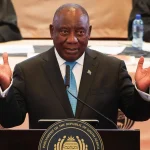
Perhaps the most globally resonant dimension of the weekend’s homegoing was the presence of African heads of state at the Rainbow PUSH headquarters on Saturday. South African President Cyril Ramaphosa flew to Chicago to deliver a tribute that went beyond condolences into the territory of political testament. Democratic Republic of Congo President Félix Antoine Tshisekedi Tshilombo was also among those who attended, a powerful signal of Jackson’s standing across the African continent.
Ramaphosa’s tribute drew the loudest sustained applause of Saturday’s service. He told mourners that South Africa did not merely join the world in mourning Jesse Jackson — South Africa claimed him as its own. He recalled Jackson’s activism against apartheid: the 1979 visit to South Africa in which Jackson was the first American leader to call publicly for Nelson Mandela’s release; the 1985 Washington march of more than 150,000 people demanding sanctions against the Pretoria regime; the personal lobbying of Pope John Paul II, Mikhail Gorbachev, and British Prime Minister Margaret Thatcher to isolate the apartheid state. In 2013, South Africa had formally recognised this history by awarding Jackson the Order of the Companions of OR Tambo in Silver.
But Ramaphosa, who has made the language of belonging central to his own political philosophy, went further. He addressed a question he posed directly to the mourners — how could a son of South Carolina belong to the people of Soweto? His answer was unambiguous: belonging is not determined by birthplace. It is determined by the causes a person chooses to champion. Jackson, he said, had chosen the cause of Black South Africa when the world’s most powerful nations were still negotiating with its oppressors.
He described Jackson’s legacy as a relay race — a torch passed from Martin Luther King Jr. to Jesse Jackson and now held by a generation that must keep running. He closed by thanking Jacqueline Jackson and the children for sharing their husband and father with South Africa and with the world. It was a moment of African solidarity that few American funerals have ever produced.
The presence of Tshisekedi added a further dimension. The DRC president’s attendance – in a period of acute geopolitical tension across the Great Lakes region – underscored the breadth of Jackson’s international footprint and the degree to which he was seen across Africa not merely as an American civil rights figure, but as a pan-African champion.
A SOUTH CAROLINA HOMECOMING AND OAK WOODS CEMETERY
The Chicago services were the final act of a memorial journey that had begun in Jackson’s birthplace. Born in Greenville, South Carolina, in 1941 – the segregated South in its full brutal expression – Jackson had returned there as a conquering son. He lay in repose at the South Carolina State Capitol in Columbia on Monday, 2 March, becoming one of the very few Black South Carolinians to receive that honour. It was a full-circle moment of historical weight: the boy who had led fellow students into a Greenville library reserved for white people in 1960 now lying in state at his state’s seat of government.
Following Saturday’s service, a procession carried Jackson’s casket through the streets of Chicago’s South Side to Oak Woods Cemetery. There, in the Greater Grand Crossing neighbourhood, he was buried in a private ceremony attended only by family and close friends. Oak Woods is where Chicago’s finest rest – journalist and anti-lynching crusader Ida B. Wells-Barnett, Olympic gold medallist Jesse Owens, and Chicago’s first Black mayor, Harold Washington. On that ground, Jackson joined a permanent congregation of those who had refused to accept the world as it was.
LEGACY: THE UNFINISHED BUSINESS
Jesse Louis Jackson Sr. died on 17 February 2026, at the age of 84, from progressive supranuclear palsy, a rare and merciless neurodegenerative disease. His passing had been long anticipated – his public appearances had diminished in recent years – but it arrived nonetheless as a shock, the way the death of a monument always does.
His legacy is both monumental and contested in the way that only truly consequential lives can be. He ran for president twice – in 1984 and 1988 – and his 1988 campaign, in which he won eleven states and nearly four million votes, remains the most successful primary campaign by a Black candidate in American history until Obama in 2008. He founded the Rainbow PUSH Coalition and Operation PUSH. He negotiated the release of hostages and prisoners on multiple continents. He marched in Selma. He was standing beside Martin Luther King Jr. at the Lorraine Motel in Memphis on 4 April 1968.
What his funeral made viscerally clear – across two days of song and speechmaking, across the testimonies of presidents and grandmothers, across the satellite images of South African heads of state crossing an ocean to stand in a Chicago church and claim him — is that Jackson’s influence was not merely American. It was planetary. He was, as Ramaphosa said, a voice that carried hope across continents.
His children have pledged to continue his work. The Rainbow PUSH Coalition will remain. His mantra – I am somebody, Keep hope alive – will be chanted by people who were not yet born when he first spoke those words. And in the quiet of Oak Woods Cemetery, beside Ida B. Wells and Harold Washington and Jesse Owens, the Reverend Jesse Louis Jackson Sr. has at last laid down the burden of an extraordinary life.
I am! Somebody!