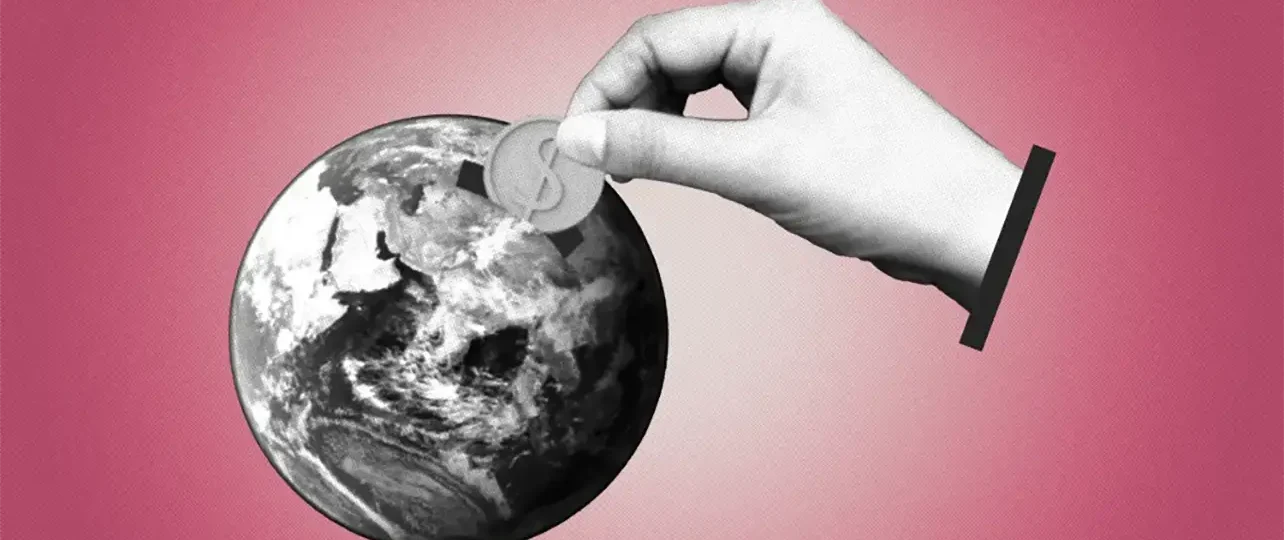

ANOTHER year, another COP, and another round of fraught loss and damage negotiations, as extreme weather continues unabated around the world. But finally, money is on the table: $250 million, for a trial run.
The Fund for Responding to Loss and Damage (FRLD), as it is officially known, has opened for business. But as it prepares to welcome its first funding proposals, FRLD staff are facing major decisions on how the institution will develop.
After major aid budget cuts, humanitarians are keener than ever to access the Fund, including to support badly needed disbursements to fragile and conflict-affected states – potentially cutting out governments. Whether grassroots groups will be able to receive loss and damage finance themselves – a long-held call of campaigners – remains contentious.
Given these high and often competing expectations – not to mention growing global needs for emergency financing in the aftermath of harmful climate impacts – how is it all going to work?
The FRLD’s first projects are being done as a pilot phase, known as the Barbados Implementation Modalities (BIM), and requests for up to $20 million can be submitted for six months from 15 December 2025.
“This first call aims to test, learn, and shape the Fund’s long-term model,” Jean-Christophe Donnellier, co-chair of the FRLD, said in a 10 November statement marking the launch of the call for funding requests.
High-income countries have historically been opposed to the Fund and have been slow to donate to it, fearing it could become a vehicle for reparations or other financial demands from the Global South.
Behind the carefully scripted communications, tensions familiar to loss and damage linger: The Fund is only worth $431.14 million(having been pledged $788.8 million), but at least $724.43 billion a year in loss and damage finance is needed, according to the Loss and Damage Collaboration, a campaign group. High-income countries have historically been opposed to the Fund and have been slow to donate to it, fearing it could become a vehicle for reparations or other financial demands from the Global South.
There’s a “need for significantly more resources to meet the vast scale of need on the ground”, Ibrahima Cheikh Diong, executive director of the FRLD, said in the same statement.
The Loss and Damage Collaboration also warned about the “absence of Loss and Damage from the [Brazilian] presidency’s core agenda [at COP30 in Belém]”, adding: “We seem to be witnessing the failing star of Loss and Damage, with very little political attention given to the issues.”
That’s long been a concern of some of the politicians who helped negotiate the Fund, and comes despite a favourable advisory ruling earlier this year from the International Court of Justice, the UN’s top court, which said “reparations” were in order for countries harmed by climate change.
While loss and damage is not a priority of COP30, humanitarians still needed to engage on it so the issue does not “fall off the table”, Mattias Søderberg, global climate lead at DanChurchAid (DCA), told a 6 November webinar.
What are humanitarians likely to get from the Fund?
The Fund’s pilot phase will release funding for projects responding to loss and damage, including “activities that are complementary to humanitarian actions taken immediately after an extreme weather event”, and “activities focused on priority gaps”, according to the FRLD’s institutional guidelines. These will be decided on a case-by-case basis by the Board, but will likely prioritise projects that strengthen national systems.
Despite the distinction with traditional relief work – loss and damage is intended to fill the gap between humanitarian and development post-disaster responses – humanitarians still see a major role for themselves as the Fund takes shape, with the UN’s Inter-Agency Standing Committee (IASC) of humanitarian leaders making it one of their main advocacy priorities for COP30.
The IASC are “really trying to push the Fund for Responding to Loss and Damage to consider humanitarian contexts”, Zinta Zommers, climate science lead at the UN’s emergency aid coordination body, OCHA, told the webinar.
Referring to the UN’s recent official acceptance that global warming will no longer be restricted to 1.5°C, she suggested this would mean that already overstretched humanitarians would need to try to respond to even more disasters.
“We’re going to overshoot. The NDCs aren’t sufficient to avoid that… as a humanitarian community, we need to also think about ‘what does this period of overshoot look like?’” said Zommers. “It’s going to be a lot of burden on the humanitarian community, a lot more loss and damage, a lot more need for adaptation.”
While climate loss and damages are a broad field, displacement is an area of concern that is already squarely within the remit of humanitarians, who in turn are eyeing the Fund because of this.
“I think it might be strategic for us to work with some countries to encourage them to also make proposals that include displacement considerations, because that will also be a test to see how the Fund is effectively able to respond,” said Alice Baillat, a policy adviser at the Internal Displacement Monitoring Centre, speaking on the same webinar.
While the Fund is still short on cash compared to need, its money is still a prospective cash boon for beleaguered humanitarian agencies, whose funding has been slashed this year, sparking a major crisis.
“It’s like the Hunger Games… all funding is a target independently of core mandates: The competition between agencies is fierce,” Mauricio Vazquez, head of policy at ODI’s Global Risks and Resilience programme, told The New Humanitarian.
Before the BIM had even launched, some agencies were already working on their connections with governments that might apply to the Fund to get ahead as “front-runners”, he said. The New Humanitarian was unable to independently verify this claim.
What about fragile and conflict-affected states?
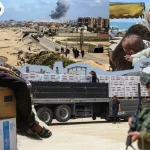
An increased climate, peace and security push at COPs in recent years has seen corresponding demands for some FRLD funding to be dedicated to fragile and conflict-affected states.
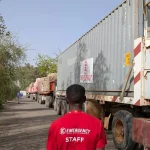
The IASC is pushing to “make sure that wherever this [loss and damage] money flows, that it reaches fragile and conflict-affected contexts, and [that] the communities can participate in locally led climate action [and that it] really ensures country-led approaches, including in contexts of conflict and fragility,” said Zommers.
Somalia – where the government is fighting al-Shabab militants, among other conflicts – is one of several countries planning to seek FRLD funding. “We’ll see which window is more acute and pressing for us,” Abdihakim Ainte, head of climate and food security in the Somali prime minister’s office, told The New Humanitarian.
Sending loss and damage money to fragile and conflict-affected contexts – a more complex and expensive aim than sending to more stable places – could be difficult under the relatively small testing phase of the Fund, Dan Lund, an FRLD board member, told The New Humanitarian. But despite the higher costs, he said, “it doesn’t mean that there isn’t potential for proposals to support these contexts,” even in the opening phase.
This will be “a very high priority of the development of the longer-term [Fund] modality, which will be a big focus of 2026”, Lund added.
Groups close to frontline communities should be able to access loss and damage funding (as well as other types of climate finance, like adaptation) as easily as their governments.
Another challenge of working in fragile and conflict-affected areas is the potential lack (for instance, due to their absence or perceived lack of credibility as a climate finance recipient) of government participation in requesting funding or decision-making – a staple for humanitarian agencies but a difficult prospect for green agencies used to working with states.
It reflects a concern that many climate activists have held for years – that groups close to frontline communities should be able to access loss and damage funding (as well as other types of climate finance, like adaptation) as easily as their governments.
They are now finding some common cause with experts who worry about the millions living under the control of non-state armed groups, who are especially vulnerable to climate change because of the lack of state capacity to protect them.
It’s “not something the Fund is yet mature enough to deal with, but certainly part of the scope of what the Fund needs to have a solution for”, said Lund. In these cases, he explained, it is humanitarian agencies who will likely need “to be empowered to make requests on behalf of vulnerable people”.
But despite the many calls for the FRLD to work totally differently from other climate funds, it may end up sharing some core similarities, particularly around the involvement of state authorities. Ultimately, “it’s hard to remove governments from the picture of a fund set up by international convention,” said Lund.
Edited by Irwin Loy and Andrew Gully.
–––––
The New Humanitarian puts quality, independent journalism at the service of the millions of people affected by humanitarian crises around the world. Find out more at www.thenewhumanitarian.org.