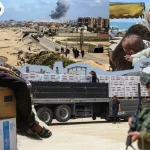
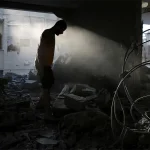
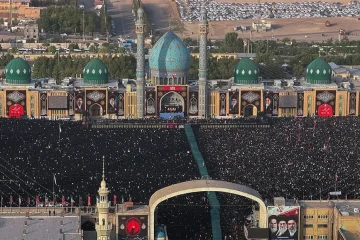
WITH all eyes on the ceasefire between Israel and Iran, which came into effect 12 days after Israel launched a major attack on Iran’s nuclear and military structure, attention towards Gaza has waned. This is at a time when attempting to gain access to food under a new model of aid distribution has been described by the United Nations as a “death trap”.
According to the UN World Food Programme, more than 470,000 people are facing “catastrophic” hunger, and the entire population is experiencing “acute” food insecurity. This was exacerbated when Israel imposed a blockade on the Strip in mid-March 2025, preventing the entry of food, medication and other aid for a period of 70 days.
Following international pressure, Israel’s prime minister, Benjamin Netanyahu, ordered the resumption of humanitarian aid through a new model of distribution, which bypasses the existing UN and NGO channels. It was devised by Israel and handed to a United States-backed organisation, the Gaza Humanitarian Foundation (GHF), to operate.
According to Netanyahu, taking control of aid delivery would prevent Hamas from seizing and selling supplies. Two of his cabinet ministers, far-right politicians Bezalel Smotrich and Itamar Ben Gvir, objected to any aid entering Gaza, due to the risk of it serving to bolster Hamas.
A video was circulated on social media on June 26, allegedly showing armed men from Hamas commandeering aid trucks in northern Gaza. Smotrich threatened to leave the coalition if supplies continued to reach the hands of Hamas. In response, Netanyahu has since halted the entry of humanitarian aid into the north of Gaza.
GHF was ostensibly established to improve the distribution of aid in Gaza. But the UN swiftly condemned its new distribution model as “inadequate, dangerous and a violation of impartiality rules”.
Reports from one distribution site on its first day of operation on May 27 showed scenes of chaos and confusion. The site outside Rafah was described as overwhelmed, with hundreds of people rushing towards the aid boxes. The New York Times reported that Israel Defence Force (IDF) personnel fired several warning shots, which sent the crowd running away in panic.
In the past two months, there have been continued reports of violence and chaos at the distribution sites, with deadly incidents a near-daily occurrence. On the day the ceasefire between Iran and Israel was confirmed (June 24) at least 46 Palestinians waiting for aid in Gaza were shot by Israeli forces in two separate incidents, according to Gaza’s civil defence agency. Over 400 Palestinians have been killed around the four aid distribution centres since they began operating.
Inbuilt chaos and lethal violence
Arguably, this chaos and violence is inbuilt in the new aid delivery system. Even before it began operations, the GHF received widespread criticism.
A letter signed by leading aid and human rights organisations criticised the GHF for not meeting the four universally recognised principles for humanitarian action: humanity, neutrality, impartiality and independence.
Critics say that the GHF system effectively militarises aid distribution. GHF’s leadership is made up of retired military officers and private security contractors, with some humanitarian aid officials. It coordinates with a private US security company on the ground in Gaza. Meanwhile, the IDF patrols the perimeters at what it calls “secure distribution sites”.
Critics argued that the proposed model would be insufficient. The plan called for only four aid distribution centres to be established in the southern part of the Gaza Strip, compared with about 400 UN-led sites in operation across Gaza prior to October 7 2023.
The reduced number and location of the aid sites can be understood as a mechanism of forced displacement. It appears to be consistent with Netanyahu’s plan to relocate Palestinians to a “sterile zone” in Gaza’s far south. UN officials argued that the requirement for civilians to travel long distances and to cross Israeli military lines and combat zones to collect aid from the sites would “put civilian lives in danger and cause mass displacement while using aid as ‘bait’”. Forced displacement is illegal under international law.
Countering the criticisms
The GHF rejected claims that the IDF had attacked Palestinians at the aid sites. Reports from Israeli news outlets have also countered the widespread media claims.
Israel Hayom, a free Israeli Hebrew-language daily newspaper, criticised “inflammatory” reports that the IDF had opened fire on Palestinians lining up for food. The right-leaning news outlet argued that it was Hamas which had shot at Gaza civilians.
The broadcaster 7 Israel National News reported that Hamas killed eight aid workers from the GHF in early June. A more positive spin from the same news outlet highlighted that improvements have been made to security at the centres and that enough supplies for 1.4 million meals had been distributed in a single day on June 5.
Despite these claims from within Israel, evidence presented by the UN has suggested that the aid mechanisms are not only failing to meet the humanitarian needs in Gaza, but are making “a desperate situation worse”.
Following two months in operation, 15 human rights and legal organisations have called for the GHF to be suspended. They argue that “this new model of privatised, militarised aid distribution constitutes a radical and dangerous shift away from established international humanitarian relief operations”.
As a consequence of both the controversial establishment of the GHF and its failures on the ground, they believe that its operations may amount to grave violations of international humanitarian, human rights and criminal law.
Leonie Fleischmann, Senior Lecturer in International Politics, City St George’s, University of London
- This article is republished from The Conversation under a Creative Commons license. Read the original article.