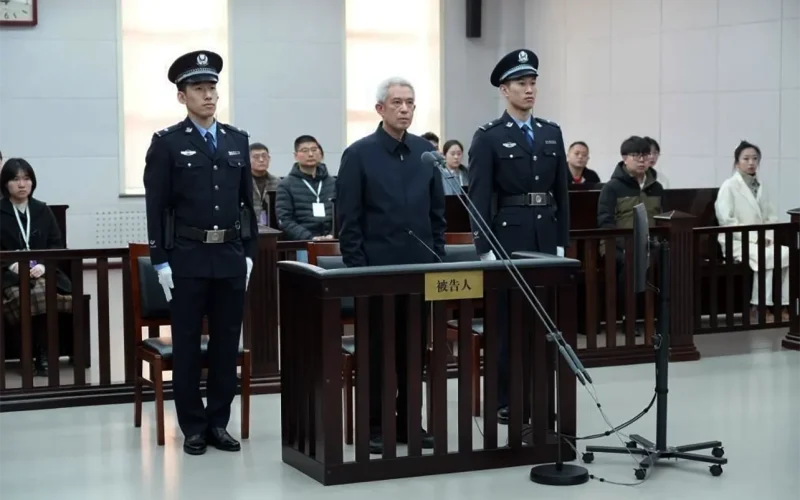
IN the corridors of China’s vast military-industrial complex, Tan Ruisong once commanded nearly absolute authority. As chairman and Communist Party secretary of the Aviation Industry Corporation of China (AVIC) — the country’s dominant state-owned aerospace and defence conglomerate — he presided over an empire spanning fighter jets, military transport aircraft, drones, and strategic aviation systems at the very heart of the People’s Liberation Army’s modernisation agenda. On Wednesday, a Chinese court delivered its verdict on how he used that power: a death sentence with a two-year reprieve, effectively a suspended execution that carries the full weight of Beijing’s no-nonsense approach to corruption in the ranks of its most sensitive institutions.
The sentence, reported by state-run Xinhua news agency, marks the culmination of a case that has unfolded across more than eighteen months of investigation, party expulsion, arrest, and prosecution — each stage ratcheting up the severity of the accusations against a man who spent his entire professional life in service to Chinese aerospace. It is also the latest and most dramatic chapter in what has become the defining political feature of Xi Jinping’s era: a sweeping, relentless anti-corruption drive that has now consumed two defence ministers, dozens of generals, multiple aerospace executives, and a senior nuclear missile force. That the head of AVIC — China’s single most important aviation and aerospace defence manufacturer — now faces a suspended death sentence sends a message that resonates far beyond Tan Ruisong himself.
A CAREER BUILT IN THE CLOUDS, UNDONE ON THE GROUND
Tan Ruisong spent four decades building a career at the apex of Chinese aviation. Born in February 1962 in Jilin City and educated at Beijing’s prestigious Beihang University — then the Beijing Institute of Aeronautics — he graduated in 1983 and entered the Harbin Dong’an Automotive Engine Manufacturing Company. By 2004, he had risen to chairman and party secretary of the Harbin Aviation Industry Group, and by 2008, he had been appointed deputy general manager of AVIC itself. In 2012, he became general manager, and in 2018, he was elevated to chairman and party branch secretary, the dual-hatted role that placed him at the top of AVIC’s command structure.
He held that position for nearly five years before being quietly removed in March 2023 — a removal that, in retrospect, almost certainly signalled the beginning of a formal investigation. In August 2024, the Central Commission for Discipline Inspection (CCDI) and the National Commission of Supervision announced publicly that Tan was under investigation for ‘serious violations of laws and regulations’. The machinery of China’s anti-graft apparatus had been set in motion.
THE WEIGHT OF THE CHARGES
When the CCDI issued its detailed findings in February 2025, announcing Tan’s expulsion from the Communist Party, the picture that emerged was one of comprehensive, multi-dimensional corruption spanning his entire tenure in senior positions. The charges were remarkable not only for their gravity but for the unusual specificity with which they were publicly articulated — a deliberate signal from Beijing about the nature of the betrayal it believed had occurred.
‘He lived off the military sector,’ the CCDI stated — a formulation that captures precisely the nature of graft that Xi’s campaign is targeting at its core.
According to the Central Commission for Discipline Inspection, Tan accepted a ‘huge amount of bribes’, leveraging his positions across the aviation industry to embezzle state funds and assets, and using his power to ‘seek illicit benefits for others’ in the restructuring, mergers and acquisitions of enterprises, contracting engineering projects, and the recruitment of employees. In plain terms, he sold access to AVIC’s vast procurement, infrastructure and personnel pipeline, and enriched himself enormously in the process.
Beyond the financial crimes, Tan was accused of engaging in ‘power-for-sex transactions’ — the Chinese Communist Party’s term for exchanging official favours for sexual access — and of ‘immoral extramarital affairs’, charges that carry particular political weight in the context of Xi’s broader campaign to restore what the CCP frames as the moral integrity of the party and the armed forces. He was also found to have ‘resisted organisational scrutiny’, engaged in superstitious activities — a phrase that typically refers to consulting fortune tellers or engaging in religious practices considered incompatible with Marxist-Leninist orthodoxy — and participated in lavish banquets that violated the party’s strict regulations on official conduct.
By August 2025, when formal charges were filed, the Supreme People’s Procuratorate confirmed that Tan was facing prosecution for four distinct offences: embezzlement, bribery, insider trading, and the unlawful disclosure of inside information. The insider trading charges — in which Tan allegedly used non-public information obtained through his official position to engage in securities transactions and leaked that information to others for their benefit — added a dimension of financial market manipulation to an already damning indictment. The case was filed at the Intermediate People’s Court of Dalian, in Liaoning province, and the verdict announced this week brings closure to one of the most significant corruption trials in the recent history of China’s defence industrial complex.
UNDERSTANDING THE DEATH SENTENCE WITH REPRIEVE
The sentence itself — death with a two-year reprieve — requires some contextual unpacking for readers unfamiliar with the specific mechanics of Chinese criminal law. It is codified in Article 50 of China’s Criminal Law, and represents a distinct category of capital punishment that is handed down more frequently than outright death sentences in the People’s Republic. Under this provision, the condemned person is not immediately executed. Instead, the sentence is suspended for two years, during which the convict’s behaviour is assessed. If the convict commits no intentional crimes during the reprieve period, the sentence is automatically commuted — typically to life imprisonment, or, in cases where the convict renders ‘major meritorious service’, to a fixed term of not less than 25 years.
The mechanism has deep roots in both Maoist jurisprudence and traditional Chinese concepts of mercy and rehabilitative punishment. It allows courts to emphasise the severity of the crime — and the gravity of the state’s judgment — while preserving a degree of flexibility. In modern practice, it also functions as a tool to reduce China’s rate of executions without formally abolishing the death penalty for corruption offences. Critically, the 2015 amendments to China’s Criminal Law specifically restricted the possibility of commutation to life imprisonment without the possibility of parole for convictions involving bribery or ‘plundering the public treasury’ — meaning that even if Tan’s sentence is ultimately commuted, he is likely to spend the rest of his life in prison.
For Xi Jinping’s anti-corruption apparatus, the suspended death sentence does something that life imprisonment alone cannot: it signals that the CCP considers the betrayal to be a matter of life and death.
AVIC AND THE STRUCTURAL PROBLEM OF MILITARY PROCUREMENT
AVIC is not simply a company. With revenues exceeding $60 billion annually and a portfolio of subsidiaries that stretches from COMAC’s C919 commercial jet to the J-20 stealth fighter and the CH-series of armed drones, AVIC is effectively a strategic arm of the Chinese state and the PLA. Its chairman wields authority over the allocation of contracts worth billions of dollars, over the restructuring of subsidiary enterprises, and over the hiring and promotion of thousands of engineers, executives, and officials. The potential for graft — and for that graft to corrupt not only public finances but the integrity of actual military systems — is immense.
The concern is not merely theoretical. Revenue at China’s largest military firms, including AVIC, fell in 2024 — a striking anomaly at a time when global arms revenues rose by nearly six percent, according to analysis by the Stockholm International Peace Research Institute. SIPRI researchers attributed the decline directly to corruption-related leadership changes and project delays stemming from the anti-graft investigations. The procurement freeze resulting from Xi’s purge has created measurable uncertainty in China’s military modernisation programme, with contracts postponed or cancelled as oversight of the procurement pipeline was scrutinised from the top down.
The broader backdrop is arguably even more alarming. A January 2024 US intelligence assessment, cited by Bloomberg, reported that corruption in the PLA Rocket Force had reached levels that directly compromised operational readiness: some missiles in China’s strategic arsenal had allegedly been filled with water instead of propellant; silo lids across nuclear missile fields were reportedly fitted with faulty components; and command and control systems showed signs of systemic failure. Whether or not every detail of that assessment is accurate, the underlying reality it reflects — that corrupt procurement processes in a closed, opaque system can hollow out military capability without detection — is precisely what the Tan Ruisong case illustrates for the aviation sector.
THE PURGE IN CONTEXT: AN UNPRECEDENTED CAMPAIGN
Tan’s sentence does not stand alone. It is the latest landmark in what the CSIS China Power Project has described as the most sweeping purge of the Chinese military since the founding of the People’s Republic. According to CSIS analysis, 36 generals and lieutenant generals have been officially purged since 2022, with a further 65 officers listed as missing or potentially purged — bringing the total of confirmed and potential removals to more than 100 people. The scale and depth of these removals are without precedent in the post-Mao era.
The purge has consumed the most senior figures in China’s defence establishment. Two consecutive defence ministers — Wei Fenghe and Li Shangfu — were expelled from the Communist Party and stripped of their rank. Li’s case was explicitly linked to the corrupt procurement of military equipment. In December 2024, senior naval officer Miao Hua, director of the Central Military Commission’s Political Work Department and the PLA’s leading political officer, was placed under investigation. By June 2025, he was dismissed. Even more dramatically, General He Weidong — at the time the highest-ranking general in the CMC after Xi Jinping himself, and long regarded as among Xi’s most trusted associates — was removed from his post and placed under investigation in early 2025, in what CSIS described as the first removal of a sitting first-ranked CMC vice chairman since 1967.
At least three other aerospace defence executives have been expelled from China’s top political advisory body in addition to Tan. Fourteen military delegates were expelled from the National People’s Congress over the past two years. The aerospace and defence procurement ecosystem — from the Rocket Force to AVIC to CASC — has emerged as one of the primary vectors of corruption that Xi’s campaign is targeting.
One Western analyst characterised Xi’s mission as ‘squeezing out the water diluting combat effectiveness’ — a formulation that resonates with brutal clarity given allegations that PLA missiles were literally diluted with water in place of propellant.
CONTROL, LOYALTY, AND THE LIMITS OF THE PURGE
There is a vigorous debate among China analysts about the precise nature and implications of the purge. The official framing — that it is a principled anti-corruption campaign designed to restore party integrity and sharpen military capability — is not without foundation. Xi himself declared in January 2025 that corruption remains the ‘biggest threat’ to the CCP, reaffirming the campaign’s centrality to his political programme. Whatever else may be true, the sheer scale of the financial crimes uncovered — and the documented impact on military procurement and capability — suggests a genuine structural problem that requires a structural response.
But analysts at the Centre for Naval Analyses and elsewhere have raised serious questions about the collateral damage. When officers have climbed the ranks through bribery rather than merit, their operational competency is itself suspect. When equipment contracts were awarded on the basis of kickbacks rather than capability, the quality of the systems entering service is compromised. When the purge extends down through multiple layers of theatre commands, support forces, and the Joint Operational Command Centre — as CSIS data now indicates it has — the institutional knowledge and command experience being eliminated represents a genuine and potentially long-lasting deficit in military readiness.
There are also the deeper questions about what the purge reveals about Xi’s own position. The removal of He Weidong — once pictured standing beside Xi at promotion ceremonies and described as a key organiser of the 2022 military exercises around Taiwan — suggests that the reach of the investigation has moved beyond factional rivals to encompass Xi’s own inner circle. Whether this reflects Xi’s extraordinary confidence and capacity for self-renewal, or a more contested internal political situation in which the purge has taken on a dynamic of its own, remains a matter of active analytical debate.
THE AFRICAN LENS: WHAT CHINA’S MODEL MEANS
For African states grappling with entrenched corruption in their own defence and public procurement sectors, China’s approach presents a double-edged lesson. On one hand, the willingness to impose the maximum sanction — even if suspended — on the chairman of a strategic national enterprise sends a message about political will that is notably absent in many African governance contexts, where accountability for elite corruption remains episodic at best and largely performative at worst. On the other hand, the concentration of anti-corruption authority in a single political figure, without independent judicial oversight or civil society participation, raises questions about whether the campaign is a genuine governance reform or an instrument of political control.
What is unambiguous is the material consequence. Tan Ruisong, who built a career at the zenith of Chinese state power, who sat in the boardrooms and politburo meetings where China’s aerospace future was decided, who by his own admission leveraged that position for personal enrichment across bribery, embezzlement, market manipulation, and sexual exploitation — now faces the remainder of his life in prison, with a death sentence hanging over the first two years of it. The court in Dalian has passed its judgment. Beijing’s message could not be plainer: in Xi Jinping’s China, no rank protects you, no proximity to power immunises you, and no national security rationale will shield you if you steal from the people and the state.