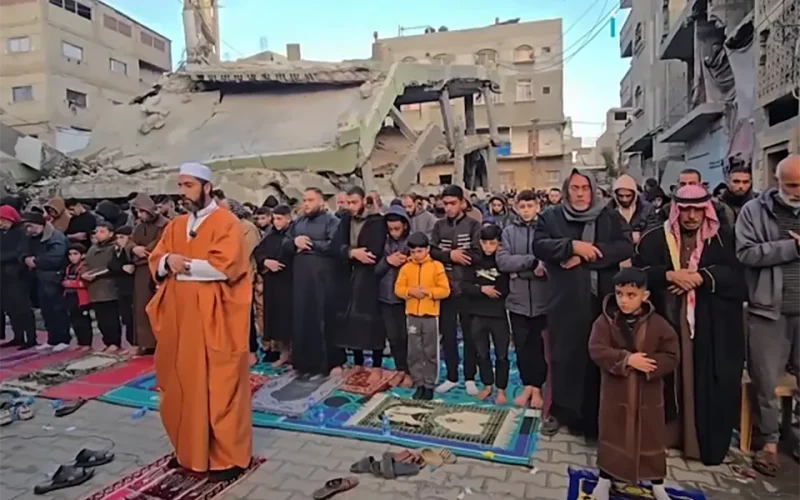
THE sound reached them before anything else. Rising from behind the Herod’s Gate and echoing off the stone walls of the Old City, the takbir — Allahu Akbar, God is the greatest — swelled into the pre-dawn air over occupied East Jerusalem. Hundreds of Palestinian worshippers had gathered at the closest points they were permitted to reach: Damascus Gate, Herod’s Gate, the streets and pavements outside a compound whose gates had been locked to them for three uninterrupted weeks.
They came for Eid al-Fitr. They came, as generations before them had, to mark the end of Ramadan with communal prayer in one of the most sacred precincts in the Islamic world. Instead, they prayed on asphalt. And when some among them attempted to advance toward the Al-Aqsa compound, Israeli forces responded with tear gas and stun grenades. At least one worshipper was detained, seized from Salah al-Din Street as the morning prayers were still echoing. Two journalists — one Palestinian, one foreign — were among those struck by batons despite displaying press credentials.
By any historical measure, 20 March 2026 stands as a rupture. The closure of Al-Aqsa Mosque to Muslim worshippers for Eid al-Fitr is the first of its kind since Israel seized East Jerusalem in the 1967 war. In nearly six decades of occupation, through wars, intifadas, a global pandemic, and repeated escalations, Palestinian Muslims have never before been denied access to the mosque compound on the day of Eid. Even during COVID-19, restrictions on Al-Aqsa were a matter for the Islamic Waqf — the Jordanian-linked body that administers the site — not for Israeli military decree. That precedent, kept intact through extraordinary circumstances, has now been broken.
This is not a passing security measure. It is a geopolitical act — one whose consequences, if left unchallenged, will reach far beyond this Eid morning.
TWENTY-ONE DAYS: THE ANATOMY OF A CLOSURE
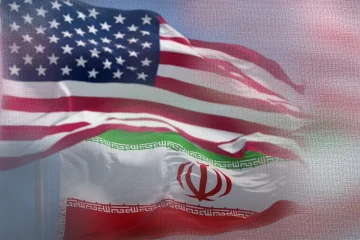
Al-Aqsa Mosque was sealed on 28 February 2026, within hours of the joint US-Israeli military strikes on Iran that ignited the current regional conflict. Israeli authorities acted swiftly and broadly: the Ibrahimi Mosque in Hebron, sacred to Muslims as the burial site of the patriarch Ibrahim, was shut simultaneously. Both closures were framed as emergency preventive measures under wartime security protocols. The framing was deliberate: security emergencies, by definition, are temporary.
Twenty-one days later, there is nothing temporary about what has unfolded. According to Middle East Eye, which broke the story exclusively days before Eid, Israeli authorities formally informed the Islamic Waqf that the closure would extend beyond Eid al-Fitr — with no end date specified. The Waqf, which manages Al-Aqsa and has done so for centuries under Jordanian custodianship, was not consulted. It was notified.
“This has fuelled fears that what is presented as a temporary measure could gradually become a permanent or semi-permanent arrangement, particularly if people become accustomed to the restrictions or if patterns of access to the site are altered.”
Aouni Bazbaz, Director of International Affairs, Islamic Waqf
The mechanics of the closure have been methodically documented. Israeli authorities restricted Al-Aqsa access to just 25 Waqf staff members per shift across the compound’s entire 144 dunums. Surveillance cameras were installed inside the prayer halls and within the Dome of the Rock itself. When the Waqf requested that a single additional staff member from its manuscripts department be permitted to enter, Israeli police refused — with a warning that was as revealing as it was alarming: allowing one Palestinian in would create grounds for Israeli settlers to resume their daily incursions into the compound.
The logic of that refusal deserves to be held up to the light. The Waqf’s administrative access and settler incursions are being treated by Israeli police as a zero-sum transaction. Palestinian presence at a Muslim holy site, in this framing, is a concession; Jewish extremist access is the equilibrium state. This is not a security position. It is a sovereignty claim.
Within the Old City, the closure has extended well beyond Al-Aqsa’s gates. The Church of the Holy Sepulchre — the site Christians hold as the location of Christ’s crucifixion and resurrection, currently approaching Holy Week — has also been subject to severe access restrictions. Entire neighbourhoods of the Old City have been effectively placed under a commercial siege. Merchants who dared open their shops during the Ramadan closure reportedly faced fines of 6,000 shekels. Pharmacies were shut. Hotels that rely on Ramadan pilgrimage tourism reported occupancy rates collapsing from over 100 percent to a mere 2 percent. The closure has not merely suppressed religious life. It has economically strangled a city.
THE STATUS QUO: HISTORY OF A FRAGILE ARRANGEMENT
To understand what is at stake in Jerusalem on this Eid morning, one must understand what the “status quo” is, how it came to be, and why it matters beyond theology.
When Israeli forces seized East Jerusalem in June 1967, they faced an immediate question about the Al-Aqsa compound. Moshe Dayan, the Israeli Defence Minister who made the consequential decision, chose to maintain Islamic administration of the site. The Islamic Waqf, affiliated with Jordan’s Hashemite monarchy — which had held custodianship since 1924 — would continue to administer the mosque, regulate access, and manage daily religious affairs. Jewish prayer at the site would be formally prohibited. Non-Muslim visitors would be permitted access, but not worship.
This arrangement — imperfect, contested, and progressively eroded — has nonetheless functioned as the axis around which successive crises over Jerusalem have turned. It was breached in 2000, when then-opposition leader Ariel Sharon’s heavily-guarded visit to the compound triggered the Second Intifada. It was tested in 2017, when Israel placed electronic metal detectors at the compound’s entrances following an attack; Palestinians refused entry for 14 days and prayed in the streets until the detectors were removed. It has been strained across recent years by the dramatically increased frequency and scale of Israeli settler incursions into the compound, conducted under police escort.
What is happening now is categorically different in kind. This is not a provocation or a test. This is a 21-day closure enforced by Israeli military decree during Islam’s holiest month and most sacred festival. Jerusalem affairs researcher Ziyad Ibhais, writing in Palestinian media, has described this as the first time the mosque has been closed on the last Friday of Ramadan in six decades of occupation. The compound has now been closed for the second Jumu’ah of Ramadan, the sixth Jumu’ah since the occupation began, Laylat al-Qadr, and now Eid itself. These are not security decisions. They are theological and political facts on the ground.
| TIMELINE OF THE CLOSURE ■ 28 February 2026: US-Israeli strikes on Iran begin; Al-Aqsa and Ibrahimi Mosque closed within hours ■ 6 March 2026: First Friday of Ramadan passes with compound sealed; Palestinians pray in streets ■ 13 March 2026: OIC, Arab League, African Union issue joint condemnation ■ 15 March 2026: Eight-nation joint statement (Jordan, Saudi Arabia, UAE, Qatar, Egypt, Turkey, Indonesia, Pakistan) ■ 15 March 2026: Laylat al-Qadr (Night of Power) passes; Al-Aqsa remains closed for first time since 1967 ■ 16 March 2026: Middle East Eye reports Israel formally notified Waqf of post-Eid continued closure ■ 17 March 2026: Israeli police attack Tarawih worshippers, beating two journalists outside Old City ■ 20 March 2026 (Day 21): Eid al-Fitr morning prayers; tear gas deployed at Damascus and Herod’s Gates |
THE IBRAHIMI PRECEDENT: A WARNING ALREADY REALISED
The spectre haunting every Palestinian and every analyst of Jerusalem’s sacred topography is a single name: Ibrahimi Mosque.
On 25 February 1994, the last Friday of Ramadan, Baruch Goldstein — a US-born settler and supporter of the Kach extremist movement — entered the Ibrahimi Mosque in Hebron dressed in an Israeli army uniform and opened fire on hundreds of Palestinian Muslims performing Ramadan prayers. He killed 29 worshippers and wounded 125 more before being overpowered and killed. Israel’s response was not to expel the settler movement from the city. It was to partition the mosque. Half was allocated to Jewish prayer as Ma’arat HaMachpela. The remaining Muslim section operates under severe restrictions, with hundreds of days each year on which Muslims are excluded to accommodate Jewish holidays.
The Ibrahimi Mosque is, today, precisely what Al-Aqsa’s defenders fear for their own compound: a Muslim holy site effectively co-administered, in practice if not in law, by the occupying power; a sacred space in which the perpetrators of violence were accommodated rather than removed. The pattern of closure, surveillance installation, restriction of Waqf authority, and settler normalisation of access is identical in every structural element to what is now being imposed at Al-Aqsa.
This is the analysis of Ziyad Ibhais and of the Middle East Eye commentary that described the closure explicitly as an act of war: that the wartime emergency is being weaponised not to protect Palestinian worshippers, but to impose new control over the mosque and change the reality of its administration. Palestinian analysts have also flagged a convergent threat: Israeli settler and religious nationalist groups have been openly campaigning to perform ritual animal sacrifice within Al-Aqsa’s compound during Passover, scheduled between 1 and 8 April 2026, days after Eid. Calls have been made within those circles to keep Al-Aqsa closed until after the Jewish holy month — and posts from extremist Temple Mount activist groups explicitly frame the current closure as an opportunity to impose that new reality.
“The closing of Al-Aqsa cannot be read as a passing security measure. It is part of an attempt to impose new control over the Mosque and change the reality of its administration, taking advantage of the state of silence and the current regional conditions.”
Ziyad Ibhais, Jerusalem Affairs Researcher, Palestinian Information Centre
A GLOBAL SOUTH REBUKE — AND ITS LIMITS
The international response has been broad, rapid, and largely cohesive. It has also, as of this writing, produced no change on the ground.
On 13 March, the General Secretariats of the Organisation of Islamic Cooperation, the League of Arab States, and the African Union Commission issued a rare joint statement condemning the closure in the strongest terms available in diplomatic language. They described the measure as a grave violation of the existing historical and legal status quo in the Islamic and Christian holy sites in the occupied city of Jerusalem, an assault on the established religious rights and heritage of the Islamic nation, and an unprecedented provocation to the feelings of Muslims throughout the world. They invoked three United Nations Security Council resolutions — 252 (1968), 267 (1969), and 476 (1980) — all of which affirm that Israel’s measures altering the status of Jerusalem carry no legal validity. They reaffirmed that Israel has no sovereignty over the Palestinian territory occupied since 1967, including East Jerusalem. And they called on the Security Council to compel Israel to reopen the mosque immediately.
The Arab League’s ministerial council, in a separate statement, went further in its language, calling the closure an unprecedented provocation to two billion Muslims worldwide and warning explicitly that its continuation poses serious repercussions for regional and international peace and security. It reaffirmed the Jordanian Waqf as the sole legal authority with exclusive jurisdiction over the mosque’s administration and access — a formulation that directly challenges Israel’s claim to administer closures unilaterally. Jordan’s Foreign Ministry used the language of flagrant breach of international law.
A bloc of eight nations — Jordan, Saudi Arabia, the UAE, Qatar, Egypt, Turkey, Indonesia, and Pakistan — issued their own joint ministerial statement, demanded the immediate reopening of the compound, and called on the international community to compel Israel to stop its ongoing violations.
The African Union’s voice in this coalition carries particular significance for readers of The African Mirror. Africa is home to over 600 million Muslims, approximately one-third of the continent’s total population. Many of Africa’s majority-Muslim nations are OIC members, several are Arab League observer states, and all are AU members. The AU’s co-signatory role on this statement was not ceremonial. It was a declaration that the Palestinian question — and specifically the question of access to Al-Aqsa — is an African question. It reaffirms what South Africa’s sustained engagement with the ICJ genocide case has demonstrated: that the Global South will not treat the fate of occupied Palestine as a matter of distant abstraction.
What this coalition has not been able to produce, however, is enforcement. The United States, which would veto any Security Council resolution compelling Israel to act, has not broken with its partner over Al-Aqsa. The UNSC remains paralysed by the same structural asymmetry that has neutered it throughout the Gaza crisis. The worshippers at Herod’s Gate prayed on asphalt this morning not because the world was silent, but because the institutions mandated to translate condemnation into consequence have not done so.
WHAT HAS BEEN TAKEN, AND WHAT REMAINS
Eid al-Fitr is not only a holy day. For Palestinian communities fractured across Jerusalem, the West Bank, the diaspora, and the communities inside Israel’s 1948 borders, the Eid prayer at Al-Aqsa is one of the few occasions on which a geographically divided people gather in a single place. For Palestinians from the occupied West Bank, especially, Ramadan — and specifically Eid — represents the narrow window in which Israel historically allowed limited access to Jerusalem. To be denied Al-Aqsa on Eid is not only a spiritual wound. It is a severing of a communal thread.
The human texture of what was lost this Ramadan was documented in detail by correspondents on the ground. Al-Wad Street, the main artery leading through the Old City to Al-Aqsa, was empty. Abu Khadija’s coffee shop — an institution of Old City social life — was closed. The alleyways of the Old City’s markets, which should have been hung with Ramadan lanterns and crowded with pilgrims and families buying Eid outfits, fell silent. Even the pharmacies are shut. A young man at a juice stall, one of the few who defied the orders to close, summed it up plainly: they had destroyed his source of living, he said, and to whom was he supposed to sell, with the city closed and no customers?
The closure has fallen hardest on those with the least leverage. Jerusalem’s Palestinian merchants, already under economic siege from years of occupation and the devastating impact of the post-October 2023 restrictions, had staked their financial survival on Ramadan. Hotel occupancy, normally above 100 percent during the month’s final days, fell to 2 percent. Five hotels in Jerusalem reportedly closed temporarily within days of the conflict’s outbreak. The economic decimation of Palestinian Jerusalem — its market economy, its pilgrimage economy, its social fabric — is not incidental to the mosque closure. It is inseparable from it.
And yet: they came. Hundreds of Palestinians gathered at Damascus Gate before dawn. The sound of the Eid takbir rose above the walls of the Old City. Prayers were performed in the streets, in defiance of orders, in defiance of tear gas, in defiance of a closure that has now stretched to 21 days. Ziyad Ibhais, writing before Eid, made the observation that matters most when the institutional analysis reaches its limit: the key to Al-Aqsa, he said, is the popular will capable of breaking these decisions.