US Donald Trump took to the airwaves promising victory in Iran, but what his 19-minute primetime address actually delivered was a masterclass in strategic ambiguity dressed as decisive command. The United States is now five weeks into a war it began on 28 February alongside Israel, and the president who launched it still cannot – or will not – say when, how, or on what terms it ends.
Trump’s core claim – that the United States had destroyed Iran’s navy, air force, and crippled its ballistic missile and nuclear programmes – was delivered with characteristic bluster. The military scorecard, taken at face value, is substantial. But even as the president spoke, air raid sirens sounded across Doha and Tel Aviv, a live rebuttal to any notion that Iran has been rendered militarily inert. A degraded adversary, it turns out, remains a dangerous one.
The president vowed to hit Iran “extremely hard” for another two to three weeks, and threatened to escalate to attacks on electricity generation and oil infrastructure if the country’s new leadership fails to negotiate to his satisfaction. He will bring them back, he said, to the “Stone Ages where they belong” – a phrase that encapsulates the contradictions at the heart of American war aims. You cannot bomb a country into a negotiating partner while simultaneously threatening to destroy the infrastructure any future state would need to function.
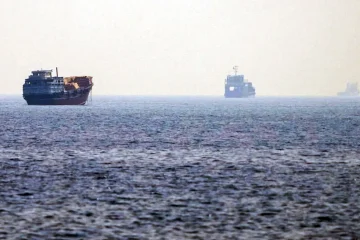
Most critically, Trump glossed over the war’s two most consequential unresolved questions: the fate of Iran’s stockpiles of highly enriched uranium, and the status of the Strait of Hormuz. The strait – the narrow chokepoint through which roughly a fifth of the world’s oil supply flows – remains effectively closed. Trump’s answer was to say it would open “naturally” once the war ends. That is not a policy. It is a wish.
Financial markets understood the subtext even if the rhetoric obscured it. Stocks fell, the dollar firmed, and oil rose in the immediate aftermath of the speech – a collective market verdict that the conflict is likely to drag on, and that the global economy will continue to absorb the punishment. For Africa, where fuel import bills are denominated in dollars, and aviation networks across the continent face sustained disruption, each additional week of war carries compounding costs that Washington does not account for in its war calculus.
Trump’s aside about petrol prices – blaming Iran while assuring Americans costs would “soon go down” – was the speech’s most politically transparent moment. A Reuters/Ipsos poll taken days before the address found 60 percent of American voters disapprove of the war, with 66 percent wanting the United States out quickly, even if that means abandoning stated objectives. Trump is losing the home crowd, and he knows it.
His handling of NATO allies was equally telling by omission. Earlier in the day, Trump had told reporters he would address the American relationship with the alliance — an institution he has threatened to abandon over its refusal to help open the Hormuz Strait. He said nothing of the sort in the speech itself. Britain, France and others have made clear they will assist with maritime security only after hostilities cease. Trump’s frustration with that position is understandable; his inability to resolve it is not.
Administration officials have floated options that range from the audacious to the alarming: a special forces operation to seize Iran’s remaining enriched uranium stockpiles, ground operations to capture strategic coastal territory, even the seizure of Kharg Island through which the bulk of Iranian oil exports flow. Thousands of additional troops continue their sail toward the Gulf. These are not the dispositions of a commander preparing to wind down.
What Trump offered on Wednesday was less a war address than a performance of control – aimed at an anxious domestic audience, rattled allies, and an adversary he needs at the negotiating table. But performances have consequences. Iran’s leadership, watching a president simultaneously claim victory and threaten greater destruction, faces a simple calculation: if talking leads to the same outcome as fighting, why talk? Trump told reporters the day before his speech that Iran didn’t need to negotiate as a precondition for the war to end. He has yet to explain what precondition, if any, he actually requires.
The risk for Africa – and for the Global South more broadly – is not merely economic, though the fuel price shock is already acute across the continent. It is the risk of strategic drift: a superpower war with no defined endpoint, prosecuted by an administration offering shifting timelines and contradictory signals, with the humanitarian and diplomatic consequences falling disproportionately on states with the least capacity to absorb them and the least leverage to influence the outcome.
Trump asked Americans to “keep this conflict in perspective,” invoking Iraq, Vietnam and Korea as precedents for wars that lasted far longer than anyone anticipated at the outset. It was the most honest thing he said all night – and the most alarming.