By Bushra Khalidi
THE situation in Gaza is beyond words, but we have to keep trying to tell the truth – because silence is complicity, and giving up is not an option. Because if we don’t speak, the silence will bury the truth.
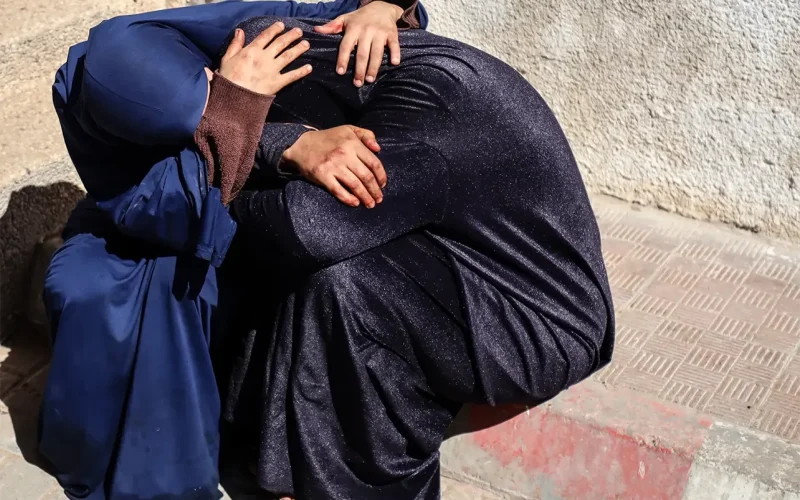
What humanitarian teams are seeing – and what Palestinians in Gaza are living through – is not just a crisis. It’s a collapse. A collapse of basic survival, of dignity, of international order. People are eating animal feed. They are boiling grass. It appears that families are slaughtering their horses – something unimaginable in our culture, something sacred – just to feed their children. We’ve seen people catching turtles from sewage-contaminated water. These are not symbolic images. This is daily life now.
Even in my own family, my brother-in-law told me the children are dizzy most of the day – not because they’re sick, but because they’re hungry. That’s how deep this has gone.
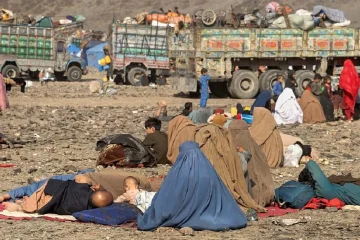
We are talking about a population being starved, forcibly displaced, and bombed, all at once – and being told that they may have to line up for food in fenced-off zones run by private military contractors.
This is not humanitarian aid. This is the militarisation of aid, and humanitarian organisations across the board – UN agencies, INGOs, local groups – we are rejecting it. We are saying clearly: Let us do our jobs.
The weaponisation of aid
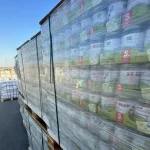
Humanitarianism is not a label you slap on a box of rations. It’s not humanitarian because a government or a foundation calls it that. What makes it humanitarian is adherence to principles of impartiality, independence, and humanity.
When those principles are stripped away – and they are being stripped away – you are not funding aid. You are funding control. You are funding the weaponisation of aid. You are funding a system that says: If you’re too old to move, too disabled to flee, you don’t deserve to eat.
My own home in the Old City has been taken by settlers – not once, but over and over again. They show up with papers and weapons, with state protection behind them, and try to erase us from our own history.
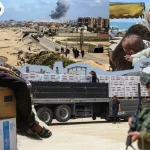
Oxfam has been working in Gaza for decades. Since the war began, our teams and partners have been doing everything they can to provide clean water, food, and hygiene kits. But Israeli restrictions are blocking nearly all aid efforts. Our water network repairs are denied. Our food aid is stalled at the border. Trucks carrying vital supplies are turned away for arbitrary reasons or because of a broken approval system. Every day of delay costs lives.
We’ve called repeatedly for a permanent ceasefire, for full and unimpeded access, and for respect of international law. Yet what we’re seeing is the opposite: growing impunity, total disregard for humanitarian norms, and proposals that seek to make this crisis permanent through militarised logistics and biometric surveillance.
And this is not isolated to Gaza. It’s part of a much broader pattern.
In the West Bank, including East Jerusalem, where I’m from, the same architecture of dispossession plays out daily. My own home in the Old City has been taken by settlers – not once, but over and over again. They show up with papers and weapons, with state protection behind them, and try to erase us from our own history. This is what settler violence and control looks like. It’s the same logic behind what’s happening in Gaza: erasure, displacement, and control.
A political and moral failure
Now, Israel is openly formalising annexation. Ministers are calling for it outright. Military rule is being handed over to civilian ministries. Settlement expansion is accelerating. Palestinians are being pushed off their land, denied permits, denied protection, and denied their future.
This is an occupation. And Gaza is what occupation looks like when it is allowed to go unchecked – weaponised, total and absolute.
The implications are terrifying – not just for Palestinians, but for the entire global system we claim to believe in. If this is allowed to continue, if this becomes the new normal, then the entire foundation of humanitarian law, human rights, and accountability crumbles with it.
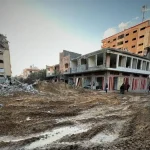
So, to everyone: Tell this story. Don’t let it get buried in euphemisms or forgotten in the next news cycle. This is about children too weak to cry. About mothers skipping meals for days. About the dead left under rubble, because there are no machines left to dig them out. About families like mine being told over and over that our lives, our homes, our futures don’t matter.
This is not just a humanitarian crisis. It is a political failure. A moral failure. And if we don’t name it, if we don’t call it what it is – deliberate, systematic destruction – then we are all complicit in its continuation.
–––––
The New Humanitarian puts quality, independent journalism at the service of the millions of people affected by humanitarian crises around the world. Find out more at www.thenewhumanitarian.org.