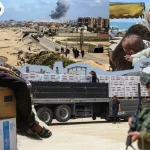
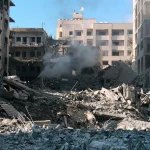
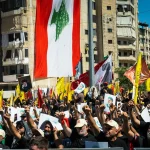
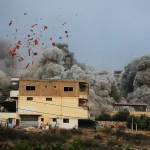
AMID the start of a reported Israeli ground offensive against the Hezbollah armed group in southern Lebanon and fears of more civilian suffering, the UN launched an urgent humanitarian appeal on Tuesday to support those most in need in the country.
The three-month, $426 million flash appeal launched by the UN and partners together with the Lebanese Government, will address “rapidly escalating” needs for food and other survival supplies, shelter, education and protection of civilians, said UN Humanitarian Affairs Coordination Office (OCHA) spokesperson Jens Laerke.
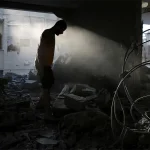
Widespread Israeli shelling has already forced one million people to flee their homes and Mr Laerke told journalists in Geneva that more displacement is to be expected.
Delivery of aid is dependent on “where the bombs fall next,” he noted.
UN Human Rights Office (OHCHR) spokesperson Liz Throssell said that Israeli strikes in Lebanon have reportedly killed over 1,000 people in the past two weeks alone. In Israel, over 60,000 have been displaced since Hezbollah escalated firing missiles across the UN-patrolled line of separation in response to the start of the war in Gaza in October last year.
OCHA’s Mr. Laerke explained that until now, there had been no humanitarian appeal in place specifically for Lebanon. Existing supplies and capacity to help those affected are insufficient and an injection of funds is needed to increase the response “which is not where it should be”.
Humanitarians are currently distributing aid primarily in collective shelters, he said, as there are around 800 schools and other public facilities that the Government has opened to house the displaced – “which also, tragically, means that kids are not going to school”.
Mr Laerke explained that it was easier to distribute food and essential items when people were gathered in one place, but that many of the displaced were on the move or sheltering with friends and family, which made it more difficult to reach them. He insisted that it is essential to provide support “for the full one million people in need”.
With Israeli troops now reportedly on the ground in Lebanon, humanitarians worry that the situation for civilians risks getting more desperate yet. According to news reports on Tuesday, the Israeli military already ordered the evacuation of some two dozen border communities in the south of the country. Inhabitants were reportedly ordered to move north of the Awali River, about 60 kilometres from the border and beyond the limits of a buffer zone between the two countries declared by UN Security Council resolution 1701 after the 2006 war, which was the last time that Israel and Hezbollah were engaged in combat on the ground.
In a statement on Tuesday, the UN Interim Force in Lebanon (UNIFIL) said that any Israeli crossing into Lebanon would be “in violation of Lebanese sovereignty and territorial integrity, and a violation of resolution 1701”. The latest reported incursion into Lebanon, which Israel has described as “localised and targeted”, crosses a line of separation known as the “Blue Line” which UNIFIL patrols.
Beyond Lebanon and north Israel, OHCHR’s Liz Throssell warned about the conflict’s “potential to engulf the entire region in a humanitarian and human rights catastrophe”.
“With armed violence between Israel and Hezbollah boiling over, the consequences for civilians have already been awful,” she said. “We fear a large-scale ground invasion by Israel into Lebanon would only result in greater suffering.”
Ms Throssell stressed the need for all parties to the conflict to “clearly distinguish between military targets and civilians and civilian objects in the way they conduct hostilities”.
“They must do all they can to protect the lives of civilians, their homes and the infrastructure essential to their daily existence, as clearly required by international humanitarian law,” she said.
Asked about the reported use by Israel of 2,000-pound bombs in the attack which killed Hezbollah leader Hassan Nasrallah in Beirut last Friday, Ms Throssell said that while OHCHR is not in a position to comment directly on the attack, the use of such heavy weapons in civilian areas is of grave concern “because of the principles of distinction, precaution in attack and proportionality” and the risk of civilian casualties.
“We have warned time and time again for almost a year against the widening of this conflict,” OCHA’s Mr. Laerke insisted. “And why do we do that? Because if there’s one universal truth in humanitarian affairs, it is that it is infinitely easier and faster to break things and hurt people than it is to fix them,” he said. “So, de-escalate, now.” – UNNews