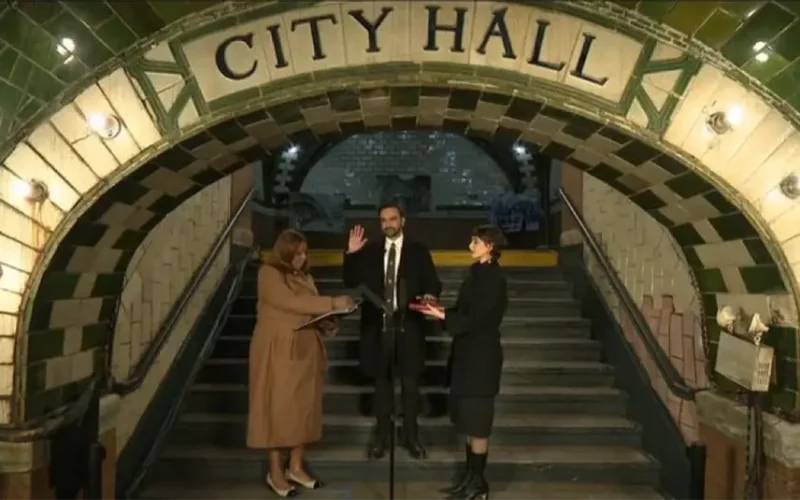
IN the hushed moments after midnight on New Year’s Day, beneath the vaulted ceilings of a century-old subway station that once welcomed America’s huddled masses, New York City did what it does best: it reimagined itself.
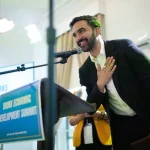
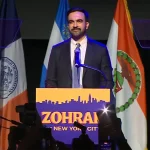
Zohran Mamdani, born in Kampala, Uganda, placed his hand on a Quran and became the first African-born mayor of the city that has long styled itself as the world’s capital. At 34, this son of a filmmaker and an academic took an oath in the Old City Hall station – a jewel of civic architecture abandoned to time – and in doing so, breathed new life into the city’s oldest promise: that here, anything is possible.
The Subway as Cathedral
The choice of venue was no accident. The old City Hall station, with its stunning Guastavino tile arches and brass chandeliers, represents New York at its most ambitious – a temple to public infrastructure, to the democratic ideal that everyone, regardless of origin or income, deserves beauty in their daily lives. That Mamdani chose this space to begin his tenure speaks to a vision of governance as bold as the city’s original dreamers.
“This is truly the honour and the privilege of a lifetime,” Mamdani said in his first words as mayor, his voice echoing off tiles laid by immigrant hands over a century ago. In that underground chamber, past and future collapsed into a single, shimmering moment.
From Kampala to City Hall
Mamdani’s journey embodies the audacious arc of the immigrant dream. Arriving in New York at age seven, he grew up in a post-9/11 city where Muslims navigated suspicion and hostility. He didn’t become an American citizen until 2018. Eight years later, he stands as the city’s chief executive – its first Muslim mayor, its first South Asian leader, its youngest in generations, and yes, its first African.
This is the alchemy only New York can perform: transforming a child refugee into the leader of eight million souls, the steward of America’s most iconic metropolis, a city whose subway rumble and street-corner symphonies have always belonged to those brave enough to claim them.
The Democratic Socialist Who Talked About Groceries
Mamdani didn’t ascend on abstract promises. He won by speaking the language of kitchen tables and rent checks, by making “affordability” not just a policy buzzword but a moral imperative. Free childcare. Free buses. Rent freezes for a million households. City-run grocery stores. His platform acknowledged what working New Yorkers have long known: that the city of possibilities has become impossibly expensive for those who keep it running.
The democratic socialist from Queens promised transformation in a city perpetually caught between its mythology and its reality, between the gleaming towers of billionaire’s row and the rent-stabilised walk-ups where dreams are deferred by the 15th of every month.
The Weight of the Job
Now comes the unglamorous work: the rats and potholes, the snow removal and subway delays, the ten thousand daily emergencies that make being New York’s mayor one of the most unrelenting jobs in American politics. Mamdani inherits a city on the upswing – crime down, tourists back, unemployment at pre-pandemic levels – but also a city where affordability remains the defining anxiety of daily life.
He faces opposition from some in the Jewish community over his criticism of Israel’s government. He must navigate a fraught relationship with President Trump, who threatened to withhold federal funding and mused about sending National Guard troops to the city during the campaign, despite a surprisingly cordial post-election meeting.
The Meaning of the Moment
But on this midnight in January, as Attorney General Letitia James administered the oath and Mamdani’s wife Rama Duwaji looked on, the complications could wait. This was a moment of pure possibility, a validation of every immigrant parent who told their children that in America, in New York especially, you could be anything.
Later today, Senator Bernie Sanders – one of Mamdani’s political heroes – will swear him in again at a public ceremony, followed by a block party on Broadway’s Canyon of Heroes, where the city has celebrated everyone from astronauts to World Series champions. The symbolism is deliberate: Mamdani is no accidental mayor. He is New York’s choice, its statement to the world.
As he climbed the stairs from that beautiful, abandoned station into the cold January air, Mamdani carried with him the hopes of a city that has always been at its best when it remembers what it really is: not a collection of skyscrapers or a financial centre, but an idea. The idea that origin is not destiny. That yesterday doesn’t determine tomorrow. That a boy from Kampala can grow up to lead the Big Apple.
There is an African in New York. And today, he’s the mayor.