AMID calls for more humanitarian trucks to enter the food and medicine-deprived Palestinian enclave of Gaza, UN humanitarians have received permission from Israel for “around 100” more aid trucks to cross into the Strip after only five were let in yesterday, But the scale of relief efforts allowed remains entirely insufficient to meet the urgent needs of people there, humanitarian workers say.
“Not enough. Five trucks, nowhere near. Not enough,” said Louise Wateridge, a spokesperson for the UN relief and works agency for Palestine refugees (UNRWA), in reference to the number of trucks that could cross on Monday. She was speaking to journalists in Geneva from a warehouse full of ready-to-be-delivered supplies in Amman, Jordan, with enough food to feed 200,000 Palestinian civilians for an entire month.
“Everything around me is aid that is supposed to be in the Gaza Strip right now,” explained Louise Wateridge, as warehouses and distribution centres lay empty in Gaza.
“Look at what the UN could do,” she continued. “We’ve done it: the ceasefire, the bombs stopped, the supplies went in. We reached every area of the Gaza Strip. We reached people who needed it most. We reached children. We reached the elderly. The supplies went everywhere,” Ms. Wateridge said, pointing to the UN’s ability to reach civilians if in the Strip with life-saving aid if only the access is granted and the security situation allows.
Five aid trucks still under Israeli control, OCHA
Since 2 March, Israel has blocked all shipments of basic humanitarian aid, including food and medical supplies, from entering Gaza. World leaders and humanitarian agencies condemned and pressured Israel to lift the siege.
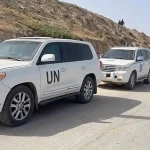
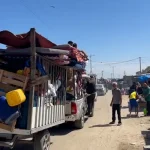
After an 11-week full blockade that has brought the territory to the brink of famine, Israel cleared nine aid trucks on Monday to cross the Kerem Shalom border, but only five of them actually managed to enter Gaza, said Jens Laerke, spokesperson for the UN aid coordination office, OCHA. Four were unable to enter for logistical reasons, as shipments must pass through several levels of Israeli checks.
“The five trucks that entered are still under Israeli control,” Mr. Laerke said. “We need permission to pick the aid up. That did not happen yesterday. However, this morning we do have the permission to collect those five trucks,” he reported.
The trucks from the World Food Program (WFP) and the UN Children’s Fund (UNICEF) carried urgently needed baby food and nutritional supplements for children. Once the aid onboard is collected, it will be distributed through the existing system, which has proven itself”, said Mr. Laerke.
“Simply use the existing system, which used to function very well,” echoed Dr. Akihiro Seita, UNRWA Director of Health. “It’s really sad to see that inside Gaza, there’s a shortage of medicine when the medicine we have outside Gaza is expiring. That’s really not acceptable,” he said.
As aid is scarce, desperation is on the rise in Gaza, with “several predictable effects,” according to OCHA. “One is that the insufficient supplies are at greater risk of being looted,” Mr. Laerke said. Looted products end up being sold at exorbitant prices on the black market, and opening access for large quantities of aid would automatically reduce the looting and improve the security situation, he said.
In the face of mounting international objections over the total blockade imposed in March, and condemnation over the risk of widespread famine, Israel started on Monday to allow limited quantities of aid to trickle in, while simultaneously increasing its military activities in Gaza. Palestinian health officials say that hundreds of people have been killed in attacks over the last few days.
“We reiterate our call, first and foremost, for a ceasefire and unconditional release of hostages and let the UN and partners do their work. There was a plan, and it delivered. There is a plan, and it will deliver,” added Dr. Rik Peeperkorn, the World Health Organisation’s representative in the Occupied Palestinian Territory (OPT).
Israeli military operations in Gaza were triggered after the Hamas attack of 7 October 2023 that killed some 1,200 people in Israel and took some 250 hostages. Fifty-eight hostages are still captive in Gaza, of whom 23 are believed to still be alive. The conflict has devastated Gaza, displacing almost all its two million inhabitants. According to the health ministry in Gaza, the offensive has killed at least 53,475 people, most of them women and children. – UN Multimedia Newsroom