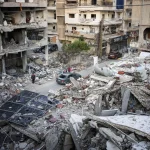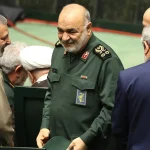
MORE than 330,000 people have been forcibly displaced — mostly within their own countries — as intensifying hostilities sweep across the Middle East, the UN refugee agency UNHCR reported Thursday. The figure, already vast, is almost certain to grow. Coordinated US and Israeli strikes against Iran aimed at regime change continue to cause loss of life and damage across the region, prompting Iranian missile and drone counter-strikes hitting targets in multiple countries.
The arithmetic of suffering is staggering in its breadth. At least 555 Iranians have been killed since the beginning of the joint US-Israeli military campaign, which began on Saturday. Among the dead: more than 168 schoolgirls killed in a direct hit on a school. In Lebanon, Israeli attacks have killed at least 77 people and wounded at least 527 since Monday, including four members of the same family in the southern village of Kfar Tebnit. In Israel, eleven civilians have been killed, among them three siblings aged 16, 15, and 13, a Filipina caretaker killed while escorting the woman in her charge to a shelter, and a mother of three who was a volunteer medic. In Kuwait, an 11-year-old girl died from injuries sustained from Iranian shrapnel. In the UAE, three civilians were killed — migrant workers from Nepal, Bangladesh and Pakistan.
The dead span nations, ages, and roles. What they share is that none of them started this war.
A Region in Motion
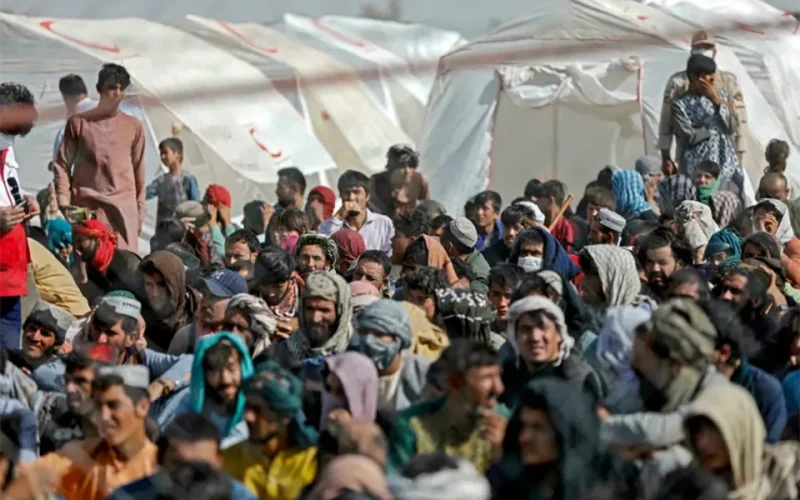
In Iran, around 100,000 people left Tehran in the first two days following the attacks, according to local estimates. In Lebanon, heavy displacement was reported across the south, the Bekaa, and the southern suburbs of Beirut after Israel issued evacuation warnings to residents of more than 53 villages. Around 30,000 people were being hosted and registered at government-designated collective shelters, while many more slept in their cars, on the side of roads, or were stuck in traffic on roads leaving the south.
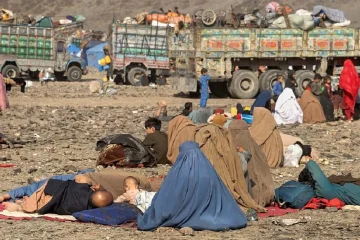
The displacement extends far beyond the immediate theatre of war. Clashes along the border between Afghanistan and Pakistan have forced thousands of families to flee, with an estimated 115,000 people displaced inside Afghanistan and around 3,000 in Pakistan. UNHCR’s capacity to assist returnees in Afghanistan has been significantly reduced due to funding cuts. The agency requires $454.2 million in 2026 to protect and assist forcibly displaced people in Afghanistan, Iran, Pakistan and Central Asia. As of the end of February, only 15 per cent had been received.
Humanitarian Systems Under Strain
The conflict is not erupting into a vacuum. Many of the affected countries already host millions of refugees and internally displaced people. Further violence risks overwhelming humanitarian capacities and placing additional pressure on host communities. Iran alone, now itself a theatre of war, has hosted 1.65 million refugees and others needing international protection. UNHCR continues to assist them despite logistical challenges, with refugee reception centres and helplines remaining open.
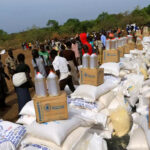
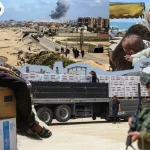
Across the region, emergency supplies — family tents, blankets, sleeping mats, kitchen sets, buckets, jerry cans and solar lamps — are available for rapid deployment from regional stockpiles, including in Termez, Uzbekistan, strategically located near Iran. But stockpiles and contingency plans were designed for crises of a different scale. The question humanitarian agencies are now quietly grappling with is whether the architecture of regional response can hold.
The Geometry of Harm
One week into the conflict, nearly every country in the Middle East is sustaining damage from missile hits or shrapnel, with many reporting casualties. In Syria, children suffered minor injuries from Iranian missile debris falling in the countryside outside Damascus. In the same country’s east, shepherd boys were photographed inspecting an unexploded Iranian projectile in an open field — a landmine-in-waiting that illustrates war’s longest shadow: the harm that persists long after the shooting stops.
The UN rights office has voiced grave concern at civilian casualties and damage to civilian infrastructure across Lebanon, and has urged both parties to return to the agreed ceasefire. UNHCR, for its part, is urgently calling for dialogue and de-escalation as violence intensifies.
The appeals are consistent. The trajectory is not.
Behind every headline about missile ranges, air defence systems, and strategic objectives, the war is fundamentally this: a Filipina caretaker shielding an elderly woman who never made it to the shelter. A class of schoolgirls who did not come home. A family of four from Kfar Tebnit. An 11-year-old in Kuwait. Hundreds of thousands of people on roads and in shelters, carrying what they could, with nowhere guaranteed at the end.
The weapons have names and specifications. The people do not make the news nearly as often as they should.