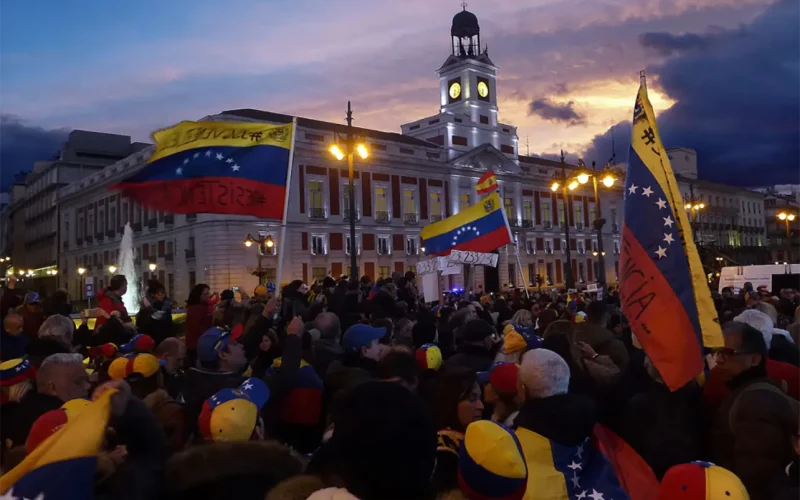
MORE than 10 days after the US military strikes on Venezuela and the kidnapping of President Nicolás Maduro and his wife in Caracas on 3 January, there is still no clarity about long-term US plans for Venezuela and its population.
As citizens cautiously resume their daily activities amid anxiety over the future and fear of more violence and state repression, aid groups are also struggling to figure out what the US control over the country will mean for their work and how it will impact humanitarian needs.
On 6 January, President Donald Trump’s administration announced an energy deal with Venezuelan interim authorities, saying the country will turn over between 30 and 50 million barrels of sanctioned oil that will be sold by the US. In a fact sheet, the Department of Energy stated the revenues would benefit both the American and the Venezuelan people, but that they would be disbursed “at the discretion of the US”. How much of it will go to Venezuela was not disclosed.
Meanwhile, it is Maduro’s inner circle – including interim President Delcy Rodríguez – who have stayed in power, and the US administration has given no timeline for any democratic transition. In an interview with The New York Times, Trump said US oversight over Venezuela would last “much longer” than a year, but shared no clear path forward.
To human rights organisations and many Venezuelans who had hoped for a significant change, the fact that the Chavista regime and its authoritarian rule have remained in place is not only a disappointment. They also fear it will drive up humanitarian needs in a country already battered by low wages, hyperinflation, and years of corruption and mismanagement.
“The continuity of the ruling elite suggests that there won’t be any changes in the social policy that has caused so much misery, so much poverty. The outlook points to continued very low wages, virtually zero pensions and enormous inefficiency in the management of public services,” Marino Alvarado, legal coordinator at Provea, a Venezuelan human rights organisation, told The New Humanitarian.
A Venezuelan humanitarian worker, who has left the country and spoke on condition of anonymity for fear of reprisals on her family, put it slightly differently. “We are likely to see a deterioration in the humanitarian situation, because it is not the priority of the government. If it didn’t show any interest in the well-being of its people before, it will even less now that it is under attack,” she said. “People who were already in a situation of vulnerability will become even more vulnerable”.
The following briefing explores what impact the US intervention is likely to have on the ongoing humanitarian crisis in Venezuela and on those trying to respond to it and help those affected.”
What is the situation now?
In Venezuela, nearly eight million people – out of a population of about 30 million – are currently in need of assistance. According to HumVenezuela, a platform monitoring the humanitarian situation, the poverty rate is at 78.6%, moderate food insecurity affects about 30% of the population, and 8.6% are severely food insecure. Access to basic services is limited, and the healthcare system has collapsed.
Compounding those issues, humanitarian organisations face dwindling funding, largely due to the end of US foreign aid. Last year, only 17% of the over $600 million required for Venezuela’s Humanitarian Response Plan was paid for.
Among the whole new set of challenges that the 3 January US assault brought to the country is the major risk of internal power disputes and the conflicts they could generate.
Political infighting has already been reported, and the presence of numerous armed militias, criminal networks, and foreign armed groups – including Colombia’s largest rebel group, the ELN – both within Venezuela and across its borders makes the situation particularly volatile. How all these actors will react to the new sense of instability ushered in by the US intervention remains to be seen.
“While direct military confrontation [with the US] is unlikely, fragmented armed resistance or guerrilla-style dynamics cannot be ruled out, especially if a post-Maduro government is perceived as US-aligned,” Tiziano Breda, senior analyst for Latin America at ACLED (Armed Conflict Location and Event Data), said in a press release a day after the US assault.
Carolina Jiménez, president of the Washington Office on Latin America (WOLA), a US-based human rights and research organisation, told The New Humanitarian that the fact that Maduro was removed but the “repressive institutional apparatus” behind him remains intact means that “the interests of the armed groups that have operated in collusion with the authorities won’t necessarily be affected”.
“Some of them, like the ELN, also operate on an ideological basis and see the US as their biggest enemy,” she said. “So we are in a stage of complete uncertainty and possible readjustments by the multiple groups operating in illicit economies, which have always had a profound humanitarian impact.”
Anxiety over the potential eruption of conflict is particularly high at the border with Colombia, where President Gustavo Petro immediately declared a state of emergency and deployed 30,000 troops and humanitarian assistance.
In the past year, turf wars between the ELN and splinter factions of the former FARC rebel group have led to the displacement of more than 87,000 people in the Colombian border region of Catatumbo. Since the US attacks, some of the guerrilla leaders who had found a safe haven in Venezuela have reportedly returned to Colombia, fearing they could be betrayed to the Americans by the post-Maduro government.
So far, no incidents have been reported, but aid groups focused on helping the thousands of vulnerable migrants and refugees who routinely traverse the border areas are closely monitoring the situation.
“It is hard to know with specificity what is going to happen, but that kind of volatility, the presence of those groups, and the challenges that poses not just for maintaining security, but also providing basic social services and humanitarian response on the Colombian side is a risk factor when it comes to any movement of people out of Venezuela,” said Ciarán Donnelly, head of international programmes at the International Rescue Committee (IRC).
Conflict within Venezuela between security forces and other armed actors may not be far away. An exclusive 11 January report by Colombian magazine “Semana” stated that the US is preparing attacks against camps set by the ELN in Venezuela, with the approval of President Rodríguez and Colombia. The next day, Petro warned on X that if the ELN didn’t embrace peace and leave Venezuela, he would start joint military actions with Venezuelan security forces against them.
Dalton Price, an anthropologist and researcher who specialises in Venezuelan migration in Colombia and is based in the Colombian city of Medellín, said these border tensions could take a toll on vulnerable Indigenous communities who have been forced to join the Venezuelan army for survival.
“In this border region, there are no economic opportunities, and they join to at least get a small income. So, poor Indigenous communities that end up in the Venezuelan army now may have to put their bodies on the line because of this,” he said.
Any reconfiguration of power could also have a major impact on the massive southern border states of Bolívar and Amazonas, where mining activities are significant and remote communities have been historically neglected.
In addition to the widespread lack of food and potable water, these populations often face cascading humanitarian needs, from lack of access to healthcare and work opportunities to sexual exploitation, gender-based violence, child exploitation, and other protection issues.
“These are large areas forgotten by the government, where it would be important to keep an eye on what is happening, because there are all kinds of companies – Canadian, American, Chinese, Russian – and criminal organisations,” the Venezuelan aid worker living abroad said. “The general population is defenceless, and NGOs will be unable to do anything, or very little, because they are very limited and monitored.”
What will happen with aid access?
If access for humanitarian groups has been a growing concern for more than a year, it is even more so today.
After being proclaimed the winner of the widely contested July 2024 presidential election, Maduro ramped up his crackdown on dissent and persecuted NGOs providing vital assistance in low-income neighbourhoods.
But only hours after the 3 January US assault, Rodríguez issued a decree that further intensifies repression and threatens to severely hinder aid access.
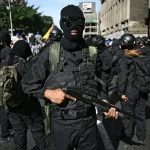
The decree restricts the free transit of people and vehicles, suspends the right to meetings and public gatherings, grants additional powers to security forces and armed civilians to defend the nation, and orders “the immediate search and detention” across the country of “any person involved in the promotion or support of the US armed attack”.
This has resulted in the establishment of checkpoints across the country where paramilitary groups known as colectivos are stopping citizens and checking their phones for evidence of support for the US intervention.
“The decree is horrible, very repressive,” said Jiménez from WOLA. “Journalists were arrested, and we can tell people are self-censoring. They won’t even tell you that they can’t find medicine or anything. If even people who are normally calm become apprehensive, it is a sign that things are not going well.”
Several of the aid workers in Venezuela that The New Humanitarian reached out to for this briefing refused to speak out of fear of reprisals, while others agreed to do so only on condition of anonymity.
The US assaults also had real-time implications. Immediately afterwards, OCHA, the UN’s emergency aid coordination body – as well as the UN humanitarian country team and local coordination forums – recommended that all aid groups operating in Venezuela suspend their field work. Some told The New Humanitarian they planned to progressively resume activities on Monday, 12.
“We have been monitoring the situation and trying to analyse when it would be a good time to resume field work,” said the member of one international humanitarian organisation who requested to speak anonymously, adding that they hoped to go back to “normality” in the next couple of weeks. “In the field, we are in constant communication with the local coordination forums, and we want to understand their reading of the situation and how we can continue to work.”
On 12 January, the Venezuelan government yielded to one of the key US demands and started releasing political prisoners, but only 56 out of about 800 were freed, and the fear of repression hasn’t dwindled.
According to Price, several organisations that were about to publish their 2025 reports on Venezuela refrained from doing so due to the volatility of the situation. “There is this fear of an intensified crackdown,” he said, adding that it is not limited to Caracas but is also palpable in small towns in other regions.
“What they are concerned about is not necessarily a US invasion. In many instances, they are more concerned about the government crackdown and all the checkpoints on the highways,” Price said.
The high level of repression doesn’t only put aid workers at risk. The communities they serve are also exposed to repercussions if they are seen with them.
The Venezuelan aid worker living abroad explained that when humanitarian aid becomes as politicised as it is in Venezuela, organisations “find it much more difficult to do their work”, both for the safety of their team and because of the duty of care they owe to the communities they work with.
“They have to be very cautious in the way they approach communities at such a delicate time,” she said, recalling how her organisation had to suspend community work for two months in 2019 due to the power struggle between Maduro and his main political opponent, US-backed Juan Guaidó.
Will US actions bring economic relief?
Trump has said on several occasions that the Venezuelan people will benefit from his plan for their country – while always making it clear that American interests go first. So far, however, the US have continued seizing oil tankers sailing to and from Venezuela, and no sanctions other than those allowing American exploitation of Venezuelan oil have been lifted.
US Treasury Secretary Scott Bessent told Reuters the US might lift more sanctions on Venezuela later this month to help the nation recover, and that “almost $5 billion worth of Venezuela’s currently frozen IMF Special Drawing Rights monetary assets could be deployed to help rebuild the country’s economy”. Bessent, who didn’t identify the sanctions he referred to, also said he would meet with representatives of the IMF and the World Bank to consider reengaging in Venezuela – a first in two decades.
“Sanctions make it extremely expensive to operate in the country because provisions are much more expensive, and there is also a great deal of scrutiny from banks when paying suppliers.”
According to Jiménez of WOLA, increased investment and an economic opening is a possible – although still currently hypothetical – scenario.
Delcy Rodríguez and her brother Jorge, who is now president of the National Assembly, “are good negotiators and close to the Venezuelan business apparatus”, Jiménez said. If they manage to obtain the lifting of some sanctions and Venezuela’s opening up to the international credit market, “there could be economic improvements that would make the humanitarian situation better”, she added.
Fewer sanctions would also make aid groups’ work easier, said the anonymous member of an international organisation.
“Sanctions make it extremely expensive to operate in the country because provisions are much more expensive and there is also a great deal of scrutiny from banks when paying suppliers,” she told The New Humanitarian. “In theory, humanitarian action is exempt from sanctions, but in practice this is not the case because banks do not take risks.”
Alvarado from Provea was more pessimistic, stating that there will be no economic improvement as long as the current regime stays in place. He underlined that the economic crisis in Venezuela may be aggravated by sanctions, but that the country’s “structural poverty issues” are the consequence of “public mismanagement and a lot of corruption”.
Even if Rodríguez strikes oil deals with the US, it’s not going to translate into better life conditions for Venezuelans any time soon, according to Alvarado.
“The oil industry is in a state of considerable decline, so even if it opens to markets it won’t be able to produce much due to the lack of investment to modernise it in the past few years,” he said. “Any attempt to reactivate the oil industry will take several years.”
Meanwhile, remittances – currently the main source of income for many Venezuelans – are decreasing due to the worsening conditions many migrants are facing in the region’s main host countries (Colombia, Peru, and Brazil) and the United States.
It is also unlikely, experts said, that big energy companies will agree to the scale of investment required to restore the Venezuelan oil industry’s infrastructure without greater assurances of political stability and more legal guarantees.
“Real money will likely not enter Venezuela while there is a complete lack of juridical stability, questions about the legal status of those signing contracts, and over $100 billion in outstanding legal claims by those whose Venezuelan assets were previously expropriated or stolen,” Evan Ellis, a professor with the US Army War College focused on Latin American security issues, wrote in this analysis.
Feliciano Reyna, founder of Acción Solidaria, a Venezuelan NGO providing medication and treatment to HIV-positive Venezuelans, called on the international community and multinational organisations operating in Venezuela to demand that money coming from the exploitation of Venezuelan resources be channelled – at least in part – into implementing a humanitarian response plan aimed at the most vulnerable.
“If these resources do not soon flow into areas of social interest for the country, it will have very serious consequences, and we will see a new wave of migration,” he said.
Will there be another exodus?
No changes in migration patterns from or to Venezuela have been registered so far, but this could change fast depending on how things unfold in the coming months or years.
Since 2014, nearly 7.9 million Venezuelans have felt compelled to leave in search of safety or better opportunities – many of them struggling to integrate in their host countries. If the US plan fails to take Venezuela’s needs into account, a new exodus could come, putting additional strain on countries in the region.
This would expose a whole new wave of migrants to a new and worsening set of challenges. With the rise of far-right leadership across the region, Venezuelans are being increasingly subjected to harsher migration policies and xenophobia.
In a new report, the Mixed Migration Centre identified three possible outcomes for “Venezuela after Maduro”: mass returns following stabilisation, political opening, and economic opportunity; partial returns driven by economic incentives despite limited political change; and a rapid and significant displacement caused by more violence and power struggles.
All entail specific challenges and risks, ranging from pressure on asylum systems and border management, strain on integration capacities, and increased control by criminal actors over migration routes in the case of a mass exodus, to documentation issues, persecution, and the risk of secondary displacement if there are large-scale returns.
To Donnelly from the IRC, this new era of instability in Venezuela also carries regional consequences that are still largely unforeseen but will likely be impossible to properly address without more funding.
“These things don’t happen in a vacuum, and what happens in one part of the region can have a real impact elsewhere,” he said. “Above all, when it involves population flows, you can then see a knock-on effect with other crises in the region being exacerbated,” he added. “It’s an alarming situation from every angle.”
Edited by Andrew Gully.
–––––
The New Humanitarian puts quality, independent journalism at the service of the millions of people affected by humanitarian crises around the world. Find out more at www.thenewhumanitarian.org.