By Mohamed Soulaimane al-Astal
“IN this war, my son, we’re all next. We are just built to keep on trying to skip our turn,” Naeema al-Ashour, 62, told me in August.
I first met al-Ashour in June when I interviewed her for an article for The New Humanitarian about how Palestinians in the Gaza Strip feel about the global debate over whether there is a famine in the enclave as we live with the day-to-day reality of not having enough to eat.
I saw her several times after that. The final time was our encounter in August, which took place as Israel heavily bombarded Khan Younis at the end of the month. I was there helping to evacuate my own parents from the city when I saw al-Ashour packing a few items from the tent she was staying in outside of the remnants of her destroyed home.
Her words stuck with me, perhaps because she was an older woman whose face and hands spoke of her life-long quest for survival. In Gaza, after all, our struggle to survive Israeli wars, aggressions, sieges, and occupation began long before 7 October last year.
Or perhaps they stuck with me because of what happened next: Hours after we spoke, al-Ashour was killed by an Israeli missile strike while still standing next to the remnants of her home. She was surrounded by her six children, five grandchildren, and other family members. Some of them survived; others did not.
In retrospect, her words to me were like a final testament before that quest – to try to skip her turn – ended, through no fault of her own.
Like nothing I’ve encountered
Al-Ashour is just one of the countless people I’ve interviewed since the war began one year ago – and she is also just one of several whose names are now counted among the more than 41,800 Palestinians killed by Israel in the past 12 months.
Seeing the killing of so many of the people I’ve spoken to while reporting – along with so many of my fellow journalists – has tested my understanding of myself and my profession.
I have been a journalist for 23 years, but this past year has changed everything about how I do my job. It has been like nothing I have ever encountered before.
The constant violence and deprivation have exposed both weaknesses and strengths I never knew I had. Now I am aware that they are there. The most basic human fears, needs, and hopes – the desire simply to stay alive – are what continue to propel us through every day of living in Gaza.
There are no frills or luxuries. There is no time to pause or to reflect. We don’t have the ability to make even basic choices about our lives – where to live, what to eat, when or if we can leave.
One full year of scrambling to survive a genocide, illnesses, and hunger.
It still amazes me that I find it in myself each morning to get up, do my job, and interact with others. That’s where al-Ashour’s words come in. I’ve learned that we are built to try to avoid being next.
No longer just sources
The members of al-Ashour’s family who survived the missile strike that ended her life are still staying in the same place where she was killed, in largely shredded nylon tents next to their demolished homes. They have no other place to go.
Interviews now often turn into intimate, vulnerable conversations with emotions being shared, tears shed, and fears disclosed. When they begin, I’m a journalist, but by the end, I am playing the role of a therapist or of someone who may be able to lend a helping hand to address an unmet need.
Her family of 15 lost six members on 24 August when the missile struck: al-Ashour, her husband Riyad, two of their sons – 38-year-old Hussam, whose body was torn apart, and 35-year-old Mohammed – as well as two of her husband’s brothers.
I know this because I have visited the surviving family members several times since August. That’s one way my job as a journalist has changed. The people I speak to are no longer just sources in the conventional sense of being someone I speak to once and then perhaps never cross paths with again.
Interviews now often turn into intimate, vulnerable conversations with emotions being shared, tears shed, and fears disclosed. When they begin, I’m a journalist, but by the end, I am playing the role of a therapist or of someone who may be able to lend a helping hand to address an unmet need. As a journalist, people believe that if I speak, others will listen.
In the end, I often end up as a member of the family, knowing vulnerable details of people’s lives.
Having gone to Nasser Hospital in Khan Younis multiple times to report on a series of stories for The New Humanitarian, my relationship with the staff working there has gone from formal handshakes to warm, tight embraces of gratitude when I see them once again due to simply knowing they are still alive.
I’ve seen them overworked, anxious, in complete despair, and shattered. They’ve seen me break down sobbing, crouched beside the corpse of a mother placed on the hospital floor while her crying five-year-old son lay on top of her, hugging her and pressing his warm lips against her cold, still face.
If my turn comes
This war has stripped us all of any ego and pretentiousness. We have no personal space or privacy. On many levels, we have been denied our individuality, and forced to rely on bare instincts of survival. We are all the same person: the one who is next in line, trying so hard to avoid our turn.
We have all been reduced to our most basic, vulnerable, human state. We have come to understand that, in the eyes of the world, we are not people with a say or a voice. We do not have blond hair or blue eyes. Our lives are not valued.
Every day I wonder what would happen to my family if my turn comes – my wife and five children, the eldest is not even 16 years old, and the youngest is a bit over two. What would happen to them?
They are the one, main reason why I am still functioning 365 days after this war wrecked everything in our surroundings. I am trying to keep them alive, but can I guarantee their safety or my own?
Ahmed Abu Nahia tried to do the same. He was killed while eagerly waiting for his young wife to deliver their first child. I met Ahmed in January when I interviewed him for another article for The New Humanitarian about the scarcity of food and the grimness of life in Gaza’s displacement camps.
Among the countless people I have spoken to, he stood out for his good-humoured sarcasm and his smile, before he became one of those who have been killed.
Ahmed was 24 years old and newlywed when the war broke out. His young married life was spent in crowded tents, cobbled-together huts, and displacement camps. So much for romance and young love, he’d joke.
Despite it all, he was cheerful and would poke fun at himself. He jokingly referred to himself as “the groom of war” as he told me about how he had worked in Sudan for three years as a farmer to save enough money to build his marital home. In the end, he only lived in it for three months before being forced to flee last November.
He joked, but the darkness was also there – in his eyes, in the hard edge that crept into his laughter, in the smirks that often replaced the smiles.
Like the rest, he described the dire living conditions he was forced to endure and his longing for peace and a normal, quiet life with his wife. But he never frowned. Perhaps his smile occasionally betrayed the darker emotions. But he never frowned.
When I met him, he did not know that he and his wife were expecting a child. On 22 July, when he was struck by the bomb that killed him, his wife was about to give birth. He had been helping displaced people move from Khan Younis to al-Mawasi – the supposed humanitarian zone designated by Israel – and he never came back.
And so go our lives, day by day, trapped in the embattled Gaza Strip that lies in ruins.
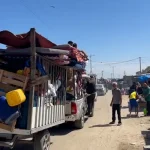
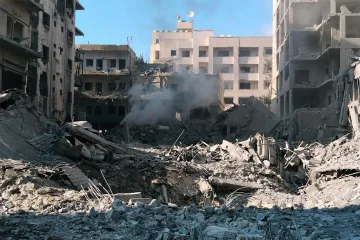
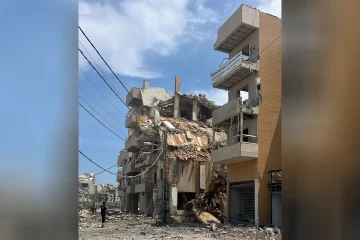
I leave my kids to bring them food, and water, or to report a story, not knowing whose turn it will be next. I ride donkey-pulled carts plodding over rubble and ruins because it’s the cheapest form of transportation and the only one available after the roads have been destroyed, fuel stations emptied, and cars rendered useless.
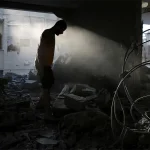
The ride is slow, and it gives me the chance to take in the carnage and the destruction that is left of Gaza. The ride is slow, and on it I wonder: Am I skipping my turn or heading right into it?
This piece is published in collaboration with Egab. Edited by Dahlia Kholaif and Eric Reidy.
–––––
The New Humanitarian puts quality, independent journalism at the service of the millions of people affected by humanitarian crises around the world. Find out more at www.thenewhumanitarian.org.