By Michelle Langrand
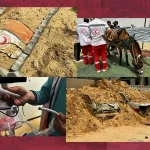
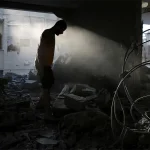
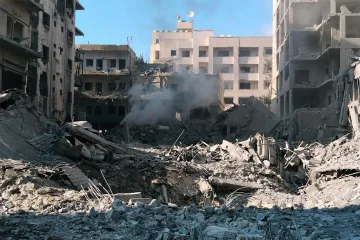
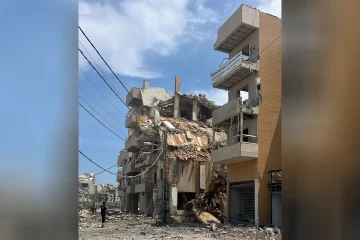
IN northern Gaza, Israel is conducting one of its deadliest offensives yet, entrapping some 100,000 people. There, some 30 staff and volunteers from the Palestine Red Crescent Society (PRCS) have been rushing their ambulances to every attack site across damaged roads, and providing emergency care to the wounded with minimal supplies.
“We are the only organisation that has not left the north, not even for a single day,” Marwan Jilani, PRCS vice-president, told Geneva Solutions.
The seasoned humanitarian is in Geneva for the International Conference of the Red Cross and Red Crescent, where fellow national societies and states have gathered to promote humanitarian action. Just as the meeting kicked off its deliberations on Tuesday, news spread of the Israeli parliament’s vote to ban the UN’s agency for Palestinian refugees, UNRWA, from operating in Israel. The decision could effectively sever the backbone of humanitarian relief for Palestinians.
Jilani, still grappling with the implications of the move, views it as another step in Tel Aviv’s efforts to pick apart humanitarian response in the occupied territories – one he fears could also target his organisation.
The Red Crescent society’s fragile origins
Headquartered in Ramallah, in the West Bank, the 17,000-strong PRCS provides ambulance and primary healthcare services in the Palestinian territories and Lebanon, with some 1,000 staff operating in Gaza.
It was at a conference like the one currently taking place in Geneva where the PRCS entered the Red Cross movement along with its Israeli counterpart, Magen David Adom, in 2006. The two faced political opposition: MDA from Arab states, and the PRCS, founded by Yasser Arafat’s brother Fathi Arafat in 1968, from Israel, which feared it would further consolidate international recognition of a Palestinian state.
A political agreement finally put the feud to rest, stating that the two branches were authorised to operate within their respective borders from 1967. But as a report presented earlier this week at the conference reveals, this is far from the reality on the ground. Israeli authorities continue restricting the Palestinian society’s access to East Jerusalem and other occupied areas in the West Bank, while settler community-run ambulances bearing MDA-like emblems have been seen in the Palestinian city of Hebron.
Jilani confirms that his organisation has also been “under attack”, but not as severely as UNRWA. He cites accusations, later debunked, of its ambulances being used to transport injured militants. The aid group has also sustained significant losses within its ranks. In the first weeks of the war, the PRCS medical centre in Jabalia refugee camp north of Gaza was destroyed, killing two of its members. Red Crescent ambulances have been hit. Some 21 staff and volunteers have been killed in the line of duty.
The Palestinian society’s relationship with the Israeli first-aid provider is also delicate. Since the start of the war, MDA has also lost six colleagues while on duty, and it is preparing its 30,000 members for a large-scale attack as Israel wages war on several fronts, including Iran, Lebanon, Syria, and Gaza. While MDA has stepped up its action to try to persuade the Israeli authorities to respect the Red Cross agreement, the report on its implementation speaks of a “total absence of trust”, partially attributed to poor communication between the national societies.
The recent naming of Gilad Erdan, Israel’s former ambassador to the UN in New York, as MDA’s global president by the American friends of MDA risks further straining the fragile arrangement. The former Likud parliamentarian and member of Netanyahu’s government made headlines in May when he shredded the UN charter at the General Assembly after a vote granted the Palestinians more rights within the world body. Erdan initially opposed Israel’s withdrawal from Gaza in 2005, and recently said in an interview, “wherever we have Jewish settlements, we have security.” He has also joined a conservative think tank, the Misgav Institute for National Security and Zionist Strategy, which has ties to Netanyahu.
MDA spokesperson Uri Shacham praised Erdan’s “vast experience” and said he would be able to leverage MDA’s needs on the international stage. He declined to comment on his political views. For Jilani, the appointment is “a stain on the Red Cross and Red Crescent movement”.
What would happen without UNRWA?
The decision to outlaw UNRWA has sparked an outcry within the humanitarian community. ICRC spokesperson Christian Cardon described the agency as “an indispensable and irreplaceable organisation in its activities and humanitarian response”.
“To remove this pillar of support and assistance will have severe consequences on top of an already catastrophic humanitarian situation,” he told Geneva Solutions.
The agency is responsible for providing food, shelter, and education for millions of Palestinians, which the Israelis have argued other organisations can do in its place. The PRCS and UNRWA work together to receive aid through the Rafah crossing and distribute it across Gaza. “We can expand certain services, but no one has the capacity and infrastructure of UNRWA. Not the PRCS or any UN agency,” said Jilani, adding that his organisation runs five hospitals across Lebanon funded through the UN agency. These don’t fall under Israel’s ban.
Beyond the humanitarian repercussions, Jilani worries about Israel’s long-term plan to replace the international humanitarian system with private contractors, as the United States did in Iraq. Media reports mentioned the American-Israeli security firm Global Delivery Company among those bidding to provide aid in the enclave.
“This will be mostly ex-army officials and ex-soldiers who have no respect for humanitarian principles, who would go there as a commercial activity, and who would be aligned with the objectives of the Israeli army in Gaza,” Jilani said. “If this is successful, and if the international community accepts it, this could also replace UNRWA in the West Bank.”
A version of this article was first published by Geneva Solutions. It was re-published here with permission.
–––––
The New Humanitarian puts quality, independent journalism at the service of the millions of people affected by humanitarian crises around the world. Find out more at www.thenewhumanitarian.org.