“All through the war, I kept thinking about when we would return home. I missed it so much,” 10-year-old Qusay says. “And I kept thinking about my bicycle.”
Qusay and his family were displaced twice – first to the city of Rafah, where they sheltered in a tent, before relocating to Khan Younis in the southern Gaza Strip. Long queues for water were a daily reality. So was a constant fear of shelling.
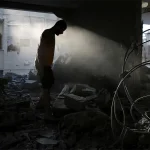
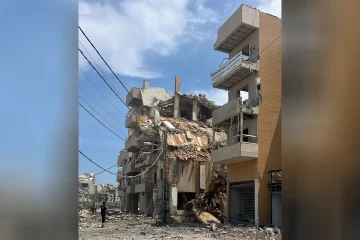
When a ceasefire was announced in January 2025, the family headed straight back to their home in northern Gaza. But there was almost nothing left when they arrived.
“Our home was completely burned. Even my bicycle was lying in the street in the rubble,” Qusay says. “I’m heartbroken because I found nothing – none of my books or toys or clothes or bed.”
The cost of the war for families like Qusay’s has been almost unfathomable. And it continues to mount.

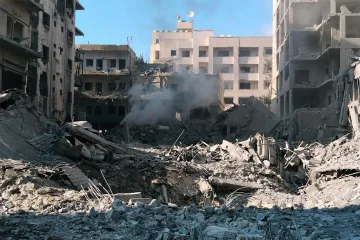
Homes have been levelled.
Vital infrastructure has been decimated.
And displaced children and families trying to return to their devastated communities are now struggling to survive amid a severe lack of food, potable water, and shelter.
And with the January ceasefire broken, families once again face relentless bombardments and ongoing evacuation orders.
“My only hope was that our house would remain safe,” says 11-year-old Jana, who was displaced from northern Gaza to the city of Deir al-Balah in the central Gaza Strip. “Unfortunately, it wasn’t. Our house was completely destroyed.”
“Life here is tough. There’s no water [on tap] so my father has to buy it.”
Jana says she has been searching through the rubble of their former home for something salvageable – clothes, books or even a toy.

But it’s hard to find much of anything amidst such widespread destruction.
Still home
Jehan is determined to remain a source of strength for her family, but admits that it’s a daunting challenge.
Her family also lost their home.

She shares a picture of the apartment building they lived in before it was destroyed.
Now, they’ve taken shelter in a tent.
“It’s cold and there’s no running water. The conditions for life here are very bad,” she says. “But we prefer it because at least it’s our home.”
“I was devastated when I found out the house was destroyed. There were so many happy memories there. But I cried in secret because I had to stay strong for the children,” Jehan says. “Inside, I’m breaking, but outside, I am strong for them. They’ve had a very difficult time.”
Just the previous night, Jehan says, her daughter was left in tears as a storm lashed their tent. “She was so scared of the noises and feeling so vulnerable. It almost felt like we were going to get blown away,” Jehan says. “So, my husband went outside and held down the wooden posts [keeping the tent in place] with his arms for a long time, until we fell asleep.”
Future fears, now
Farah is grateful that her home in Gaza City, in northern Gaza, is still habitable, but she worries about the impact that the conflict has had on her children.

“I hope they’ll get back to school and receive a good education,” she says, as she hugs one of her daughters, who is sitting on her lap. “But they need support.”
“The little children still cry at night. The war, the noise of the bombs – it left them with fear.”
Farah’s concerns speak to the long-term impact on children’s mental health as they come to terms with the violence, devastation and upheaval that have shaped their lives for more than 15 months. During the conflict, families have endured staggering violence, severe injuries and the loss of loved ones. Many remain cut off from essential services like clean water, health care and education. Through it all, children often lack access to mental health and psychosocial support, with potentially devastating long-term effects.
For around a million children in the Gaza Strip, there is no ‘post’ to the traumatic stress they are enduring – it is a chronic stress of deprivation, uncertainty, and loss. Anxiety, depression and other stress-related problems threaten their ability to grow up healthy and happy. This level of chronic stress is not just harmful – it can be life-threatening. Chronic stress can lead to lasting neurological and physical changes, making children more vulnerable to lasting psychological and physical harm. UNICEF teams see children becoming withdrawn, irritable, and struggling with clinical levels of depression and anxiety.
“I’m exhausted. I have no home”
Five-year-old Mira, whom a UNICEF team met recently, has stopped speaking, her grandmother Tulay says. Tulay describes the day her son, Mira’s father, was killed.
“I smelled gas. I started shouting ‘Gas! Gas!’” Tulay recalls. “But my children said it’s not the smell of gas. Suddenly, the house exploded in front of us. And the house collapsed.”
“The first day I buried my son, the father of this little girl. I’m exhausted. I have no home.”
UNICEF is working with partners to provide children and caregivers with community-based mental health and psychosocial support and has been training psychologists and counsellors to treat severe traumatic stress symptoms in children.
UNICEF is also expanding mental health services across the Gaza Strip to try to meet the massive needs – through schools, mobile health clinics, major centres, and community spaces, while also supporting families hosting unaccompanied and separated children.
Hala, 19, already has her eye on a future beyond the loss and heartbreak around her, suggesting that her dreams of becoming a doctor might have been delayed, but are far from being abandoned.
“I love my speciality – it’s my dream,” she tells us after attending a mental health session in Gaza City. “I want to help. I want to be an active member in society.”
“This war has taken everything from us.”
“I couldn’t complete my education. I was supposed to be in my second year at university. But because of the war, I lost a year,” she explains. “And I don’t want to lose another one…I don’t want to lose my education and my future.”
“We want to make the impossible possible – to progress and succeed.”