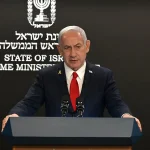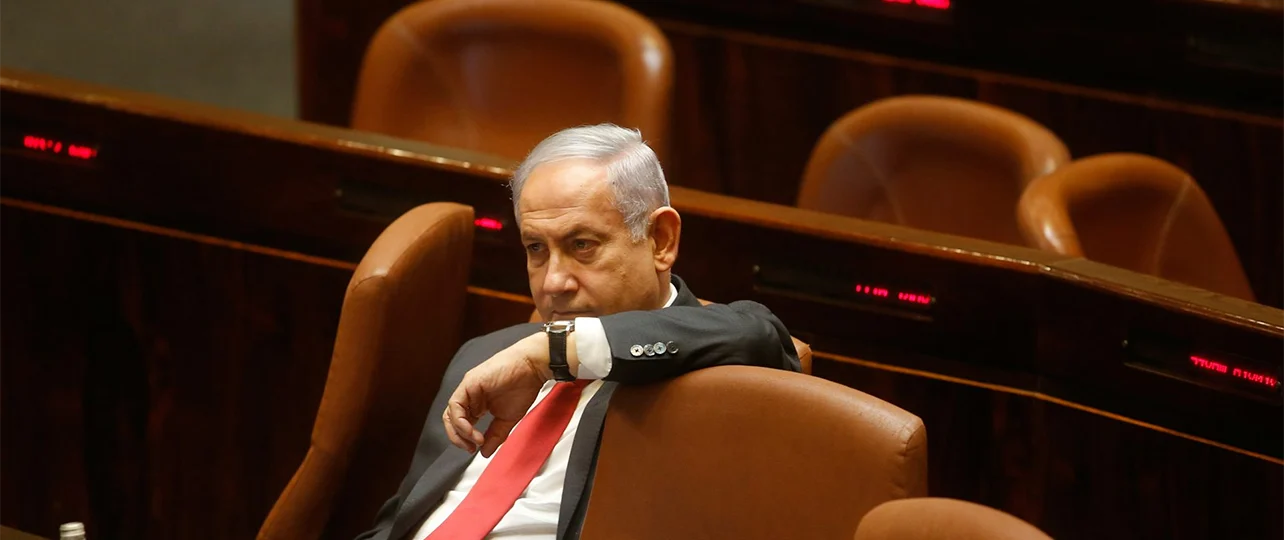

ONE of Israel’s ultra-Orthodox Jewish parties, Shas, has announced it will resign from Prime Minister Benjamin Netanyahu’s government. The party said its decision was made due to the government’s failure to pass a bill exempting ultra-Orthodox students from military service.
Its exit increases the political pressure on Netanyahu. Days earlier, six members of another ultra-Orthodox coalition partner, the United Torah Judaism party, also quit the government, citing the same concerns. The moves leave Netanyahu with a minority in parliament, which will make it difficult for his government to function.
Opposition leader Yair Lapid says the government now “has no authority” and has called for a new round of elections. But even before these developments, Netanyahu was reportedly considering calling an early election in a bid to remain in power despite his unpopularity.
To win another term, he would, in my view, have to spin a narrative of victory on three fronts: securing the release of the hostages, defeating Hamas and delivering regional security. It is a tall order.
In his visit to Washington in early July, Netanyahu emphasised his pursuit of a ceasefire in Gaza that facilitates the return of the remaining hostages held by Hamas.
Israelis have grown increasingly weary of the war, with recent surveys showing popular support for ending it if it brings back those still held captive. A ceasefire that sees hostages released would probably help Netanyahu generate support during an election campaign.
But Netanyahu has insisted that, while he wants to reach a hostage-ceasefire deal, he will not agree to one “at any price”. This indicates not only Israel’s refusal to compromise on security but also that any deal Netanyahu does make – whether or not it sees the release of all the hostages – will be presented as a victory to Israeli voters.
To provide the electorate with further hope of an end to the fighting, Netanyahu will also have to claim that the military campaign in Gaza is nearing its goals. Senior military officials stated recently that they have “almost fully achieved” their objectives – namely, defeating Hamas.
Netanyahu has, so far, prolonged the war to remain in power. But he will now need to spin the military campaign as a victory if he wants to win votes. This will be especially hard as critics like Yitzhak Brik, a retired Israeli general, claim that the number of Hamas fighters is now back to its pre-war level.
The hard-right members of Netanyahu’s government add another dimension to this equation. His two ultranationalist coalition partners, Jewish Power and Religious Zionism, oppose ending the war entirely. They insist on fighting Hamas to the finish.
Netanyahu will most likely want to keep his options open during an election campaign to form a coalition with whatever he can pull together at the time. He may calculate that a short-term pause in fighting to free hostages can be spun as a victory to win votes, after which military operations could resume to appease hardliners if he needs them.
A final part of Netanyahu’s electoral strategy will be to push the message that he has delivered regional security. He has declared the war with Iran in June a success, saying “we sent Iran’s nuclear program down the drain”.
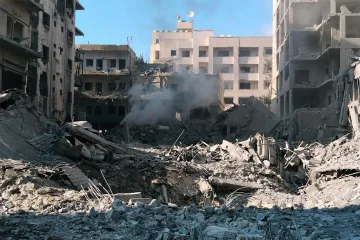
And Israel has also continued its campaign of strikes to assert its military dominance in the region, the latest in Syria and Lebanon.
Slim peace prospects
Observers warn that Netanyahu’s approach is about political survival and will come at the expense of long-term peace prospects for Israelis and Palestinians. According to The New York Times, he seems to be “kicking the Palestinian issue once again down the road”.
Indeed, part of Netanyahu’s mooted strategy for claiming victory in Gaza involves supporting a constrained political outcome for the Palestinians that ends the fighting without Israel conceding on core issues.
In this scenario, the Gaza Strip would be carved up and demilitarised under prolonged Israeli security oversight. Some areas would be annexed by Israel. Remaining parts of Gaza, along with fragments of the West Bank, would be handed over to an interim authority to create the appearance of a nascent Palestinian state.
The goal would be to declare that Israel has facilitated Palestinian statehood – but strictly on Israel’s terms – while eliminating Hamas’s rule in Gaza. The reality would probably be a designed chaos to force as many Palestinians as possible to leave.
Such a state, lacking full sovereignty and territorial continuity, would fall far short of the independent state that Palestinians seek. Crucially, this imposed outcome would also bypass substantive negotiation of issues like borders, refugees and Jerusalem, which both Israel and Palestine claim as their capital.
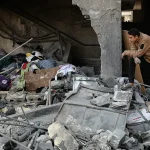
Palestinian leaders would almost certainly reject a curtailed state. And if they did not, then ordinary Palestinians – reeling from the war’s devastation – are unlikely to view it as a just peace. A new cycle of violence would probably begin, and the Palestinian population would have been heavily concentrated into restricted spaces that would be wide open to Israeli bombardment.
As Netanyahu weighs pulling the election trigger, he is effectively writing the next chapter of the Israel-Palestine conflict. The outcome of this manoeuvring is highly uncertain.
If his three-pronged victory narrative convinces Israeli voters, he could return to power with a fresh mandate and perhaps a retooled coalition. He might seek a broader unity government after an election, sidelining his most hardline partners in favour of centrist voices to navigate post-war diplomacy.
But if the public deems his victories hollow or indeed false, an election could sweep him out of office. This would open the door for opposition leaders who may take a different approach to Gaza and the Palestinians.
Brian Brivati, Visiting Professor of Contemporary History and Human Rights, Kingston University
- This article is republished from The Conversation under a Creative Commons license. Read the original article.