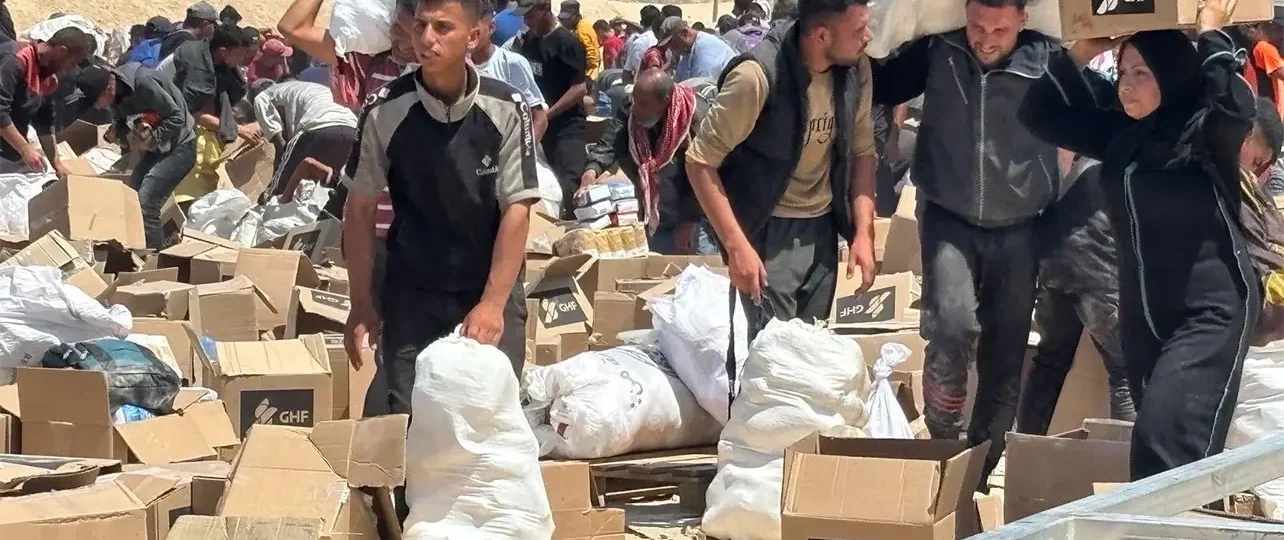

UNRWA has raised “significant concerns” requiring “urgent clarification” about a meeting other UN agencies and large aid organisations held last week with the Gaza Humanitarian Foundation (GHF), according to a leaked letter obtained by The New Humanitarian.
Philippe Lazzarini, who leads the UN’s agency for Palestine refugees (UNRWA), warns in his letter to the UN’s top humanitarian, Tom Fletcher, that refraining from criticising the GHF in the wake of the 6 August meeting risks being seen as UN complicity in Israeli war crimes.
By Tammam Aloudat, Will Worley and Eric Reidy
The letter – dated 12 August – from the head of UNRWA, historically the largest and most important UN agency in the Gaza Strip, comes amid wider alarm over the fracturing of the humanitarian community’s united front against the GHF’s militarised aid operations and food distribution centres, which have been the sites of daily massacres.
Last week, The New Humanitarian published a leaked email readout of the 6 August meeting between officials from four UN agencies – OCHA, WFP, IOM, and UNICEF – the International Committee of the Red Cross, the INGO InterAction, and Johnnie Moore, executive chairman of the GHF, which is US- and Israeli-backed.
The readout said participants at the US-brokered meeting in New York agreed to “fuller collaboration” between international aid groups and the GHF and to “lower the public rhetoric and to focus on moving forward rather than what has happened or said previously”.
In response, Lazzarini wrote: “The United Nations… [has] a clear obligation to advocate for and protect Palestinians subject to human rights and IHL [international humanitarian law] violations, including when these are associated with the GHF.
“Silence in the face of incidents that may amount to war crimes – which have continued since last week’s meeting – may be perceived as complicity. This may prompt conclusions that humanitarian principles have been subordinated to political or military objectives, which would have consequences for humanitarian action beyond Gaza. The same applies to any proposed cooperation with the GHF,” he added.
In May, the UN’s emergency aid coordination body, OCHA – which Fletcher leads as Emergency Relief Coordinator – denounced the GHF’s food distribution plans as a dangerous and “deliberate attempt to weaponise aid” to serve Israel’s “military strategy” in Gaza.
Between the end of May, when the GHF began operating, and the beginning of August, nearly 1,400 Palestinians were killed and thousands more injured by the Israeli military in the vicinity of the GHF’s four distribution centres and by US security contractors who staff the sites. Dozens of people continue to be killed and wounded on a daily basis.
Médecins Sans Frontières has called the GHF’s distribution centres sites of “orchestrated killing and dehumanisation”, and Amnesty International has described the organisation as “another tool in Israel’s campaign of genocide”. UN experts and more than 200 NGOs have called for the GHF to be dismantled.
Lazzarini’s letter to Fletcher warned that OCHA needed to clarify the proposed follow-up to the meeting between the UN agencies and the GHF to prevent the “fracturing of the humanitarian community in Gaza and further endangering humanitarian operations and personnel”.
As evidence that this fracture is already taking place, the GHF announced on 11 August that the US-based, evangelical Christian NGO Samaritan’s Purse is partnering with them to provide medical care. Both the scale of those services and where they are being administered are unclear. Last week, US Ambassador to Israel Mike Huckabee told media outlets there was a plan to increase the number of GHF food distribution sites from four to 16, and to run them 24 hours a day.
Lazzarini’s warning also comes as the Israeli military prepares to fully occupy Gaza City, which humanitarians say will exacerbate the already desperate living conditions for Palestinians in Gaza, where the vast majority of the population is displaced and facing Israeli-orchestrated famine. The AP reported this week that the Israeli government is exploring resettling Palestinians from Gaza to South Sudan – which would amount to another war crime.
Lazzarini’s letter also highlighted the drastic change in position made by humanitarian officials on the GHF, which Fletcher previously called a “cynical sideshow, a deliberate distraction, a fig leaf for further violence and displacement”.
Such high-level advocacy was powerful and consistent, wrote Lazzarini. It “guided humanitarian action in Gaza and created a strong sense of unity amongst local and international humanitarian entities”, he said, adding that this was “critical as conditions on the ground have continued to deteriorate and the space for principled humanitarian action has continued to shrink”.
Throughout its 22-month military campaign in Gaza, Israel has worked to sideline UN-led humanitarian efforts and build a parallel system under its control. Israel has also been waging a campaign to dismantle UNRWA – ultimately banning the agency within Israeli territory – claiming it has been infiltrated by Hamas.
In response to Israeli allegations against specific employees, UNRWA preemptively fired 12 people in January 2024. A subsequent UN investigation into allegations against a total of 19 employees – out of around 13,000 in Gaza – concluded that it could not “independently authenticate information used by Israel to support the allegations”.* Israel has provided no verifiable evidence of wider collusion.
* A previous version of this sentence incorrectly stated that UNRWA fired employees following the results of the UN investigation.
Tammam Aloudat reported from Geneva, Switzerland. William Worley reported from Oslo, Norway. Eric Reidy reported from BOSTON, United States. Edited by Andrew Gully.
–––––
The New Humanitarian puts quality, independent journalism at the service of the millions of people affected by humanitarian crises around the world. Find out more at www.thenewhumanitarian.org.