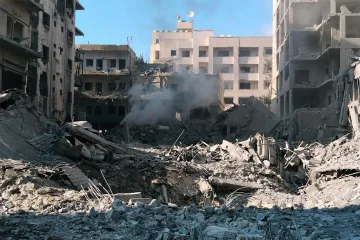
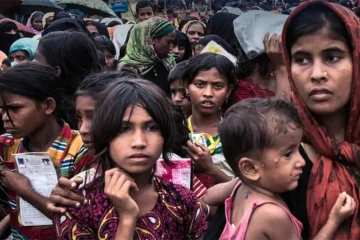
FAMINE has been confirmed in parts of Gaza for the first time since the beginning of Israel’s 22-month war on the Palestinian territory, with the world’s foremost hunger authority warning that “avoidable deaths will increase exponentially” if “a ceasefire is not implemented to allow humanitarian aid to reach everyone in the Gaza Strip, and if essential food supplies, and basic health, nutrition, and WASH (water, sanitation and hygiene) services are not restored immediately”.
This is the first time the UN-backed Integrated Food Security Classification System (IPC)’s Famine Review Committee has determined that the strict requirements for famine have been met in Gaza, but the committee and others have issued multiple warnings about widespread hunger and the possibility of famine because of Israel’s siege, blockage of aid, destruction of infrastructure, and forced displacement of Palestinians.
The IPC’s most recent data says over half a million people in Gaza “are facing catastrophic conditions characterised by starvation, destitution and death”. Famine declarations are based on several factors, using a calculation of households without enough food, children suffering from acute malnutrition, and the death rate from starvation or the interaction of malnutrition and disease.
“Never before has the Committee had to return so many times to the same crisis, a stark reflection of how suffering has not only persisted but intensified and spread until famine has begun to emerge,” the committee said.
The 22 August announcement says famine is already occurring in the Gaza governorate – home to Gaza City – and is likely to come to Deir al-Balah and Khan Younis in the coming weeks. It did not issue a classification for north Gaza – where Israel has forcibly displaced most of the civilian population – because of limited evidence on the population, but said the severity of conditions there is “similar or worse” than in Gaza governorate.
“Never before has the Committee had to return so many times to the same crisis, a stark reflection of how suffering has not only persisted but intensified and spread until famine has begun to emerge.”
“As this famine is entirely man-made, it can be halted and reversed,” the committee added. “The time for debate and hesitation has passed, starvation is present and is rapidly spreading. There should be no doubt in anyone’s mind that an immediate, at-scale response is needed. Any further delay – even by days – will result in a totally unacceptable escalation of famine-related mortality.”
In some ways, the declaration of famine is a technicality, given that Israel’s campaign in Gaza has clearly long caused mass hunger and malnutrition-related deaths. Data collection and strict technical requirements mean famine declarations tend to come too late, after people are already dying of starvation. In Gaza, Israel’s destruction of infrastructure, siege, and obstruction of aid mean that almost the entire population of Gaza is facing some level of hunger.
More than 60,000 people, the majority of them women and children, have been killed since Israel began its military operations in Gaza in October 2023, not including victims of starvation or people whose bodies have not been recovered from rubble.
Human rights organisations and legal experts have widely described Israel’s actions as genocide.
Edited by Philip Kleinfeld.