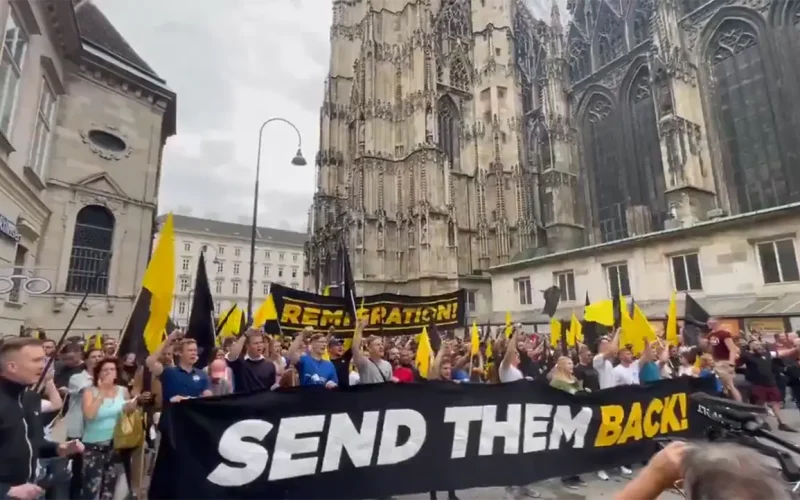
A wave of anti-immigration sentiment is crashing across Western democracies with unprecedented force, manifesting in violent protests that have overwhelmed police forces and sparked a parallel crackdown by immigration authorities. From the burning streets of The Hague to the detention centres filling across America, the politics of migration have reached a boiling point that threatens to reshape the social fabric of multiple nations.
The Netherlands: When Police Lines Break
The most dramatic scenes have unfolded in the Netherlands, where anti-immigration protesters have pushed law enforcement to its limits. On Saturday, September 20, 2025, what began as a demonstration at The Hague’s Malieveld quickly spiralled into chaos that authorities struggled to contain.
Police deployed water cannons and tear gas as demonstrators threw bottles and stones at officers and set a police car ablaze. The violence was so intense that 37 people were arrested and four police officers were injured, with the unrest spreading beyond the planned protest zone as one group broke away and headed toward the Binnenhof parliamentary complex.
The scenes in The Hague represent more than isolated incidents of civil disorder. They reflect a broader Dutch society grappling with housing shortages, economic pressures, and cultural anxieties that protesters directly attribute to immigration policies. Several thousand people initially participated in the rally against immigration and in favour of stricter asylum regulations and more affordable housing.
The timing is particularly significant, occurring just weeks before the Netherlands’ general election, suggesting that anti-immigration sentiment has become a defining political issue capable of mobilising thousands and overwhelming traditional law enforcement responses.
England: The Tommy Robinson Phenomenon
The Netherlands crisis follows massive demonstrations in England that have fundamentally altered the country’s political landscape. On September 13, 2025, controversial activist Tommy Robinson organised what became one of the largest far-right gatherings in recent British history.
More than 110,000 people took to London’s streets in anti-immigration protests that turned violent, with police officers “attacked with projectiles” and “assaulted”. The sheer scale of the demonstration caught authorities off guard, as protesters broke through police barriers and attempted to confront counter-demonstrators.
The London protests represented a mainstreaming of previously fringe ideologies, with far-right groups like Britain First, the Homeland Party, and Reform UK playing active organisational roles. Social media platforms, particularly Facebook and Telegram, proved instrumental in mobilising participants and spreading the messaging that drew such massive crowds.
What made the English protests particularly significant was their geographic spread beyond London, with smaller but still substantial demonstrations occurring across the UK, including over 300 people gathering in Bournemouth under the “stop the boats” banner, highlighting regional frustration with asylum seekers arriving by sea.
The Broader European Context
These dramatic incidents in the Netherlands and England are part of a continental pattern of rising anti-immigration sentiment that has moved from the political margins to the mainstream. Across Europe, similar movements are gaining momentum, driven by overlapping concerns about housing shortages, economic competition, and cultural change.
The protests share common themes: demands for stricter immigration controls, calls to “reclaim” national identity, and frustration with political establishments perceived as disconnected from citizen concerns. Protesters consistently frame their activism as defending national sovereignty and protecting public resources from being overwhelmed by immigration pressures.
What distinguishes the current wave from previous anti-immigration movements is both its scale and its tactical sophistication. Modern far-right groups have mastered social media organising, enabling them to mobilise unprecedented numbers while spreading narratives that resonate with broader public anxieties about economic security and social cohesion.
America’s Enforcement Response
While Europe witnesses street-level upheaval, the United States has responded to similar immigration pressures through the dramatic expansion of enforcement capabilities. Congress approved unprecedented funding representing a 265 percent annual budget increase to ICE’s detention budget, creating capacity for daily detention of at least 116,000 non-citizens.
Since January 23, 2025, ICE began carrying out raids on sanctuary cities, with hundreds of immigrants detained and deported, after the Trump administration reversed previous policies and gave ICE permission to raid schools and hospitals. The enforcement surge represents a systematic approach to immigration control that contrasts sharply with the grassroots protest movements dominating European headlines.
Since President Trump took office on January 20, ICE has deported 145,419 illegal immigrants from its detention centres, with deportations peaking in June at 27,970. These numbers represent a significant escalation in enforcement activity, suggesting that American authorities have chosen institutional rather than street-level responses to immigration pressures.
The Politics of “Taking Back Control”
Across both continents, the movements share a common narrative framework: the idea that immigration has reached crisis levels requiring dramatic action to restore national control. European protesters and American enforcement advocates both invoke themes of sovereignty, security, and social cohesion under threat.
European demonstrations emphasise popular mobilisation and direct confrontation with authorities, reflecting political systems where immigration policy remains contested and where protest movements can influence electoral outcomes. The timing of Dutch protests before elections and the scale of British demonstrations suggest these movements see themselves as representing the majority sentiment that established parties have ignored.
American enforcement expansion, by contrast, operates through existing institutional channels, reflecting a political system where immigration hardliners have captured federal agencies and can implement their agenda through administrative action rather than street protests.
Authority Responses and Democratic Strain
The contrasting responses reveal different approaches to managing immigration-related tensions within democratic frameworks. European authorities have generally sought to contain protests while addressing underlying concerns through policy discussions, though their capacity to manage large-scale demonstrations has proven limited.
Dutch and British police forces found themselves overwhelmed by the scale and intensity of recent protests, suggesting that traditional crowd control methods may be inadequate for addressing movements that can mobilise tens of thousands of committed participants. The violence directed at law enforcement officers indicates a level of confrontation that goes beyond typical protest activity.
American authorities have avoided similar street-level confrontations by channelling anti-immigration sentiment into institutional enforcement expansion. The $29.9 billion allocated toward ICE’s enforcement and deportation operations represents a systematic approach that aims to address immigration concerns through administrative action rather than relying on public demonstrations.
Long-term Implications
The simultaneous eruption of anti-immigration activism across multiple Western democracies suggests deeper structural pressures that transcend national boundaries. Economic insecurity, housing shortages, and cultural anxieties appear to be creating similar political dynamics across different societies, even as they manifest through different institutional channels.
The scale and intensity of recent protests indicate that immigration has become a defining political issue capable of mobilising unprecedented numbers of people and challenging established authority structures. Whether European governments can address underlying concerns while maintaining social order remains an open question, particularly as enforcement approaches that work in the American context may not be applicable to European political systems.
The effectiveness of street-level mobilisation in Europe and institutional enforcement in America suggests that immigration politics will continue to reshape democratic governance on both sides of the Atlantic. The question is whether democratic institutions can adapt to these pressures while maintaining their fundamental character and commitment to human rights.
As these movements continue to evolve, they represent perhaps the greatest test of Western democratic resilience since the Cold War, challenging assumptions about immigration, national identity, and the proper relationship between citizen demands and government policy in pluralistic societies.