ISRAELI authorities have sharply stepped up home demolitions and forced evictions of Palestinian residents in the Silwan neighborhood of occupied East Jerusalem, human rights groups say, in what critics describe as an orchestrated campaign to change the city’s demographics that may amount to international crimes.
According to Human Rights Watch, the demolitions and eviction enforcement in Silwan — a cluster of neighborhoods immediately south of Jerusalem’s Old City — have accelerated since October 2023 and surged again during recent hostilities in Gaza and Israel’s 2026 confrontation with Iran. United Nations data shows 587 Palestinians have been displaced by demolitions since October 7, 2023; roughly one quarter of those displacements occurred during the March–April 2026 fighting, the UN Office for the Coordination of Humanitarian Affairs (OCHA) reported. Ir Amim, an Israeli watchdog, says more than 2,000 Silwan residents now face imminent risk of forced displacement — one of the largest such waves in East Jerusalem since 1967 if it continues.
“Israeli authorities are intensifying their longstanding illegal policy of emptying areas surrounding Jerusalem’s Old City of Palestinians and replacing them with Israeli settlers,” said Sarah Sanbar, acting Israel and Palestine researcher at Human Rights Watch. “Israeli efforts to change the demography of Jerusalem are war crimes, enabled by the impunity granted by Israel’s close allies,” she added.
The displacement has concentrated in two areas: Batn al‑Hawa and al‑Bustan. In Batn al‑Hawa, eviction lawsuits filed by settler group Ateret Cohanim, invoking laws that allow Jewish individuals to reclaim properties lost in 1948 while denying Palestinians reciprocal claims, have produced a sharp rise in court-ordered removals. Peace Now, an Israeli monitoring group, says Ateret Cohanim’s legal actions have led to 30 family evictions involving 139 people since October 2023; in the eight years before then, only 36 people were evicted.
Residents and lawyers interviewed by Human Rights Watch said the speed of rulings has dramatically increased since October 7, 2023. “It used to take three to five years to go through all the courts and appeals. After October 7, the whole process only takes 45 days,” said Zuheir al‑Rajabi, director of Batn al‑Hawa’s community center. A local lawyer told researchers some decisions now come in “one working day.”
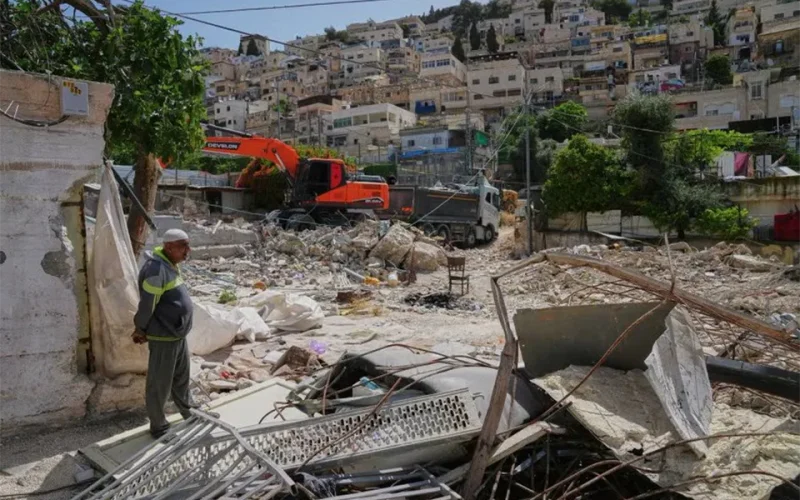
In al‑Bustan, municipal demolition orders tied to a plan to create an archaeological park have put roughly 115 homes — about 1,500 residents — under threat. OCHA and local monitors report that since October 2023, more than 50 homes in al‑Bustan have been demolished, with 15 of those destroyed in March–April 2026 alone, forcibly displacing 145 people, including 52 children.
Families facing demolition describe sudden, punitive enforcement. Harbi and Nidal al‑Rajabi received a final eviction order on March 20, 2026, as regional missile exchanges unfolded. Nidal said police blocked the family from retrieving valuables when they tried to remove possessions and later enforced the eviction. The family relocated to a property they own in neighboring al‑Bustan, where they again face demolition orders.
Israeli authorities justify demolitions by citing a lack of building permits. Palestinian residents and rights groups say obtaining such permits in East Jerusalem is effectively impossible. “They will not give you a permit to build,” Harbi al‑Rajabi told Human Rights Watch. Municipal orders also give homeowners the option of paying the city to demolish their homes, or carrying out the demolition themselves — a choice critics call coercive.
International law experts and global bodies have criticized the practice. The International Court of Justice’s 2024 advisory opinion concluded that Israel’s forcible evictions and house demolitions in East Jerusalem violate the prohibition on forcible transfer under Article 49 of the Fourth Geneva Convention and found discriminatory permit practices contribute to unlawful transfers. Under the Rome Statute, forcible deportation or transfer of an occupied population is a war crime. Human Rights Watch notes forced displacement in Gaza and the West Bank has previously been documented as amounting to war crimes and crimes against humanity.
The European Union has publicly urged Israel to halt evictions and demolitions in Batn al‑Hawa and al‑Bustan, but Human Rights Watch said condemnations have not been followed by measures to stop the displacements. The rights group called on other states to impose targeted sanctions on individuals and organizations responsible, ban trade with settlements and suspend preferential trade agreements with Israel to pressure a halt to the demolitions.
“For decades, families in Silwan have lived next to one another; now they are being split apart by legal and administrative tools deployed to remove them,” Sanbar said. “Other countries should do everything in their power to stop it.”
Human Rights Watch researchers visited Silwan in April 2026, interviewed affected residents and lawyers, and reviewed legal documents and demolition orders. The organization said it had attempted to reach Ateret Cohanim for comment but received no response. The Jerusalem municipality and Israeli government did not immediately respond to requests for comment on the recent surge in demolitions and evictions.
Key facts
- 587 Palestinians displaced by demolitions since October 7, 2023; roughly 25% displaced during March–April 2026, according to OCHA.
- More than 2,000 people in Silwan face imminent risk of forced displacement, according to Ir Amim.
- Ateret Cohanim litigation has led to 30 families (139 people) evicted since October 2023; 36 people were evicted in the previous eight years, Peace Now reports.
- Al‑Bustan’s 115 homes (about 1,500 people) remain under threat of demolition for an archaeological park plan.