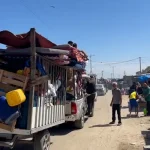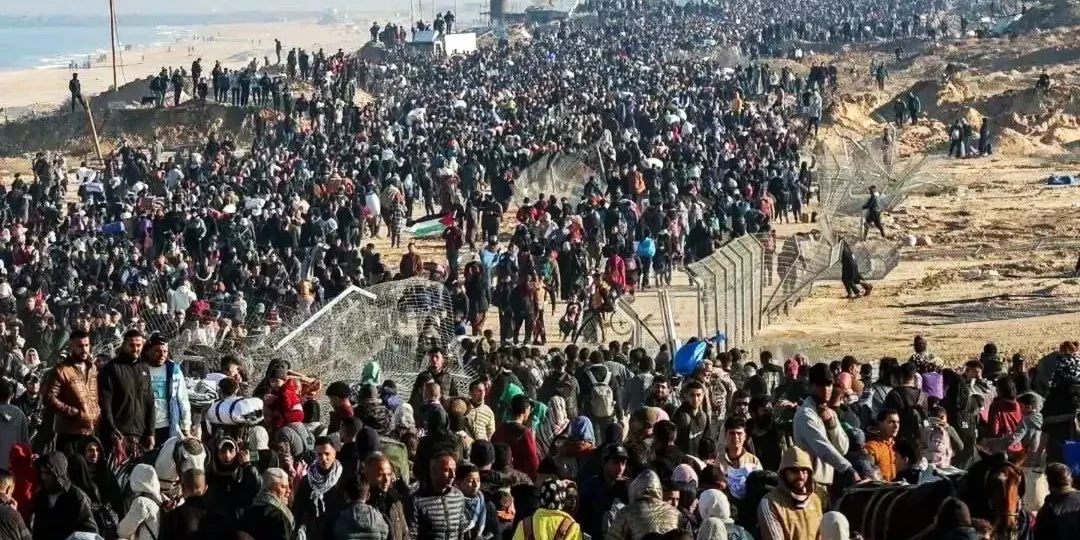

THE roads of Gaza are alive again, but not with the sounds of war. For the first time in two years, thousands of displaced Palestinians are streaming back towards their homes, their faces etched with a mixture of hope, exhaustion, and trepidation as a newly announced ceasefire between Israel and Hamas takes effect and Israeli troops begin their promised withdrawal from parts of the devastated territory.
The scenes unfolding along Al-Rashid Street and throughout the Gaza Strip paint a portrait of a population caught between jubilation and devastation — celebrating the silence of guns while confronting the ruins of everything they once knew.
A Deal Brokered in Blood and Desperation
The ceasefire agreement, reached after intensive negotiations mediated by the United States, Qatar, and Egypt, represents what President Donald Trump has characterised as a “momentous” breakthrough in one of the world’s most intractable conflicts. The deal’s first phase, approved by Israel’s cabinet on Thursday, calls for a cessation of hostilities, the exchange of hostages held by Hamas for Palestinian prisoners in Israeli custody, and a phased Israeli military withdrawal from Gaza.
According to the agreement, Israel will release more than 1,000 Palestinian prisoners and detainees in exchange for the remaining Israeli hostages captured during Hamas’s October 7, 2023, attacks. This includes 250 prisoners held by the Israeli Prison Service and approximately 1,700 Gaza residents arrested after the attacks who were not directly involved in the assault.
Hamas’s chief negotiator, Khalil al-Hayya, has stated the group received guarantees from American and regional mediators that this ceasefire marks “the complete end” to the Gaza war — though the details of subsequent phases remain shrouded in uncertainty, and Israeli officials have offered no such assurances.
The Human Tide Returns
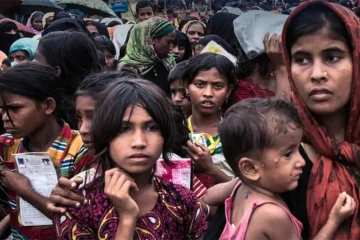
As word of the ceasefire spread through displacement camps and temporary shelters across Gaza, the response was immediate and overwhelming. Families began gathering their meagre possessions — often little more than what they could carry — and setting out on journeys to homes many hadn’t seen in months or even years.
The United Nations Children’s Fund (UNICEF) reported that approximately 500,000 people had streamed back into Gaza City alone within days of an earlier phase of negotiations, a mass movement that speaks to the desperate yearning of Palestinians to reclaim whatever remains of their former lives.
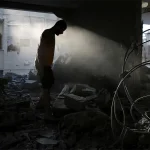
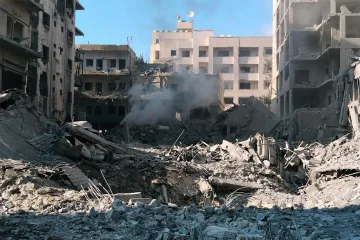
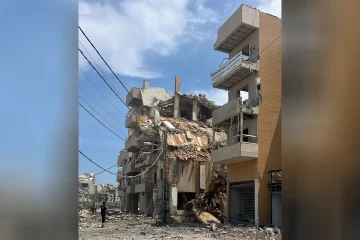
Yet what awaits them is heartbreaking. Gaza has been transformed into an apocalyptic landscape. Entire neighbourhoods have been reduced to mountains of concrete and twisted rebar. Buildings that once housed bustling markets, schools, and family apartments now stand as hollow shells, their facades perforated by artillery and their interiors gutted by fire.
Dreams Meet Devastation
The collision between hope and reality is perhaps nowhere more painful than in the faces of those making the journey home. Many are discovering that “home” is now a word without physical meaning — an address that corresponds only to rubble, a memory preserved in photographs that somehow survived when the structures did not.
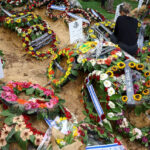
The war has exacted a staggering toll. More than 67,000 Palestinians have been killed according to recent figures, with the actual number likely higher as bodies remain buried beneath debris. Nearly every family in Gaza has lost someone — parents, children, siblings, neighbours, friends. The survivors are now returning to a landscape haunted by absence, where the silence is filled with the ghosts of those who will never come back.
“We’re returning from one hard place to another,” one displaced father told journalists, capturing the impossible choice facing Gaza’s population. Remaining in displacement camps meant continuing to live in crowded, unsanitary conditions with limited access to food, water, and medical care. But going home means confronting destruction on an unimaginable scale and attempting to rebuild lives with virtually no resources or infrastructure.
A Territory on Life Support
The challenges facing returning Palestinians extend far beyond damaged or destroyed housing. Gaza’s essential infrastructure has been systematically devastated. Water and sewage systems have collapsed in many areas. Electricity is sporadic at best. Hospitals that once served as the backbone of the territory’s healthcare system have been damaged or destroyed, their equipment looted or rendered inoperative, their staff depleted by death and displacement.
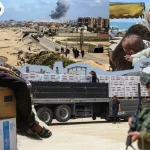
The ceasefire agreement stipulates that Israel must allow “sufficient quantities” of humanitarian aid into Gaza, but the actual implementation of this provision remains to be seen. Even with increased aid flows, the humanitarian crisis is so severe that it will take years, if not decades, to address.
Children — who constitute a massive proportion of Gaza’s population — face particularly dire circumstances. Many have known nothing but war for their entire lives. Schools have been destroyed, education disrupted for years, and an entire generation traumatised by experiences no child should endure. UNICEF officials on the ground describe scenes of children wandering through destroyed neighbourhoods, searching for familiar landmarks in a world that has been completely transformed.
The Shadow of Uncertainty
While Palestinians celebrate the cessation of active combat, profound uncertainty hangs over Gaza’s future. The current ceasefire is characterised as “phase one” of a multi-stage process, but the details of subsequent phases remain vague and subject to interpretation by parties with fundamentally different objectives.
President Trump has promoted a controversial plan that would place Gaza under a form of international trusteeship supervised by what he calls “the Board of Peace,” which he would personally chair. The plan suggests that while Palestinians would be “allowed to remain in Gaza,” those who wish to leave “will be free to do so and free to return” — language that has sparked deep fears among Palestinians about potential mass displacement or permanent exile.
Israeli officials, meanwhile, have given no concrete guarantees about refraining from future military operations once the hostages are returned. When asked what assurances Israel had provided, Trump could only say the U.S. has “a lot of power” to ensure compliance — a nebulous statement that offers little concrete comfort to Gazans contemplating their future.
The negotiations themselves continue in the Egyptian resort city of Sharm el-Sheikh, where Israeli negotiators led by Ron Dermer, one of Prime Minister Benjamin Netanyahu’s closest advisers, engage in indirect talks with Hamas representatives through mediators. The presence of high-level American officials, including Middle East envoy Steve Witkoff and Jared Kushner, underscores Washington’s deep investment in making this agreement hold.
A Respite, Not Resolution
What remains abundantly clear is that this ceasefire, however welcome, represents a pause in hostilities rather than a resolution to the underlying conflict. The fundamental issues that have fueled cycles of violence for decades — the political status of Gaza, the blockade, the right of return for refugees, the question of sovereignty and self-determination — remain entirely unaddressed.
Hamas, though significantly degraded militarily, has not been eliminated and maintains political influence in Gaza. Israel’s stated objective of destroying Hamas as both a military and political force remains unfulfilled. The hostages-for-prisoners exchange may satisfy immediate humanitarian imperatives, but it does nothing to resolve the deeper structural issues that gave rise to this war.
Moreover, even as the ceasefire takes effect, violence has continued. At least 30 Palestinians were killed in the hours immediately after the ceasefire was announced, including in an Israeli strike on the Ghaboun family home in northern Gaza — a grim reminder of how fragile peace remains and how easily it can shatter.
The Long Road Ahead
For the Palestinians now picking their way through the ruins of their former lives, the ceasefire offers something precious but precarious: time. Time to search for lost loved ones. Time to salvage what can be saved from the wreckage. Time to begin the overwhelming task of rebuilding not just structures but lives, communities, and some semblance of normalcy.
The international community faces its own reckoning. The reconstruction of Gaza will require tens of billions of dollars and many years of sustained commitment. It will demand not just financial resources but political will to address the root causes of this conflict. The question is whether the world’s attention, so focused on Gaza during the height of the violence, will remain engaged during the long, unglamorous work of recovery.
For now, though, as dusk falls over Gaza on this first day of ceasefire, thousands of Palestinian families are sleeping in or near their homes — or what remains of them — for the first time in two years. The guns are silent. Children can play without fear of falling bombs. People can move freely along roads that have been closed for months.
It is a fragile dawn, uncertain and shadowed by the ruins of the past and the uncertainties of the future. But for a population that has endured unimaginable suffering, even fragile hope is something to celebrate.
The question that haunts Gaza tonight is whether this pause in violence can be transformed into something more lasting, or whether it will prove to be merely another intermission in a tragedy that seems to have no final act. For the thousands streaming back to their devastated homes, that question will be answered not in the conference rooms of Sharm el-Sheikh, but in the daily struggle to rebuild lives from rubble and create meaning from loss.
The world watches and waits. Gaza has been here before — suspended between war and peace, destruction and reconstruction, despair and hope. What makes this time different, if anything, remains to be seen. For now, the people of Gaza are simply going home, to whatever home means in a landscape transformed by war.
And that, perhaps, is where any peace must begin: with the simple human act of coming home.
This analysis is based on reports and information available as of October 10, 2025.