SHAHFAHAD KHAN DAWAR was helping three of his seven children and his nephew prepare for school in Pakistan’s Khyber Pakhtunkhwa province in May when one of his sons ran to him, pointing into the sky and exclaiming, “Baba, Baba, there’s a drone.”
His wife also tried to warn everyone that something was flying at low altitude towards their home in Hurmuz, a village in the mountainous North Waziristan district.
By Jamaima Afridi
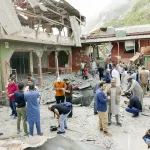
Before anyone could react, the strike hit. The four children were all killed. Dawar’s wife and six others were wounded.
Relatives warned of a second drone, but Dawar was in shock. “I was in so much pain, I was saying it does not matter anymore – things were already so bad,” he recalled in a telephone interview with The New Humanitarian.
No one has accepted responsibility, but the strike on Dawar’s house was part of an ongoing Pakistani military campaign to root out alleged militant elements in what are often referred to as the nation’s tribal areas.
Ethnic Pashtuns, who are the majority here – and in neighbouring Afghanistan – accuse the Punjabi-dominated Pakistani government of decades of marginalisation and rights abuses. But the Pakistani military claims it is responding to attacks by the Tehrik-e-Taliban Pakistan (TTP) militant group, which Islamabad says operates from sanctuaries across the Afghan border.
Though Khyber Pakhtunkhwa has been subject to military operations for decades, an increase in insurgent attacks over the last year has led to an intensification of the campaign. In July, security forces began “Operation Sarbakaf”, targeting militants in Bajaur district and placing 16 villages under curfew. These operations have forced at least 100,000 civilians to flee to other areas within Bajaur, like Khar Tehsil, where they’ve found shelter in schools and government-run camps. Local families have also opened their doors, providing food and shelter.
The Pakistani government says many “security incidents” are attacks carried out by militant actors, specifically the TTP. Following the Taliban’s return to power in Kabul in 2021, Pakistan claims the TTP and affiliated groups returned to re-establish bases in Afghanistan and have ramped up violence in Pakistan, resulting in more frequent clashes between Pakistani security forces and the militants.
“How could someone kill a child?”
This year, drone strikes have surged dramatically across Khyber Pakhtunkhwa. Islamabad claims the intensified operations are a much-needed response to the growing number of security incidents, but like the Obama administration’s drone war on the region in the 2000s, many of the victims of the Pakistani military’s attacks continue to be civilians like Dawar’s family.
Amnesty International documented four drone strikes between March and June 2025: the Katlang strike in Mardan on March 29, which claimed at least 11 lives; the Mir Ali strike in North Waziristan on May 19, which killed four children and is described above; the Wana attack on May 28, which wounded 22 people, many of them children; and the Dashka strike in South Waziristan on June 20, which killed a child. Amnesty expressed serious concerns about what it called “an alarming series of attacks which have escalated since March of this year”.
Dawar is still haunted by the strike on his family. He is filled with questions that have no answers. “In a war, how could someone kill a child?” he asked. “When the drone was above, these people saw our children with backpacks and heading off to school. What did they think? Did they think these children were terrorists? How could they do that to us?”
After the incident, the family, along with other local residents, protested and blocked roads to demand accountability. Dawar said the government vowed that nothing similar would happen again, but he added that the drone attacks are still continuing, and that women and children are still being wounded.
Shazia, a 30-year-old mother of two from the Tirah Valley, lost her unborn child in a June 2025 drone attack, which, like many strikes, was not even reported. Interviewed in person by The New Humanitarian, she recalled her daughters entering her room saying, “Oh, there’s something in the sky.”
Along with two other women and two children, she was hit as she rushed outside to pick up her child. A local hospital refused to admit her, and she had to travel more than five hours to Peshawar, where her family had to convince doctors to treat her due to the severity of her bleeding, which eventually led her to miscarry.
Afghanistan and Pakistan trade cross-border attacks
Pakistani officials claim the security situation in Khyber Pakhtunkhwa drastically worsened after the Taliban returned to power in neighbouring Afghanistan four years ago. Based on open-source data, the number of attacks claimed by militant groups increased from 282 in 2021 to 1,758 last year: 2024 was the worst year for attacks on Pakistan’s military and civil security services in a decade, with 444 security incidents confirmed by officials and at least 685 casualties.
With more than 700 incidents in just eight months of 2025, attacks have been increasing rapidly this year. Pakistani officials claim the increased violence by the TTP is due to support from the Taliban in Afghanistan. On 16 September 2025, Pakistan’s permanent representative to the UN, Ambassador Asim Iftikhar Ahmed, stated that Pakistan has “solid proof that these groups are working together through coordinated attacks, illegal weapons trade, joint training, and shelter for terrorists”.
A serious escalation between the two neighbours earlier this month saw Pakistani forces breach Afghan airspace to launch attacks on Paktika province and Kabul, claiming to have killed TTP leader Noor Wali Mehsud in the Afghan capital. That claim was debunked when Mehsud sent a voice message saying he was alive and well in Pakistan minutes after the 9 October strike.
The Islamic Emirate responded by staging attacks on Pakistani outposts and soldiers that they say breached Afghan territory. By 15 October, Pakistan had staged fresh attacks on Spin Boldak, a border district of Kandahar province, and a residential area of central Kabul. Those attacks led to 17 deaths and more than 300 injuries, according to UN figures.
The Islamic Emirate rejects allegations that armed groups use Afghan territory to strike in Pakistan, calling these charges “false” and claiming they are the Pakistani government’s way of avoiding accountability for its own shortcomings, including continued claims of disenfranchisement, aggression, and enforced disappearances of the nation’s Pashtun and Baloch minorities.
The two sides were eventually brought to the mediation table by Qatar and Türkiye, but Pakistan put the onus on the Taliban reining in any armed groups operating out of Afghan territory if the ceasefire is to hold.
Trauma and educational fallout
Khyber Pakhtunkhwa journalist Razia Mahsood, 36, noted that regardless of who is to blame for this escalation, “local people are the ones who suffer and constantly live in fear because of these attacks.”
Although community pressure has resulted in compensation in some drone strike cases, Mahsood, who has been detained countless times for protesting Pashtun rights abuses, said, “This is not an adequate solution. Local residents should always be protected because they are the ones most impacted, especially women and children.”
Dr. Abdul Hai, a psychiatrist from Waziristan, emphasised the severe psychological consequences of attacks on victims. Civilian survivors, he said, feel extraordinarily anxious and can even be triggered by harmless birds or planes flying overhead.
“I have seen the effects of chronic stress on individuals’ lives, including education, work, and other activities,” he said.
“As soon as we begin resetting our lives, something occurs in our community, causing devastation. We are confused about what to do.”
A teacher in a government-run school in Khyber District described the impact on education, particularly for girls, some of whom have been dropping out of school from fear.
“I have seen it in my students, how they are mentally disturbed, can’t study, and how the dropout rates are progressing,” she said. “Students even fainted, and when we investigate the reason, the majority of the time it is due to something that happened in their families because of the military operation.”
The growing insecurity has forced thousands of civilians to leave their homes and shelter in schools and temporary camps, mostly in Bajaur.
Iman, a mother of seven in her mid-thirties, now lives in a government high school in Ghani Adai district. More than 60 families have found shelter there, two or three squeezed into each room.
“We had to hurry out of our home with just a few clothes,” Iman told The New Humanitarian, recalling her fear as she fled with whatever she could grab as bombs fell all around.
“We’re tired of this everyday struggle,” Iman said, tears running down her face. “As soon as we begin resetting our lives, something occurs in our community, causing devastation. We are confused about what to do. We’re not asking for much. All we want is to live our lives without fear. When will we be allowed to return home and live like everyone else?”
Opposition to military operations seen as dissent
There has been widespread opposition to the military operations in Khyber Pakhtunkhwa at a variety of levels: political, social, and tribal.
In December 2024, the KP Assembly unanimously passed a resolution against possible military intervention. Protests against military operations continue in the districts of Bajaur, Waziristan, Khyber, and Swat.
“Drones are simply one component of the larger set of tactics. This is clearly the war zone of different tactics at play.”
However, even those calling for peace and discussion face severe retaliation. Live gunfire broke out during a peace protest march in Bannu, leading to the deaths of four protesters. Members of Ulasi Pasoon, a youth group that organised peace marches in Swat, have been arrested. Activists who speak out against brutality and call for peace and Pashtun rights are frequently arrested. In August, more than 40 were detained to prevent them from participating in a protest in Islamabad.
“Drones are simply one component of the larger set of tactics,” National Democratic Movement (NDM) chairman Mohsin Dawar told The New Humanitarian. Besides displacement, civilians also become victims of enforced disappearances or are murdered, he said, adding: “This is clearly the war zone of different tactics at play.”
Community advocacy has delayed some military operations, but Dawar said it would take a lot longer to turn the situation around in Khyber Pakhtunkhwa: “The struggle for rights and freedom is a long-term effort that needs perseverance and patience.”
According to the Pashtun Tahafuz Movement (PTM), which fights for Pashtun rights and against alleged abuses by the Pakistani state, more than 32,000 Pashtuns have gone missing from the tribal regions in the last decade due to military offensives.
Those speaking out for justice or peace frequently face violence. On 10 July 2025, Maulana Khan Zeb, a prominent religious scholar and political leader in Bajaur, was assassinated while promoting a peace march.
PTM’s leader, Ali Wazir, has been arrested numerous times, primarily for speeches or attending demonstrations opposed to state policy. For NTM’s Dawar, it is clear why: “By doing this, the state wants to create a sense of terror in the public, discouraging resistance against the project.”
This piece was published in collaboration with Egab. Edited by Lina El Wardani and Ali M. Latifi.
–––––
The New Humanitarian puts quality, independent journalism at the service of the millions of people affected by humanitarian crises around the world. Find out more at www.thenewhumanitarian.org.