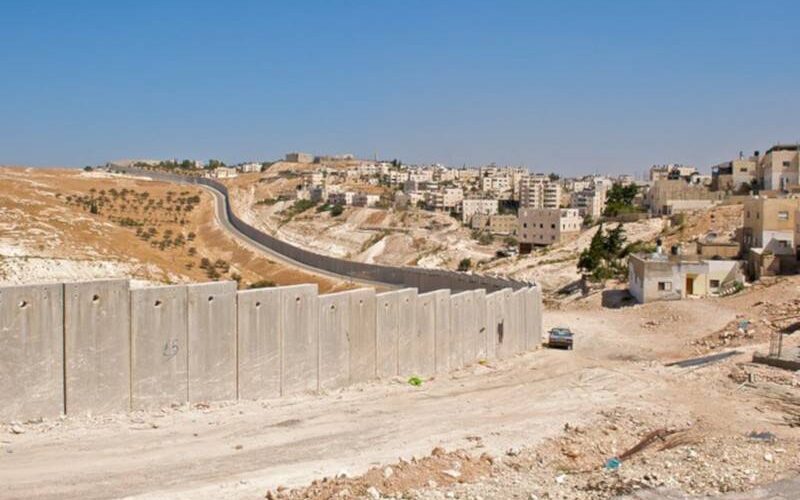
I’VE been travelling regularly to the West Bank since 2005. In that time, I’ve witnessed the expansion of settlements, the construction of the separation barrier, and the proliferation of checkpoints and roadblocks. I’ve witnessed home demolitions, military incursions into refugee camps, crackdowns on protests, and arbitrary arrests. I’ve seen the crippling effects of land seizures, the denial of travel permits, and the depletion of livelihoods.
By Julie M. Norman
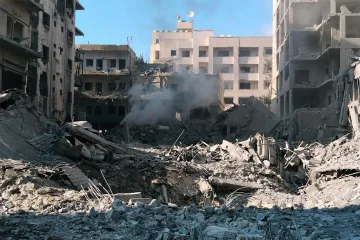
During my most recent visit, in summer 2025, the tribulations of the past two decades were still there, but all have been exacerbated in the period following 7 October 2023. The Israeli military has imposed severe movement restrictions and launched deadly raids throughout the territory, settlers have been allowed to rampage with impunity and even encouragement from the government, and Palestinians have seen increasing land grabs as communities have been displaced and the economy smothered.
During my visit, the weight of Gaza hung over every interaction. Even as conditions in the West Bank deteriorated, it was as if everyone was holding their breath, laden with grief, anxiety, and an inescapable sense of guilt that, whatever they were experiencing, it didn’t compare to Gaza.
Now, though, with the fragile ceasefire in place, there is relief mixed with anguish and despair for Gaza, but also growing fear. What will this next phase mean for the West Bank? Will Israel exploit the moment to further consolidate control of the territory? Will Israeli Prime Minister Benjamin Netanyahu try to placate the far-right members of his government with yet more settlement expansion and de facto annexation of territory? And with all eyes on Gaza, will anyone notice?
“Will I live or die today?”
The bus ride from Ramallah to Nablus now takes longer than it used to, the most direct road now blocked, forcing Palestinian traffic to take the long way around. Over a dozen Israeli settlements have been developed around Nablus, with three more recently approved for construction. At a junction, the Arabic on the road sign has been blacked out by spray paint, leaving only the English and Hebrew lettering. A bit further on, a billboard, erected by settlers, states, “There is no future in Palestine”, in large Arabic script.
In Nablus, I took a short taxi ride to Balata Refugee Camp. Balata is one of the oldest camps in the West Bank, with over 33,000 residents, mostly descendants of Palestinians driven from their homes during the 1948 Nakba. My friend Mahmoud*, 28, met me at the entrance of the camp. A banner stretched across the small archway, showing a dated photograph of a smiling young man in a black t-shirt, recently released from an Israeli prison. We walked under the banner and past the faces of dozens of shuhada (martyrs) pictured on faded, peeling posters along the inner wall.
Mahmoud hasn’t left Nablus since 7 October 2023, when he was held at a checkpoint for eight hours while trying to get home from Ramallah. Like many young men from the camp, he’s a hard worker; he taught himself English and studied chemical engineering at Al-Najah University, the main university in Nablus. But there are no jobs in the West Bank these days, so he picks up work where he can as an IT consultant, filmmaker, and fixer.
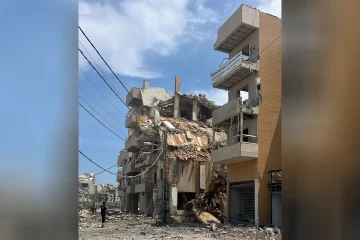
That day, he told me how his grandmother’s house in Tulkarem Refugee Camp, about 15 miles west, was destroyed in an Israeli military operation earlier this year. The incursions by the Israel Defence Forces (IDF) occurred in three camps in the northern West Bank – Jenin, Nur Al Shams, and Tulkarem – destroying homes and civilian infrastructure, carving new access roads, and displacing an estimated 40,000 residents.
The IDF maintained that the raids were necessary to thwart armed groups operating in the camps. But almost a year later, the so-called Iron Wall operation is still ongoing, with the Israeli army still occupying the camps and declaring them closed military zones. Most Palestinians view the take-overs as land grabs, or worse, as deliberate attempts to strip residents of their refugee identity and push them into the cities. According to Mahmoud, “It’s like another Nakba. My grandfather used to say there would be another Nakba, and we never believed him. But now it’s happening.”
Mahmoud said people in Balata are scared their camp will be next. The IDF issued warnings to the camp in the spring, dropping leaflets saying, “Hell is coming.” So far, Balata has not faced the large-scale incursions like the neighbouring camps, but there have been increased armed raids, arrests, and targeted shootings, sometimes forcing residents to take shelter for hours at a time. “Every day I wake up thinking, will I live or die today?” Mahmoud told me. “When I leave the house, I always hug my mom, just in case I don’t come back.”
“Most young people feel no hope anymore”
When the army enters the camp, one place of relative safety is the Yafa Cultural Centre, a community space that serves as a health clinic, youth centre, theatre, recreation space, and social hub.
On the day I arrived, the narrow building was teeming with kids attending a summer camp offered by the centre. With few recreational options available for youth in Balata, Yafa was running three consecutive waves of the summer camp with 130 kids in each session. My friend Mona, 45, said that “it’s hard for the staff to lead something ‘fun’ like a summer camp while the genocide in Gaza is ongoing.” But they decided it was best to continue. “We had a choice: Halt everything or keep going and try to build the sumud (resilience), and try to give the youth and the community some positive experiences.”
Mona is the head of Yafa’s health team. Along with nine other nurses – all crowded into a small office for their morning meeting – she provides assistance to over 5,000 camp residents with chronic diseases such as diabetes and hypertension. Another member of their team, Rasmi Arafat, 35, was shot and killed during an IDF raid three weeks after 7 October. Photos of him – youthful, smiling, assisting patients – are tacked up around the small office.
As the nurses met, I chatted with Mona’s 19-year-old son, Marwan, who is studying English and translation at Al-Najah. He’s recently started learning Spanish, and he dreams of moving to Spain. “Most young people feel no hope anymore,” he told me. “They want to leave, or they want to die. Even I, if I have the chance to leave for Europe to study, I know I should come back to Palestine after. But sometimes I feel I never want to come back. Palestine will be free someday, we know this, but when, we don’t know.”
Marwan took me upstairs, where the summer camp kids were packed row upon row in front of a small stage. The kids stood for the Palestinian national anthem, followed by youth performances of poetry, drumming, and the traditional Palestinian dance, dabke. The last piece was a tribute to children who have been killed in Gaza. The young performers joined hands at the end and said, “You still live in each of us.”
“The settlers rule everything”
In the southern West Bank, by the Israeli border, the arid desert hills stretching into the distance are a stark contrast to the crowded alleys of Balata. I went to visit Masafer Yatta, an area of remote Palestinian villages that has become increasingly subjected to extremist settler violence and harassment. Such incidents are not new, but they surged after 7 October 2023, with over 3,000 documented attacks in the West Bank, resulting in over 1,000 Palestinians killed and thousands displaced.
The Masafer Yatta area garnered global attention when it was featured in the 2024 Oscar-winning documentary No Other Land. Since then, little has changed, and by most accounts, the situation has gotten worse. In March, the Palestinian co-director of the film, Hamdan Ballal, was detained by Israel, and one week after my visit in July, Odeh Hathaleen, a consultant for the film, was shot and killed by an Israeli settler.
I went with a diplomatic delegation visiting a herding community called Khirbet al Majaz, a cluster of simple houses on a hillside, alongside a low-roofed school built with international donor assistance. It’s one of a dozen villages that have been at the centre of a years-long legal battle with Israeli authorities, who declared the area to be a military firing zone in 1981, putting the villages at constant risk of demolition.
Humanitarian organisations view the firing zone designation as an excuse by Israel to push Palestinians off rural land to enable settlement construction. Since 1995, the West Bank has been divided into three administrative areas: Area A, under full Palestinian Authority (PA) control; Area B, under joint Israeli-Palestinian control; and Area C, under full Israeli control. About 18% of Area C land has been declared as firing zones.
The demolition threat has long loomed as the primary concern for residents of Khirbet al Majaz, and not without reason – a neighbouring village, Khallet al Daba, was destroyed in May. But residents said during my visit that, since 7 October 2023, the daily threat of settler violence and harassment has become the most immediate worry. Cars and homes have been torched. Children and teachers are harassed by settlers when coming from other villages to reach the school, and women trying to travel into the nearest town to gather provisions are blocked by settlers who refuse to let them pass.
Surviving off the land, as the communities have always done, has become nearly impossible. “We depend on herding for our livelihood,” a woman named Alaa told us, “but we can’t access the land to graze the sheep. When we do, the settlers steal the livestock, they destroy the crops, they attack the water sources.”
Sometimes, the settlers wear military uniforms, so the residents can’t tell the difference between the settlers and real soldiers. As a youth activist from a neighbouring village said, “The settlers have ruled everything since 7 October. Now the soldiers take orders from the settlers, not the other way around.”
“Whatever will stop the killing”
A few days later, I met an old friend in Beit Jala, a mixed Christian-Muslim town on the edge of Bethlehem. The streets of Bethlehem near Manger Square were quiet; the storefronts, reliant on tourists and pilgrims, were mostly shuttered. But Beit Jala was bustling, and we met in a new cafe where students from the nearby Bethlehem University were busy typing on their laptops.
At 57 years old, Nadir is a seasoned activist. He grew up in a refugee camp, was arrested multiple times as a teenager during the First Intifada in the 1980s, and has participated in countless demonstrations, protests, and strikes. And yet, I always find him smiling, working on new initiatives, usually with youth, trying to enact some positive change.
He’s worried now, though, about the lack of political vision in Palestine. “People would still protest and take to the streets to fight for Palestine if there were leaders, but there are no leaders now,” he told me. “We tried some small protests after 7 October, but the crackdown was very harsh and there has been very little since.”
He explained that the economic crisis in the West Bank has also impeded any forward thinking; the Palestinian Authority is only paying employees a third of their salaries, and anyone relying on permits from Israel has been out of work since 2023.
Nadir has long dreamt of a Palestinian state, but like many activists I’ve met, he’s become disillusioned with the two-state model. An early adopter of the idea of a one-state model, Nadir believes in what he describes as a “progressive, democratic, and secular state with equal rights for all, Israelis and Palestinians.”
As Nadir describes it to me, “Internationals are still stuck on the two-state solution, but this won’t happen now. We need to start planning for the long term, for a single state. And we need to start educating our people now, on how to live together.”
Nadir and I both know that Israel would never agree to a one-state model – since Palestinians would outnumber Jewish Israelis, it would mean the end of Israel’s identity as a Jewish state. But I was also curious how an idea like this would be received in Palestine in the current context, on the backdrop of Gaza. He acknowledges that the post-7 October era has made this thinking much harder. Still, he said, it’s what will probably be necessary in the long-term: “It may take 10 or 20 years, but why can’t we learn to live with them? This isn’t normalisation, it’s part of the struggle.”
When I related the conversation to a friend over drinks in Ramallah a few nights later, he said that everyone understandably bemoans the two-state model, but in reality, most Palestinians would accept any solution at this point, two-state, one-state, or otherwise: “People will accept whatever will stop the killing.”
*Names have been changed to protect interviewees’ safety.
Edited by Eric Reidy.
–––––
The New Humanitarian puts quality, independent journalism at the service of the millions of people affected by humanitarian crises around the world. Find out more at www.thenewhumanitarian.org.