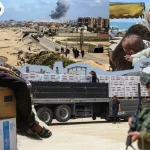
THE thunder of bombs has given way to the hiss of drones, random gunfire at checkpoints, and the silence of hospitals that no longer heal. The words of the ceasefire that was announced with fanfare last month have fallen on Gaza like dust, coating the tongue and choking the air. It may have paused some of the airstrikes, but it did not end the occupation.
By Nour ElAssy
In exile in Paris, I wake to the same messages each morning from my family in Gaza: “Don’t be afraid, ya mama, we are alive”. But at night, I still feel terrified and leave my mother, younger sister, and friends voice notes filled with tears. Their messages to me are not about hope or progress, but survival. “It feels like the air is holding its breath,” my eldest sister texted last night from northern Gaza. “We cannot trust quiet anymore.”
In Gaza, calm is a prelude to destruction. The ceasefire that entered into effect on 10 October – brokered by the United States, Egypt, and Qatar – was supposed to end two years of annihilation. But it has not ended the hunger, displacement, or fear. Israel has also continued to shell and shoot people in Gaza, violating the truce over 100 times, killing more than 240 and injuring over 600.
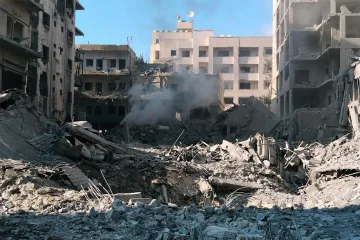
Israel is still demolishing buildings and homes en masse. And entire neighbourhoods, such as Shuja’iyya (where my home is) and Jabalia, are still inaccessible.
“They call it a ceasefire,” my cousin Islam, a nurse at Shuhada al-Aqsa Hospital in Deir al-Balah, told me. “But the hospitals are graves. We have patients whose conditions are still deteriorating towards death rather than healing. A lot of times, they die quietly because the generator cuts out or because there are not enough doctors or space. We have no fuel to let them live.”
An illusion of stability
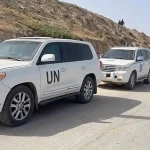
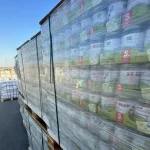
My friends and family tell me that food is more available than it was during the worst periods of starvation over the summer, but affordability is a new siege of its own. Israel is allowing commercial trucks into Gaza but continuing to restrict aid convoys. Most people have no money to buy goods, and prices of essential items are still higher than they were before the war, and even than during the previous ceasefire earlier this year.
Bread is still scarce, flour is rationed, and lentils and rice arrive in markets that most cannot reach. My mother told me that a kilo of tomatoes now costs more than a family’s entire daily wage – and most families don’t even have a source of income. “We buy half a portion, and we call it enough,” she said.
A ceasefire that doesn’t address the utter economic devastation in Gaza is just an illusion of stability.
That’s the situation for those who still have access to money. The unemployment rate has been around 80% or higher for more than a year. People have to use informal brokers who charge commission fees of over 20% to withdraw money from their bank accounts. During the many months of displacement, entire life savings have been spent on tents, blankets, and water that’s sold by the litre. “Even if you have money, you don’t really have it,” my friend Mariam said.
A ceasefire that doesn’t address the utter economic devastation in Gaza is just an illusion of stability. Israel’s laying waste to the enclave has caused an estimated $70 billion in damages. The UN estimates that 81% of all buildings in Gaza have sustained damage. Of those, 61% are totally destroyed. Around 86% of cropland has been damaged. The healthcare system is in tatters. Almost 1.5 million people (71% of the population) are in need of emergency shelter. Over 91% of schools need either to be entirely rebuilt or to undergo major rehabilitation to be functional.
Even if the guns actually fell silent today, the truth is: Gaza is uninhabitable. The only way people can survive is by being put on life support by the international community – and even that is being blocked.
From Gaza to the West Bank
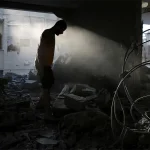
Families who have returned to the north are still living in the debris where their homes once stood. The walls that are still partially standing are burned black as coal. People inhale the debris of destruction day and night.
Return has become a pilgrimage to absence. Families walk north, retracing streets that no longer exist. A father bends to lift a photograph buried in concrete. A child asks why the streets are so grey.
Beyond Gaza, the West Bank disintegrates more quietly. In the past weeks, Israeli settlers have attacked Palestinians trying to harvest olives from their land, burned people’s homes to the ground, and attacked Palestinian’s livestock. “More trees have been damaged and more communities affected this year than in the previous six years,” Tom Fletcher, the UN’s top humanitarian official, said.
All of this is done with total impunity and even support from the Israeli government. “When Gaza burns, they take our hills,” my friend Motaz, a student in Paris with me from Hebron in the southern West Bank, said. “And when Gaza stops burning, they say it’s peace.”
Somehow, not everyone has lost hope. My former colleague and friend Ismael Abu Dayyah, who is still documenting daily life in the Strip, told me: “The ceasefire means I can send you photos again. It means one more day of breath. Maybe that’s enough for now.”
Hope, here, is an act of resistance. To rebuild a tent, to plant mint in broken soil, to teach a child the alphabet under a plastic roof – all of it is defiance. Yet despair stalks every conversation. “We are afraid to rest,” my mother said. “Every time we start to breathe, they start again.”
A real ceasefire
A real ceasefire would mean: open crossings for aid, fuel, and people, monitored by international observers with real enforcement power; the release of all Palestinian detainees held without charge, including medical personnel and journalists; and a freeze and reversal of settlement expansion in the West Bank.
It would mean: the prosecution of settler violence; restoration of farmers’ access to land; reconstruction of water, power, and healthcare systems, not as charity but as an obligation under international law; economic reconstruction; the stabilisation of Gaza’s banking system; and the breaking of the black-market commission syndicates that steal survival from the poor.
Anything less than this is not a ceasefire; it is a pause in the bombing under continued domination.
Gaza is the spectacle, the West Bank is the bureaucracy. One system, two tempos, one coloniser. You cannot separate bombardment from annexation and pretend to discuss “security”.
The ceasefire’s vagueness is deliberate. It is how domination renews itself without noise. We refuse the language that launders this reality. We refuse to celebrate a silence that smells of smoke. The ceasefire has kept us breathing. It has not made us free. Freedom – not a pause between violent raids, not a quota of aid trucks, not the right to rebuild ruins again – is the only end to this story that deserves the word peace.
Edited by Eric Reidy.
–––––
The New Humanitarian puts quality, independent journalism at the service of the millions of people affected by humanitarian crises around the world. Find out more at www.thenewhumanitarian.org.