STOGIE T’s new album, aNomy, consolidates lyrics in his rap music repertoire as the most politically sophisticated, most intellectually literate and most worldly and historically informed in the South African rap scene. I have not come across any other South African rap artist with the same political depth in their lyrical rendition. My musical appreciation runs across all genres; from classics, jazz, choral, maskanda, kwaito, amapiano and everything in between – only if they are well thought-out and well-constructed musical offerings. I have a liking for rap lyrics because I came into the liking of this genre through my love for poetry.
Today I had the luxury of being alone on the highway and took the opportunity to play the album, aNomy, in the car – I had downloaded it a few days ago but had not had the chance of listening to it. I ended up playing the whole album three times in a row.
Political sophistication in Stogie T’s lyrics cannot be divorced from the environment of his upbringing; the community and family nurturing that he received as he grew up. He was born in Tanzania as Boitumelo ‘Tumi’ Molekane during the years of the liberation struggle. His parents, the late Mandla Msibi (known as Blackman in exile) and Ellen Molekane (known as Jane in exile), are ANC struggle veterans. Ellen Molekane later became the Deputy Minister of Intelligence in a democratic SA. One of Stogie T’s uncles is a youth struggle icon, Rapu Molekane, of the ANC Youth League fame (a comrade of Peter Mokaba), who today has been South Africa’s ambassador in several countries.
In 2012, Tumi came to perform at Harare International Festival of the Arts. At the time, he still carried the band name of ‘Tumi and the Volume’ before he embarked on a solo career and changed to Stogie T. In the middle of his stomping performance, he stopped rapping and instructed me to stand up where I was sitting in the gallery. He told the cheering crowd that they must never forget that the South African ambassador to Zimbabwe, Vusi Mavimbela, is his uncle who brought him up when he was still a boy. He told them that whenever they see him, they must always know that he has an uncle in Harare.
He was referring to the 1980s when he, his mother Jane, and I shared a four-roomed house in Lusaka, Zambia. At the time, Tumi was a young, ebullient and inquisitive Primary school-going boy who evinced no propensity for musical arts – or perhaps because of our untrained eyes, at the time Jane and I failed to detect the inclination. When I first heard that he was coming to perform in Harare, I phoned Jane and alerted her of Tumi’s coming performance in Zimbabwe, to which she responded that she had never imagined her boy would be hooked into music, let alone rap music, and asked me to take good care of him when he is in Zimbabwe.
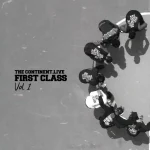
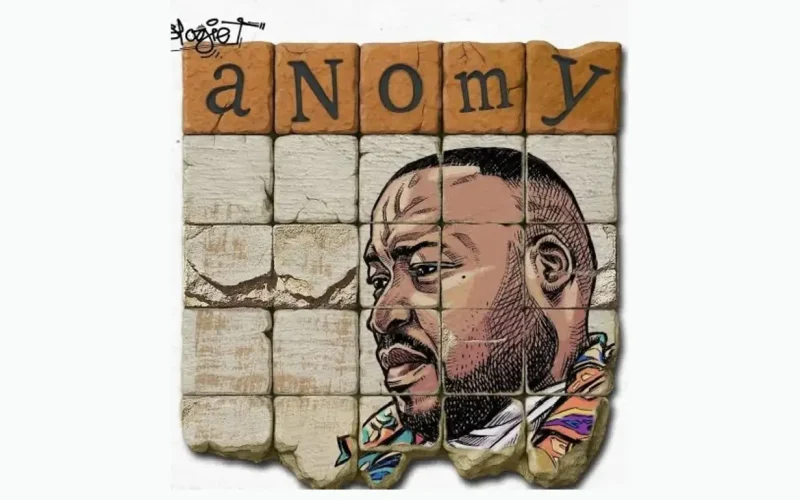
The album, aNomy, is yet another great offering to savour. Stogie T raps about ‘Sankara’s Grief’ all the way to the atrocities of Leopold II in Congo. The title song, aNomy, is a highly poetic rendition and narration on anomie, alienation, hopelessness – a society losing its moral compass. The cover of the album depicts this anomie; a face depicted through a broken mural and the humanity’s condition of life scattered and fractured across everything. But the broken face is also trying to figure out what still needs to be done when everything seems to degenerate into disuse, and “SA is in flux”. And yet the face signals that there is a linger of hope that something can still be done. The poignancy of the title song and its lyrics are made more authentic by the innocence that is injected by Thandiswa Mazwayi’s pan-Africanist chanting voice and additional rapping by Maglera Doe Boy (Tokela Moyakhe).
Congratulations, Boitumelo Tumi Molekane, for another great offering!!
- Vusi Mavimbela is a diplomat, author of multiple books and music aficionado