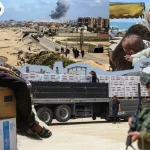
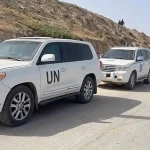
ISRAEL’S decision to suspend 37 international humanitarian organisations working in the Gaza Strip beginning on 1 January is not a technical or administrative measure. It is a political act that is deepening the already catastrophic humanitarian collapse caused by Israel’s genocidal war.
By Rita Baroud
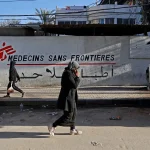
The organisations that have been suspended represent nearly every established and credible aid group that has been involved in the humanitarian response in Gaza over more than two years – from Médecins Sans Frontières and Mercy Corps to World Vision and the Danish Refugee Council. Israel’s excuse? These organisations refused to sign on to new registration rules explicitly designed to exert Israeli control over the aid response and bend it to its political and military goals.
Under international humanitarian law, facilitating humanitarian assistance and protecting humanitarian actors are not optional gestures but legal obligations. Instead of upholding the law, the international community has lent its support to US President Donald Trump’s farcical peace plan for Gaza while continuing to allow Israel to perpetrate grave violations.
The recent US announcement that the so-called ceasefire is entering its second phase – with the establishment of a “Board of Peace” to oversee whatever the next steps are – only underscores the utter disconnect between diplomatic messaging and the reality on the ground. While peace is discussed without input from the people who have been subjected to a genocide, policies of impunity, siege, and humanitarian strangulation continue uninterrupted inside Gaza.
Suspending the work of such a large number of organisations effectively dismantles what remains of Gaza’s fragile life-support system, not because these organisations were sufficient but because they were performing functions no other actor could.
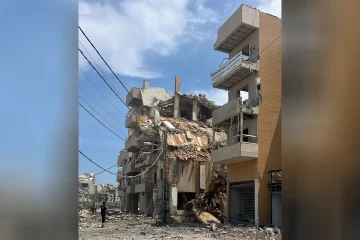
The announcement of the second phase and the decision to suspend the aid organisations comes at a moment of near-total exposure for Gaza’s population: food insecurity is still widespread; access to clean water is severely limited; hospitals are operating under permanent emergency conditions without sufficient fuel or medicine; daily life is defined by displacement, fear, and uncertainty; Israel continues to bomb Gaza, killing people at will; and winter storms are battering the enclave, bringing flooding and deepened misery. At least six children have died already this winter from the cold.
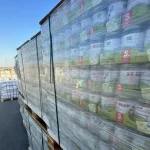
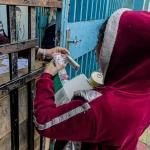
In this context, humanitarian organisations were not auxiliary actors. They were the last remaining structure preventing complete societal breakdown. Suspending the work of such a large number of organisations effectively dismantles what remains of Gaza’s fragile life-support system, not because these organisations were sufficient but because they were performing functions no other actor could. They provided food to the vast majority of Gaza’s population, medical care to those without access to hospitals, and minimal stability in an environment where the basic support structures for everyday life have been erased.
When these organisations are suspended, their role is not transferred or replaced. A vacuum is created – one whose consequences are immediate, predictable, and deadly.
Will there be consequences?
The impact extends far beyond aid recipients. In Gaza, where Israel’s war has wiped out the economy, humanitarian work has become one of the last remaining sources of income. Thousands of families depend directly on these organisations for survival.
Field staff, administrators, mental health professionals, drivers, logistics workers, and low-paid volunteers rely on humanitarian employment in a context where no alternative livelihoods exist. Suspension means loss of income, inability to provide for one’s family, and forced descent into extreme poverty.
There is no alternative labour market, no social safety net, and no realistic possibility for people to go elsewhere in search of safety or opportunity. Each new shock visited upon people in Gaza compounds layers of deprivation and trauma from which the population has never been allowed to recover.
People are also aware that such measures are applied uniquely and selectively to Palestine. Comparable restrictions are not imposed with the same ease or permanence in other conflict zones, nor are they left without scrutiny or accountability. The persistent exception reinforces a widespread understanding among Palestinians in Gaza: They exist outside the international system, beyond the protection of rules that are otherwise presented as universal.
The absence of accountability that will almost certainly greet Israel’s decision to suspend 37 aid organisations is not accidental – it is structural.
Gaza is not treated as a humanitarian emergency, but as a space where the limits of international inaction can be continuously tested. Each decision imposed on it is preceded by the same calculation: Will there be consequences? Repeatedly, the answer has been a resounding “no”. No sanctions. No meaningful political pressure. No accountability. Expressions of concern are issued, absorbed, and forgotten while the same policies continue uninterrupted.
The absence of accountability that will almost certainly greet Israel’s decision to suspend 37 aid organisations is not accidental – it is structural. In Gaza, the double standards embedded in the international humanitarian and human rights system are laid bare.
The same international community that routinely invokes human rights norms, teaches international humanitarian law, and condemns violations elsewhere responds with paralysis – or silence – when these rights are collectively undermined in Gaza. Human rights discourse is mobilised when it carries little political cost and abandoned when enforcement would require action.
Humanitarian work, ostensibly neutral and independent, has been made contingent – subject to political calculation rather than human need. In this context, the suspension of humanitarian operations is not an aberration but part of a broader strategy of crisis management that perpetuates, rather than resolves, the Israeli-precipitated humanitarian collapse.
Lowering the threshold
More alarming than the decision itself is what it reveals about Gaza’s position within the global order. Gaza has become a place where institutions can be shut down, aid suspended, and livelihoods destroyed without triggering international consequences. This persists because impunity has been normalised. Each unchallenged decision lowers the threshold of acceptable suffering and sets a precedent for the next.
This decision is not an endpoint. Rather, it is one more administrative weapon in an ever-evolving arsenal that Israel has wielded and deployed long before 7 October 2023, and that the world has shown – once again – it can continue to wield without consequence. In a global system that observes without intervening, Gaza stands as a stark illustration of what happens when law is detached from power and rights from accountability.
When suspending humanitarian work elicits no meaningful response, it becomes precedent. When precedents accumulate, they become policy. In Gaza today, impunity is the rule, not an exception. This impunity is an ongoing test of whether the international community is prepared to uphold its professed principles or will continue to merely deploy them rhetorically.
So far, the international community has resoundingly failed this test. Silence has become policy, and, when it comes to Gaza, silence constitutes complicity.
Meanwhile, people in the enclave live with the constant awareness that what little remains can be taken from them at any moment, as they continue to try to survive in a place that has been systematically stripped of the foundations of life.
–––––
The New Humanitarian puts quality, independent journalism at the service of the millions of people affected by humanitarian crises around the world. Find out more at www.thenewhumanitarian.org.