THE transatlantic order that has anchored Western power for eight decades now faces its gravest test not from external adversaries, but from within. President Donald Trump’s escalating campaign to seize Greenland from Denmark has ignited a confrontation between Washington and Brussels that threatens to shatter the very foundations of the NATO alliance and plunge global markets into chaos.
This is no longer diplomatic theatre or negotiating posture. Two geopolitical giants are hurtling toward collision, and the wreckage could reshape the international system.
The Ultimatum
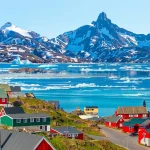
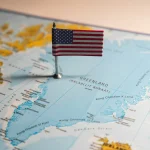
Trump’s threat is stark and unprecedented: impose escalating tariffs on seven European nations—Denmark, Sweden, France, Germany, the Netherlands, Finland, and Britain—starting February 1 unless the United States gains control of Greenland, an autonomous Danish territory home to 57,000 people. The president has refused to rule out military force.
What makes this confrontation particularly dangerous is Trump’s own explanation for his hardened stance. In a remarkable text message to Norwegian Prime Minister Jonas Gahr Stoere, Trump explicitly linked his Greenland offensive to being denied the 2025 Nobel Peace Prize, which went instead to Venezuelan opposition leader Maria Corina Machado.
“I no longer feel an obligation to think purely of Peace,” Trump wrote, “but can now think about what is good and proper for the United States of America.”
This is the language of rupture, not alliance management.
Europe’s Counter-Punch
The European Union is not backing down. EU leaders will convene an emergency summit on Thursday in Brussels to finalise their response, with two potent weapons under consideration.
The first: activating suspended tariffs on $108 billion worth of U.S. imports, set to automatically trigger on February 6. The second: deploying the untested “Anti-Coercion Instrument,” a legislative weapon that could restrict American access to European public contracts, investments, banking, and digital services—sectors where the U.S. runs a significant surplus.
German Chancellor Friedrich Merz captured Europe’s mood: “If we are confronted with tariffs that we consider unreasonable, then we are capable of responding.” Norway’s government has made clear it will not shift its position despite Trump’s threats.
Denmark’s Foreign Minister Lars Lokke Rasmussen framed the dispute in moral terms that resonate across the continent: “We are living in 2026, you can trade with people, but you don’t trade people.”
The Strategic Collision Course
Both sides are now locked in positions from which retreat appears politically impossible.
Trump insists Greenland is essential to American security, claiming Denmark cannot defend the island from Russia or China. “The World is not secure unless we have Complete and Total Control of Greenland,” he declared. Treasury Secretary Scott Bessent warned European retaliation would be “very unwise,” dismissing any connection to the Nobel Prize as a “complete canard.”
But Europe views capitulation as existential surrender. Accepting Trump’s demand would establish the principle that American economic coercion can redraw sovereign borders between allies. It would render the NATO charter’s mutual defence guarantees—and by extension, European security architecture—worthless.
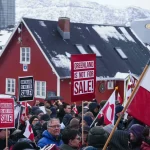
Greenland itself has rejected becoming a bargaining chip. Prime Minister Jens-Frederik Nielsen stated flatly: “We will not let ourselves be pressured. We stand firm on dialogue, on respect and on international law.”
The Davos Showdown
The confrontation will intensify this week at the World Economic Forum in Davos, where Trump is scheduled to appear on Wednesday and Thursday. Both Stoere and Merz have adjusted their schedules to attend, setting up potential face-to-face encounters that could either defuse or detonate the crisis.
Trump appeared dismissive of European resistance. “I don’t think they’re going to push back too much,” he told reporters. “Look, we have to have it.”
That confidence may prove a catastrophic miscalculation.
What Hangs in the Balance
Financial markets have already begun pricing in worst-case scenarios, with investors recalling the volatility of 2025’s trade war. European industry is rattled. The NATO alliance, already strained by disagreements over Ukraine and defence spending, faces potential collapse if Washington follows through on threats against fellow members.
The symbolism is devastating: Danish soldiers landing in Greenland on Monday for the Arctic Endurance exercise were met with Trump’s contempt. “That wasn’t a military,” he scoffed, describing it as “a few people.”
Russia, watching carefully, declined to comment on whether American designs on Greenland were positive or negative, but noted Trump would “go down in world history” if he succeeded in taking control of the Arctic island.
The Grass Beneath
When elephants fight, the grass suffers. The African proverb applies with brutal precision to this confrontation.
Smaller NATO members face impossible choices: align with Washington and betray European solidarity, or stand with Brussels and risk American abandonment. Global trade faces renewed disruption just as economies had stabilised. The rules-based international order—already fraying—could fragment beyond repair.
British Prime Minister Keir Starmer’s call for “calm discussion” reflects the desperation of allies caught between the giants. His belief that Trump isn’t seriously considering military action may be wishful thinking rather than a strategic assessment.
The ultimate question is whether either elephant possesses the wisdom to step back before the collision becomes unavoidable. Trump shows no sign of retreat. Europe cannot afford to yield.
The grass, as always, will bear the cost of their confrontation—whether it takes the form of economic chaos, alliance collapse, or something far worse.