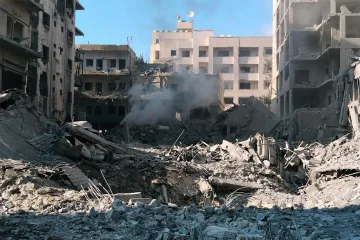
SINCE the last time I wrote for The New Humanitarian in November, the world has been busy with Christmas and New Year’s celebrations, and a news cycle jolting from one crisis to another. But in Gaza, there were no lights, no decorated trees, no festive tables, and no distraction from our daily struggles. There is only a heavy winter, an exhausted city, and people trying to survive atop layers of rubble.
Our lives are completely occupied with basic questions: How do we get through the coming night? How do we protect our children from the cold? And how do we prevent water from seeping into what little remains of our lives?
Amid our daily exhaustion – between the constant search for water, bread, and shelter from the rain – a new term has entered our lives: US President Donald Trump’s Board of Peace. At first glance, the name sounds reassuring. Peace is a word we desperately need, one we cling to like a blanket on a cold night. But the more I think about the idea, the more I feel my heart split in two.
Part of me wants to believe. It wants to hold on to any possibility of a future that is less cruel for my children. But the other part, more cautious and perhaps more wounded, sees in this board a silent danger.
How can we speak of peace when we are absent from it? How can Gaza’s future be drawn without Palestinians? There are no representatives of the people of the Strip, no voice for those who lived through the genocide, nor for those who now sleep under cracked roofs or in torn tents. As it is being presented, the Board of Peace does not seem to view us as a people with the right to self-determination, but rather as a humanitarian file that needs management, not justice.
A peace that does not include us in its making frightens me. I fear this council could turn into a new form of guardianship, another way of controlling our fate under the banner of stability. I fear our right to self-determination will become a postponed clause, a secondary detail, or something that can be bypassed under the pretext that the timing is not right.
A few days ago, I was sitting outside my rented home, watching the grey sky, when I met Basma al-Ayadi, 36, who lives in a tent nearby. She was trying to secure a piece of plastic over her tent after a harsh, rainy night. I asked her what she had heard about the Board of Peace.
She stopped working, looked at me, and said: “We are tired of big words – peace, boards, plans. None of that stops the rain from entering the tent. If this board will let my children sleep without fear, then I am with it. But if it will decide how I live and who rules me, then no. We are not political orphans.”
She paused for a moment, then added in a low voice: “I am afraid they will steal our rights while we are busy surviving.”
Daily routines
Life since I returned to Gaza City on 11 November, one month into the current ceasefire, has felt like an open-ended test, one with no clear end. A test of patience, of endurance, and of a simple yet harsh definition of survival.
I thought, perhaps naively, that returning home after being displaced to the south by Israel’s assault on Gaza City in September would mean the end of one phase and the beginning of another, less brutal one. However, I have learned that war does not end when the planes fall silent, but when a home becomes safe, water is available, and sleep is possible without fear.
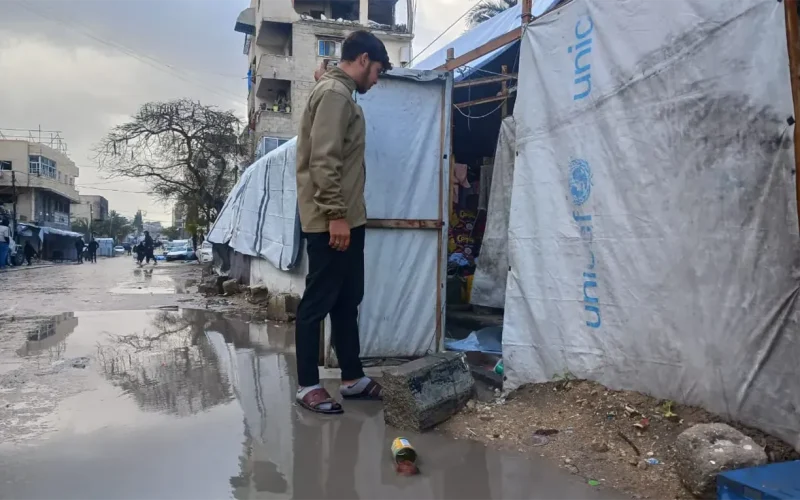
When I returned to Gaza City, where I grew up, I felt both joy and dread. I was returning to a destroyed city, but returning nonetheless. I clung to the idea that being in a house, no matter how cracked, was better than living in a tent. Today, months after that return, I realise that this is a false comparison. Houses that escaped total destruction have themselves turned into concrete tents, offering no protection from the rain and no reassurance to the heart.
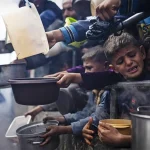
Life now begins at first light, not because we are energetic, but because we have no choice. Water is the primary concern. We go out early in search of it, carrying empty jerrycans, standing in long lines, watching the sky and watching one another in silence. Sometimes we return with barely enough for a single day. Sometimes we return empty-handed.
On the first rainy night, water started seeping in quietly, then more persistently. We placed bowls under the drips, moved mattresses, lifted clothes, but the water was faster than us. My husband and I did not sleep a wink, watching the ceiling and chasing rainwater as it streamed through the cracks.
After water, comes the race for bread. Like most women in Gaza, I knead flour every day and prepare it for baking using a clay taboon oven fuelled by wood, paper, cardboard, palm fronds – whatever we can get our hands on that will burn. Then I transform into a teacher, trying to give my children a small share of education in core subjects such as languages, mathematics, and science. My children, like all children in Gaza, have been deprived of schooling since the war began in October 2023. Their schools have been reduced to piles of rubble and destruction.
The house we rented in western Gaza City initially seemed like a form of salvation: a roof, walls, and a door that closes. But with the first winter storm, the truth revealed itself. Cracks in the ceiling – caused by intense bombardment – began to show their consequences. On the first rainy night, water started seeping in quietly, then more persistently. We placed bowls under the drips, moved mattresses, lifted clothes, but the water was faster than us. My husband and I did not sleep a wink, watching the ceiling and chasing rainwater as it streamed through the cracks.
In the morning, the smell was the first thing to greet me: dampness, spoiled food, and clothes that had not dried. I opened the wardrobe to find most of the clothes soaked. The food we had stored for days had spoiled. Bags of flour had absorbed moisture. I felt a heavy sense of helplessness, not only because what we owned was being ruined but because we had no alternative.
Shared misery
This is not my story alone. When I speak with neighbours, I hear the same narrative with different details. A woman in a nearby house says water entered her children’s room while they were sleeping. A man in his fifties tells me he did not sleep all night, sitting and watching the ceiling, fearing it might collapse. Another says bitterly, “We thought those living in houses were better off than people in tents. Now we are the same.”
At night, everything changes. The wind howls, sounds intensify, and fear becomes tangible. We sleep in our clothes, keeping our shoes close in case we need to flee. The children ask questions we have no answers for: “Will the house collapse? Will we go back to the tent?”. I answer with reassuring words, but my heart does not share my tongue’s certainty.
A few days ago, the wind became unusually strong. In a shelter camp near our home, it uprooted several tents. I could hear the sounds from afar: screams, calls for help, children crying. Shortly after, there was a knock at my door. It was a displaced family: the father carrying a soaked child; the mother holding the hand of a shivering little girl. The man said, “Our tent is completely flooded. We have nowhere to go.” I did not hesitate. I opened the door.
Soon after, a second family arrived, then a third. The small apartment filled with people. We shared the space, women and children in one area, men in another. We spread what dry blankets we had left. We sat close together, sharing what little warmth there was. That night, the house became a tent again, and the tent became an idea rather than a place. I heard a woman whisper, “Even houses no longer protect us.”
One child kept asking questions. He looked at the ceiling and said, “The rain is strong.” His mother tried to calm him, but she too kept looking upward. The fear was not imaginary. During those same days, we kept hearing news about homes collapsing on top of their residents.
Collapses and deaths
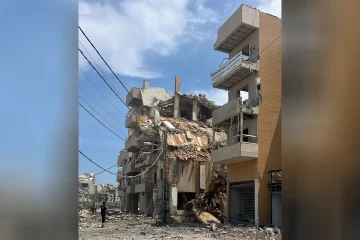
Between 12 and 15 January, a severe weather depression hit Gaza. Heavy rain, strong winds, and completely shattered infrastructure. Dilapidated houses could not withstand the pressure. Walls collapsed, roofs fell, and people were killed.
On 13 January, Mahmoud Basal, spokesperson for Gaza’s Civil Defence, said in a brief but heavy statement that rescue teams had dealt with seven deaths since the beginning of the current storm due to the partial collapses of buildings and a child who died from extreme cold. This brought the total number of victims of storms and cold weather since the beginning of winter to 31. He stressed that damaged buildings are no longer safe shelters and that the humanitarian situation is extremely dangerous.
At night, we are left alone with fear, with the sound of the wind, with water seeping in, with the idea of collapse. Many people sleep ready to flee at any moment. Some do not sleep at all.
When I heard these words, I was not shocked, but I was afraid: afraid on a deeply personal level; afraid for my children’s lives. I looked around at the walls, at the ceiling, at the cracks I know by heart. In Gaza today, death does not need a missile. Rain alone is enough.
People here talk a lot about the night. The night is the greatest enemy. During the day, we can move, search for food and water, and distract the children. At night, we are left alone with fear, with the sound of the wind, with water seeping in, with the idea of collapse. Many people sleep ready to flee at any moment. Some do not sleep at all.
A few days ago, I sat with my neighbour Umm Mohammed, a 52-year-old woman who lost her home entirely and now lives in a windowless concrete room. She told me, “We used to fear the bombing. Now we fear the rain. It is the same fear, just a different shape.”
Conflicting emotions
As for the ceasefire, emotions are conflicted. No one is celebrating it. Some see it as a fragile truce; others see it as nothing more than a pause before another round. The plans being discussed for Gaza’s future feel distant, abstract: reconstruction, governance, political horizons. But what about tonight? What about the child shivering from the cold? What about the house that might collapse?
People here are calling for trailers or mobile housing units to be allowed to enter as an alternative to tents. Several popular protests have taken place in Gaza demanding that the international community provide them, but no one is listening.
Basma’s words about the distance between the declarations of world leaders and our everyday lives keep echoing in my mind. We truly are busy surviving, and that is what makes the fear of what is being plotted for us even greater – decisions about our destiny being made while people here battle cold, hunger, and fear; Gaza’s future being drawn in distant rooms while we are simply trying to get through one night to the next without new losses.
I do not reject peace. On the contrary, I desperately want it. But peace, for me, is not a council without Palestinians nor an administration imposed from the outside. Peace is being part of the decision, not its subject – being treated as a people, not merely as a humanitarian disaster.
Between the ceasefire, the rain, the tents, and the Board of Peace, we feel suspended: neither in full war nor real peace. But we know one thing for certain – any future that does not see us or hear us will not be safe, no matter what name it carries.
For me, the ceasefire has not entered my home. It has not sealed the cracks, stopped the rain, provided water, or restored reassurance. Peace, if it exists, has not yet reached the small details that make up life.
And yet, people here do not stop. They repair what they can, cover roofs with plastic sheets, support walls with wooden beams, share what little they have, and open their homes, even if they are unsafe, to those who have nothing. This is not heroism, as some like to call it. It is a struggle for survival.
When I ask myself what has happened since the ceasefire was announced in October, the answer is clear: The war has stepped back, but suffering has moved closer. The world celebrated the New Year, and we faced the winter. The displaced returned to what remains of their homes, only to discover that return is the beginning of a new battle.
Gaza today is not a territory that has emerged from war, but one that is being tested – a test of life in the absence of all its basic requirements. And yet, we are still here. We live, we write, and we bear witness: perhaps because bearing witness is the last thing we own, and perhaps because life, despite everything, still finds a way through the cracks.
Edited by Eric Reidy.
–––––
The New Humanitarian puts quality, independent journalism at the service of the millions of people affected by humanitarian crises around the world. Find out more at www.thenewhumanitarian.org.