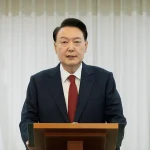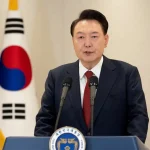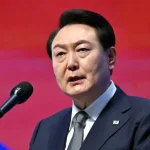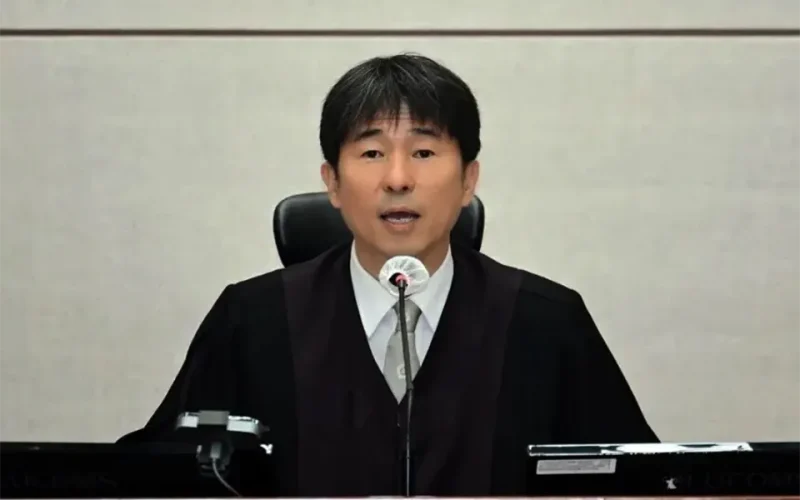
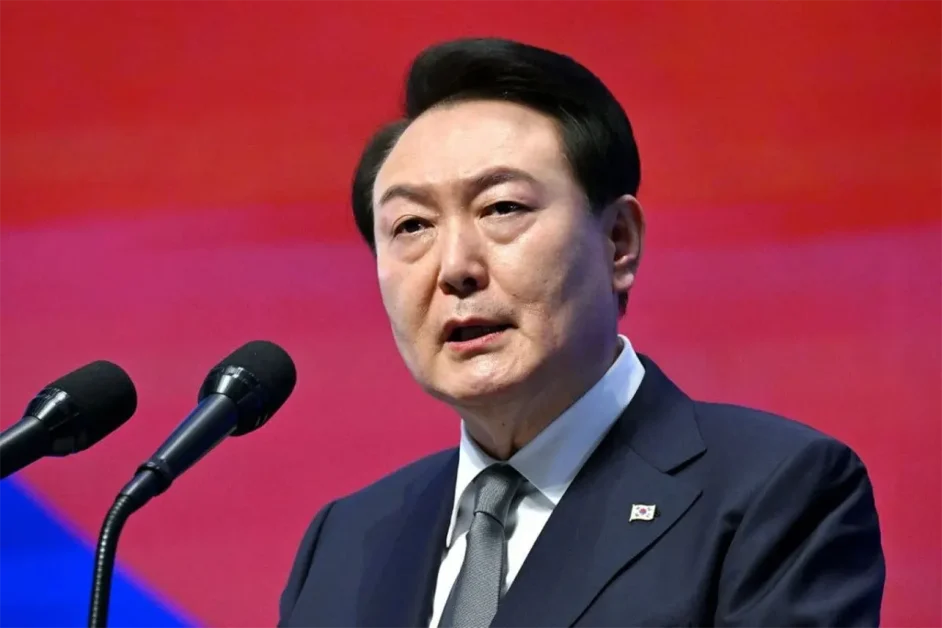
WHEN Judge Jee Kui-youn lifted his gaze to a packed Seoul courtroom on Thursday morning and pronounced a life sentence upon Yoon Suk Yeol, the 65-year-old stood ashen-faced in a dark navy suit. The former president — once the most powerful man in Asia’s fourth-largest economy — received his reckoning not from the ballot box, which he had tried to circumvent, but from the judiciary he had underestimated.
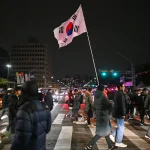
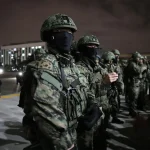
The verdict is more than a sentencing. It is a constitutional statement. In a country long tested by authoritarian temptation — military coups, state oppression, mass protest — Thursday’s ruling completes a circle that began in the chaos of December 3, 2024, when Yoon declared martial law and dispatched armed troops to the National Assembly. Those troops were turned back. Parliament voted within hours. The people flooded the streets. And now, fourteen months later, the courts have had their say.
“It is the court’s judgment that sending armed troops to parliament… and using equipment to try to make arrests all constitute acts of insurrection.”
— Judge Jee Kui-youn, Seoul Central District Court
The Architecture of the Ruling
The three-judge panel did not arrive at its decision lightly. Before delivering the sentence, Judge Jee took his courtroom on a sweeping journey through two millennia of democratic betrayal — from the collapse of Roman republican norms to the trial and execution of England’s King Charles I, who was condemned for waging war against his own parliament. The historical framing was deliberate: Yoon’s actions were to be understood not as a political miscalculation, but as a category of conduct that civilisations have condemned across centuries.
The court found that Yoon conspired with then-Defence Minister Kim Yong-hyun to subvert the constitutional order — deploying soldiers to paralyse the legislature, using equipment in attempted arrests, and incurring, in the judge’s words, “an enormous social cost” upon the nation. Kim received 30 years. Senior police officials were sentenced alongside them. The breadth of the convictions signals something beyond individual culpability: it is a judicial reckoning with an apparatus of power that believed itself untouchable.
Prosecutors had sought the death penalty — a sentence South Korea has not carried out since 1997. The life term handed down instead is, in practical terms, equally final for a 65-year-old man. But it also reflects a court unwilling to make a martyr, choosing instead a sentence designed to endure.
Six Hours That Changed Everything
The martial law declaration lasted only six hours. By any measure of immediate impact, it failed spectacularly. Citizens ran toward parliament, not away from it. Lawmakers clambered over fences to cast their votes. Soldiers stood down. The emergency was lifted before dawn. And yet those six hours cracked South Korea’s political order in ways that will not heal quickly.
What followed was a prolonged constitutional crisis: an impeachment, a snap presidential election in June 2025 won by liberal Lee Jae Myung, and a cascade of trials for the men who had gathered in the war room on the night of December 3. Yoon, who described his move as an alarm bell against opposition obstruction, watched his framing systematically dismantled in court after court. In January 2026, he was already serving a five-year sentence for obstructing his own arrest. Thursday’s life term for the underlying insurrection dwarfs that conviction into a footnote.
The Message the Courts Have Sent
Judicial systems in fragile democracies are often the last line of defence — and the first to be compromised. What makes Thursday’s verdict remarkable is precisely that it did not bend. South Korea’s courts proceeded methodically, publicly, and without apparent political interference, through eight separate trial proceedings involving a sitting — then former — head of state. The panel of three judges reached their conclusion based on the evidence and applied the law as written, including its most severe provisions.
The message encoded in the life sentence is unambiguous: democratic institutions are not procedural obstacles to be bypassed by those who command armies. They are the foundation of legitimate power, and any attempt to dismantle them by force will be treated — as it was under Roman law, as it was in 17th-century England, as it is in 21st-century Seoul — as among the most serious crimes a person can commit.
President Lee Jae Myung, posting to social media ahead of the ruling, captured something of this spirit. The nation that faced down troops without violence, he wrote, would set an example for history. Some international academics have gone further, floating a Nobel Peace Prize nomination for the Korean public itself — the ordinary citizens who streamed toward a besieged parliament on a cold December night and simply refused to let their democracy be taken from them.
The Road Ahead: Appeals, Divisions, and an Unfinished Reckoning
The verdict is not final. Yoon’s legal team has indicated they will discuss an appeal, with his lawyer publicly dismissing the ruling as one that “completely ignored the key legal principle of basing findings on evidence.” Kim’s lawyer was more direct: the former defence minister would “of course appeal.” The appellate process, including potential Supreme Court review, could extend for years — a legal marathon that will keep the wounds of December 2024 open long into the next political cycle.
Nor has the country healed. Outside the courthouse, hundreds of Yoon supporters gathered to demand his freedom, a visible reminder that South Korea remains a society fractured along lines of ideology, generation, and political identity. Ko Jeong-suk, 65, who watched the ruling at Seoul Station, voiced a different kind of grief — not satisfaction, but a fear of repetition. The life sentence, she said, should serve as a deterrent. History, she implied, has a way of forgetting.
Prosecutors, for their part, expressed “some regret” at the sentence — a cryptic formulation that suggests they may yet consider appealing upward, seeking the death penalty the panel declined to impose. That possibility, however remote, adds another layer of legal uncertainty to a case that has already consumed South Korea’s public life for more than a year.
What Endures
Democracies are tested not only by the crises that befall them, but by how they respond. South Korea’s response to the events of December 3, 2024, was — in the streets, in the legislature, and now in the courts — to hold. The institutions bent under pressure. They did not break.
There is a phrase embedded in Judge Jee’s historical preamble that cuts to the heart of Thursday’s ruling: those who take up arms against the will of the governed have always, eventually, faced judgement. The form that judgement takes has changed across centuries. The principle has not.
In a packed Seoul courtroom on a Thursday morning in February 2026, a former president in a dark navy suit heard that principle applied to him. He stood ashen-faced. The court had spoken. And in speaking, it had done what courts at their best are designed to do: remind the powerful that the law is not their instrument. It is everyone’s.