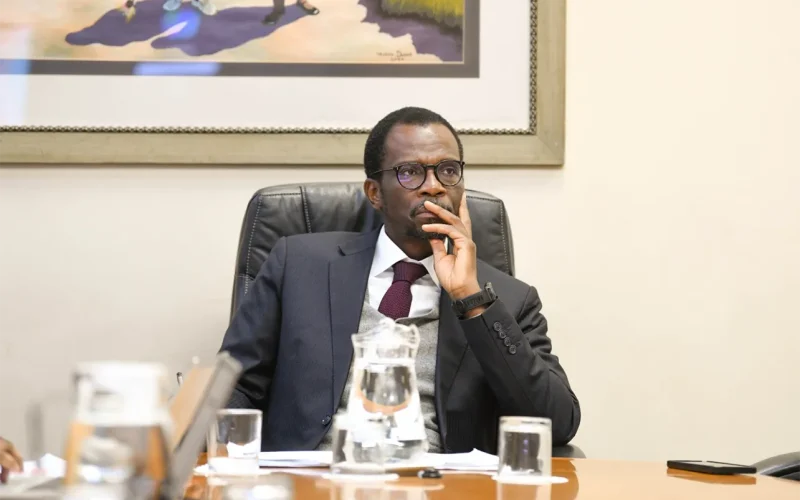
THE Johannesburg High Court has issued a sweeping interdict against businessman Ralebala Matone Mampuele, ordering him to retract defamatory allegations made against Public Investment Corporation (PIC) Chairman and Deputy Minister of Finance Dr David Masondo – and to pay punitive legal costs for refusing to desist even after being warned.
Justice Wright, delivering judgment in Masondo v Mampuele (Case 2026-032265) on Wednesday, found that a campaign of emails, media briefings and podcast appearances by Mampuele – spanning from 9 to 19 January 2026 – was “prima facie wrongful and defamatory” in that the publications “lower Mr Masondo in the eyes of ordinary, right-thinking persons.”
The ruling marks the second time the PIC has sought and obtained judicial intervention to protect its institutional reputation.
What the Court Found
The dispute has its roots in a soured business relationship. Mampuele, a director of Levoca 805, is a businessman who does or did business with the PIC. When that relationship turned acrimonious, Mampuele launched a sustained public campaign against Masondo and the PIC’s senior leadership.
Between 9 and 19 January 2026, Mampuele emailed the Public Protector, accusing the PIC’s Head of Legal of misusing state funds and taking bribes – and alleging that Masondo was complicit. He forwarded the same email to contacts in banks and businesses. He then became the named source for a widely published newspaper article alleging a “history of financial wrongdoing” at the PIC. He followed that with a further email claiming the PIC was “attempting to make hundreds of Millions from Black Entrepreneurs and benefiting a few top politicians and executives.” On 19 January, he appeared in a YouTube podcast in which he stated that Masondo was “running a scheme” and was “part and parcel of bankrupting Limpopo Treasury.”
Justice Wright drew a critical legal distinction. While acknowledging that Mampuele had a right to report alleged crimes to the proper authorities – including the Public Protector and the SAPS – the court held that this privilege does not extend to broadcasting the same allegations to private business contacts and the media. “It cannot be held,” the judge wrote, “that continued publication to any person other than the above mentioned authorities is in the public interest.”
The court was unmoved by Mampuele’s public interest defence, noting bluntly that “the weak point in Mr Mampuele’s case is that he provides no evidence to prove his allegations. There are no real disputes of fact.”
Punitive Costs and Compelled Retraction
The court’s order is unusually pointed. Mampuele was not merely interdicted from further publication. He was directed to deliver – within 24 hours – a formal written retraction to every recipient of the original defamatory emails, stating that the allegations he made against Masondo “are false and were made recklessly by me without verifying the true facts.”
He was also ordered to pay the costs of the application on the punitive attorney-and-client scale, including the costs of two counsel. Justice Wright explained that punitive costs were warranted because Mampuele “was asked to desist. He did not, and he repeated his point of view in his answering affidavit.”
The court carved out one important protection for Mampuele: the interdict expressly does not prevent him from approaching the Public Protector or the SAPS with his allegations. The judge amended the draft order presented by Masondo’s counsel, Adv Ngwako Maenetje SC, specifically to preserve that avenue.
Masondo: “A Victory for Public Servants”
In a statement released after the ruling, Masondo framed the judgment in terms that go beyond personal reputation. “This judgment transcends personal vindication; it is a victory for the public servants whose pensions and savings we are mandated to protect,” he said. “Every rand the PIC invests represents the hard work of a public official. When borrowers like Levoca and its directors default on these obligations, it is public servants who bear the cost.”
Masondo was equally direct in rebutting what he characterised as an attempt to weaponise racial or political narratives to avoid debt accountability. “The PIC remains committed to supporting entrepreneurs. There is a legal and moral obligation on beneficiaries of PIC funding, regardless of their colour, gender or geographical origin, to service their debt. The PIC does not provide grants. We invest in businesses to generate sustainable financial returns to the investment portfolios of our clients and to their beneficiaries, who, in this instance, are public sector workers.”
He added that the institution would not be deterred by reputational attacks designed to circumvent financial obligations: “The PIC maintains a zero-tolerance approach toward attempts to use defamatory tactics to evade financial accountability or undermine the fiduciary duties owed to public sector workers.”
Context: A Pattern of Litigation
The judgment is notable for what it signals about the PIC’s litigation posture. This is the second successful court intervention the corporation has secured to defend its institutional standing. The case also confirms that South African courts will not treat a business grievance – however genuine – as a licence for unverified public allegations against senior public officials.
The court’s application of Reddy v Siemens Telecommunications (Pty) Ltd [2006] SCA 164 as the governing standard for final relief on motion proceedings reflects an orthodox approach: where the respondent’s own version, taken together with admitted facts, does not justify the order sought, final relief will be granted. Mampuele’s failure to produce any supporting evidence for his corruption allegations was, in the court’s assessment, fatal to his defence.
Mampuele was represented by Adv AP Allison, instructed by Vardakos Attorneys. Masondo was represented by Adv Maenetje SC and Adv B Manentsa, instructed by Webber Wentzel.