THE history of racial discrimination in South Africa is well known.
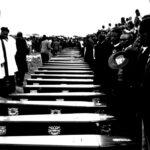
The racist apartheid system, which was declared a crime against humanity, unleashed one of its most brutal attacks in the 1970’s to 1980’s, with the massacre of students in 1976, the creation of the fake independent state of Transkei in 1976, and others subsequently, and the near permanent States of Emergency in the 1980’s. The people’s organisations, the African National Congress (ANC) and the Pan African Congress (PAC), were banned earlier, following the Sharpeville Massacre in 1960. However, the masses of our people did not bow to this onslaught from the racist regime. They rose under the umbrella of the Black Consciousness Movement with the formation of the South African Students’ Organisation (SASO) in 1968 and its official inauguration in 1969 at the University across the road from us, followed closely by the Black People’s Convention (BPC) in 1972. The assassination of Steve Biko and banning of Black Consciousness organisations in 1977 saw the masses rise again to form the Azanian People’s Organisation (AZAPO) in 1978. The racist regime responded with more aggression, but the masses rose again and launched the United Democratic Movement (UDF) in 1983.
On the legal side, the racist regime used the courts extensively to support its treatment of blacks as sub-human and continue their relegation to the margins of society, in their own land. Examples abound. In the 1953 case of R v Tusini, the court took judicial notice, meaning took it this as a true fact that required no evidence, that blacks can see and recognise people they know in the dark, where white people cannot. In two other cases, that of R v A in 1952 and the 1965 case S v M, judicial notice was taken at a trial that black women submit to rape without protest. In the later case of S V Augustine in 1980, Rumpff, then Chief Justice, made the remark that sometimes coloureds and Africans stab one another for no reason, other than ‘oënskynlike steeklus’ [apparent lust for stabbing]. (cases cited in a 2013 study, Racism and Discrimination in the South African Penal System; By Amanda Dissel and Jody Kollapen).
Of women, this is what apartheid judges had to say:
In the 1912 judgement of Incorporated Law Society v. Wookey, the full bench
of the Cape Supreme Court, led by Chief Justice Rose Innes, refused Wookey’s
application for registration of her articles of clerkship, holding that the term
‘person’ excluded women.
In 1914, the South African Law Journal published an article titled ‘Women as
Advocates and Attorneys’ written by RPB Davis, who would later be appointed
judge of the Supreme Court in the Cape. Davis referred to an American court
decision which found that women were temperamentally unsuitable for the
legal profession: ‘nature has tempered women as little for the juristical
conflicts in the courtroom as for the physical conflicts of the battlefield.’
Davis concluded that women should not ‘mix professionally in all the nastiness
of the world which finds its way into courts of justice; on the unclean issues, all
the collateral questions of sodomy, incest, rape’. Deepening the negative
stereotype, M De Villiers argued that women were ‘conspicuously unfitted’ for
the law because they ‘have no idea of relevance, or analogy, or evidence.’
On the international front, the 70’s and 80’s saw black people rose up against the racism they had endured and Britain was consumed with race riots. The pushback against the limited successes of the American Civil Rights Movement was in full throttle.
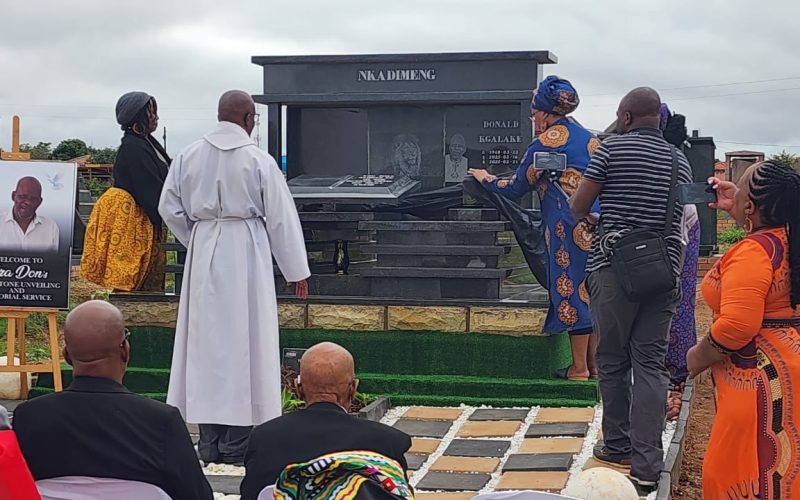
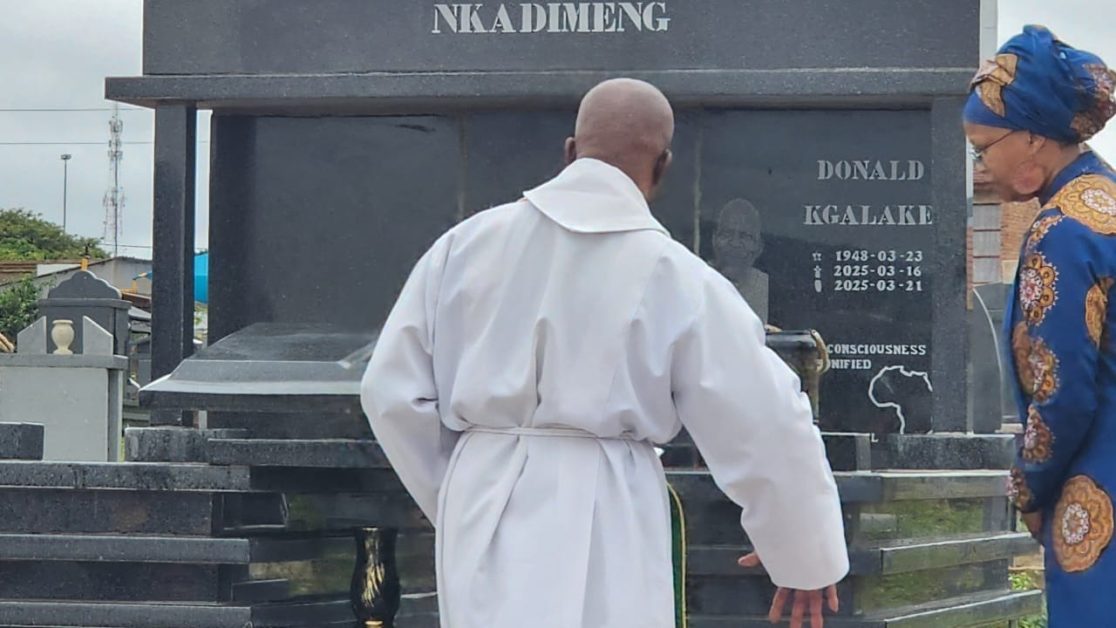
This is the theatre that Donald Kgalake Nkadimeng consciously chose to enter. On the political front, he became active in SASO when he was a law student, and went on to become one of the founders of AZAPO. On the legal front, he chose to study law and was admitted as an Attorney in 1977. The choice to practice law and become a political activist during that period in apartheid South Africa is not one that many would make. Yet this is precisely the intersection that Donald Kgalake Nkadimeng chose to sit at.
He sat at the intersection of law, justice and politics.
The pursuit of justice for black people in an unjust, apartheid South Africa is what Don Nkadimeng and his generation of black lawyers took on as their mission. They chose not only to study and practice law. They chose to use their intellect, their political acumen and their capacity to ensure that black people, despite all the unjust laws of the time, could have a glimpse of what a just society based on the universal recognition that all people are born free and equal, could look like. That generation knew that to do that would entail playing on more than just the legal theatre. They became activists; they became part of an international anti-racist movement. Don Nkadimeng knew that the liberation of his people must of necessity entail fighting the struggle on all fronts.
As I have stated before, the apartheid regime used the court system as a major enforcer and proponent of the overall racist ideology that black were lesser human beings.
The exchange between Steve Biko and Judge Boschoff in the SASO/BPC trial is instructive in this regard. While discussing SASO resolutions, the Judge asks Steve:
“Just before you leave that document, now you say you people stand for one man one vote?
Biko: Yes
Judge Boschoff: Now is it a practical concept in the African set-up? Do you find it anywhere in Africa?
Biko: Yes, we find it, even within this country.
Boshoff: Now apart from this country, I mean now let us take any other country in Africa. Do you have one man one vote in any other country?
Biko: Yes”
Clearly the judge was of the opinion that black people do not possess the necessary intelligence to elect representatives on the basis of one person one vote. This is in 1976.
Further on during the testimony, Judge Boschoff returns to his disdain for Black people:
“Well, take the Gold Standard, if we were to debate whether this government should go on the Gold Standard or go off the Gold Standard, will you feel that you know enough about it to be able to cast an intelligent vote about that?
Biko: Myself?
Boschoff: Yes?
Biko: I think probably better than the average Afrikaner in the street, My Lord.”
The African- American activist, lawyer, journalist Millard Arnold, who we can now claim as a South African, writes in his book, the Testimony of Steve Biko, that Don Nadimeng was reportedly stunned by Biko’s appearance at the SASO/BPC trial:
“Steve spoke his mind in that court. He could display his intellectual superiority so superbly, and there were times when we – as the audience – would wonder whether Steve himself was the judge and the judge the accused. Judge Boschoff was surprised at the quality of the man and the testimony. It was clear that he never expected that he was questioning a witness who had written extensively on the philosophy which was on trial. He was so shocked that he almost stopped the trial.”
Don Nkadimeng understood that he was fighting a system, the white supremacist system. One of his legal colleagues who also understood the system for what it was, Bram Fischer, said in his statement from the dock during his trial in 1966 in the State v Abram Fischer and thirteen others:
“1. I am on trial for my political beliefs and for the conduct to which those beliefs drove me. Whatever labels may be attached to the fifteen charges brought against me, they all arise from my having been a member of Communist Party and from my activities as a member. I engaged upon those activities because I believe that, in the dangerous circumstances, which have been created in South Africa, it was my duty to my fellow citizens to do so. (Political belief and conduct cannot be separated. I believe that to hold a belief and to fail to set upon it constitutes cowardice)
2. When a man is on trial for his political beliefs and actions, two courses are open to him. He can both confess to his transgressions and plead for mercy or he can justify his beliefs and explain why he acted as he did. Were I to ask forgiveness today I would betray my comrades. That course is not open to me. I believe that what I did was right. I must therefore explain to this Court what my motives were: why I hold the beliefs that I do (certain beliefs) and why I was compelled to act in accordance with them.
4. There is another and more compelling reason for my plea and why I persist in it. I accept the general rule that for the protection of a society laws should be obeyed. But when laws themselves become immoral and require the citizen to take part in an organised system of oppression – if only by his silence or apathy – then I believe that a higher duty arises. This compels one to refuse to recognize such laws. The laws under which I am being prosecuted are enacted by a wholly unrepresentative body, a body in which three-quarters of the people of this country have no voice whatever.
These laws were enacted, not to prevent the spread of communism, but for the purpose of silencing the opposition of the large majority of our citizens to a Government intent upon depriving them, solely on account of their colour, of the most elementary human rights, of the right to freedom and happiness, the right to live together with their families wherever they might choose, to earn their livelihoods to the best of their abilities, to rear and educate their children in a civilized fashion, to take part in the administration of their country and obtain a fair share of the wealth they produce; in short, to live as human beings. My conscience does not permit me to afford these laws such recognition, as even a plea of guilty would involve. Hence, though I shall be convicted by this Court, I cannot plead guilty. I believe the future may say that I acted correctly.”
Don Nkadimeng and his generation employed effective tactics to confront the scourge of apartheid not only in the courts. They employed the known tactics of struggle; mobilisation, organisation and solidarity. They knew that organisation was an important element, hence they formed the Black Lawyers Association. They reached out across the world, in pursuit of the common liberation goal. Legal luminaries in the struggle for black liberation, such as Judge Leon Higginbotham became part of the Black Lawyers Association supporters. Judge Higginbotham, he who’s favourite poem, Dream of Freedom by Langston Hughes, ends with this line:
“This dream today embattled
With its back against the wall
To save the dream for one
It must be saved for All.”
in one of his judgements, Commonwealth v Local Union 542 (1974), where the litigants applied for his recusal because he was Black and had addressed gatherings of largely black Americans, had this to say:
“When stripped to its essence, the gravamen of defendants’ objection seems primarily based on the following express or implicit allegations:
(1) I am black;
(2) Some of the defendant union’s members are white;[7]
(3) The instant case involves a claim of racial discrimination;
I concede that I am black. I do not apologize for that obvious fact. I take rational pride in my heritage, just as most other ethnics take pride in theirs. However, that one is black does not mean, ipso facto, that he is anti-white; no more than being Jewish implies being anti-Catholic, or being Catholic implies being anti-Protestant. As do most blacks, I believe that the corridors of history in this country have been lined with countless instances of racial injustice.
In many ways this opinion may appear to be too long and prolix. But if defendants’ arguments are asserted in good faith and sincerity, they nevertheless represent an almost subconscious expression of their expectation of the deportment of blacks and, more specifically, of black judges. If America is going to have a total rendezvous with justice so that there can be full equality for blacks, other minorities, and women, it is essential that the “instinct” for double standards be completely exposed and hopefully, through analysis, those elements of irrationality can be ultimately eradicated. It is regrettable that in this case I must take substantial time and effort to answer defendants’ meritless allegations, but in some respects the motions merely highlight the duality of burdens which blacks have in public life. Blacks must meet not only the normal obligations which confront their colleagues, but often they must spend extraordinary amounts of time in answering irrational positions and assertions before they can fulfill their primary public responsibilities”.
Don Nkadimeng understood the difference between law and justice.
Writing in the Northwestern University School of Law Scholarly Commons Faculty Working Papers in 2011, Anthony D’Amato defines law as “officially promulgated rules of conduct, backed by state-enforced penalties for their transgression” and justice as “rendering to each person what he or she deserves”.
Apartheid South Africa was, for black people, the antithesis of justice, and because Don Nkadimeng knew that “the arc of history is long, but it bends towards justice” he knew what to do every time he came to the intersection of law and justice.
The practice of law is regulated by a myriad of rules. One of those is that a practitioner must collect funds first before acting on behalf of a client. The argument is that to do otherwise would amount to touting, which is not allowed.
Don Nkadimeng understood the demands of the period during which he started practice. Steve Biko was murdered by the apartheid police. Makompo Kutumela was murdered by apartheid police. Thousand of young people were routinely rounded up and locked up in terms of the apartheid unjust laws, most times without anyone in their families knowing. Most of these young people or their families did not have any money. One of these young activists was Peter Mokaba, who was to become a leading figure in the ANC. There was no state support for indigent accused and they would not have accepted lawyers appointed by the very state they sought to destroy. Under those circumstances, there was no space or time to first collect monetary deposits from these thousands of young people, or their families. But because Don Nkadimeng’s arc pointed towards justice, he took it upon himself to defend all of these young heroes without having received a penny from them and for that, the system punished him. There were international organisations that assisted with funding those cases, but funding would invariably be inadequate and received late, opening attorneys to the risk of being blacklisted for failing to pay counsels fees. That would have meant the inability to field advocates such as Dikgang Moseneke, who was briefed in the case of the murder of Makompo Kutumela.
Don decided not to leave these young activists fully exposed to the cruelty of the apartheid regime. He defended them, without any financial cover. This country owes Don Nkadimeng a medal of honour. Most of the young people he defended have gone on to occupy very important leadership positions in our country.
Lawyers before him had chosen justice over the law and have been commended for that. To return to Bram Fischer. On 25 January 1965 he failed to appear in court. His counsel read a letter he had received from Bram, dated 22 January 1965. The letter stated:
“By the time this reaches you I shall be a long way from Johannesburg and shall absent myself from the remainder of the trial. But I shall still be in the country to which I said I would return when I was granted bail. I wish you to inform the Court that my absence, though deliberate, is not intended in any way to be disrespectful. Nor is it prompted by any fear of the punishment which might be inflicted on me. Indeed I realise that my eventual punishment may be increased by my present conduct… My decision was made only because I believe that it is the duty of every true opponent of this Government to remain in this country and to oppose its monstrous policy of apartheid with every means in its power. That is what I shall do for as long as I can…
…I can no longer serve justice in the way I have attempted to do during the past thirty years. I can do it only in the way I have now chosen.”
A further letter from Fischer dated 4 February 1965 was also made available to the Court, the relevant portions thereof stated:
When an advocate does what I have done, his conduct is not determined by any disrespect for the law nor because he hoped to benefit personally by any ‘offence’ he may commit. On the contrary, it requires an act of will to overcome his deeply rooted respect of legality, and he takes the step only when he feels that, whatever the consequences to himself, his political conscience no longer permits him to do otherwise. He does it not because of a desire to be immoral, but because to act otherwise would, for him, be immoral”.
Bram Fischer has correctly been honoured for defying apartheid laws.
Don Nkadimeng also placed the well-being of his staff ahead of his own needs. I have spoken about how he supported me as a candidate attorney when I was not bringing any income into the firm due to pregnancy complications. Not once did he fail to pay my salary in the seven months I was away from the office. A true feminist, when feminism was not even a buzzword in this country.
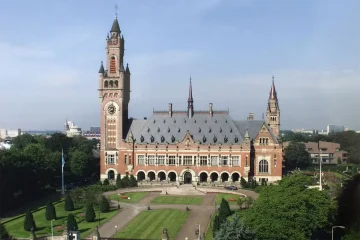
There are rare circumstances where the law and justice walk along the same path, but other circumstances override that. In the case submitted by South Africa against Israel, before the International Court of Justice (ICJ), international law sets our circumstances under which genocide can be established. The law, as set out in the Convention on the Prevention and Punishment of the Crime of Genocide states:
“In the present Convention, genocide means any of the following acts committed with intent to destroy, in whole or in part, a national, ethnical, racial or religious group, as such:
(a) Killing members of the group;
(b) Causing serious bodily or mental harm to members of the group;
(c) Deliberately inflicting on the group conditions of life calculated to bring about its physical destruction in whole or in part;
(d) Imposing measures intended to prevent births within the group;
(e) Forcibly transferring children of the group to another group”.
Don would explain that the Palestinian people are in fact a national group as described in the Convention. He would state without equivocation that they are being targeted and killed as a group. He would not tolerate a play with words such as “Genocide is a big word”, while people are dying. Justice demands that they be protected.
Despite huge pressure brought to bear upon the ICJ, the interim ruling erred on the side of the law and the demands of justice, to a large extent, stating, among others, that:
THE COURT,
Indicates the following provisional measures:
(1) By fifteen votes to two,
The State of Israel shall, in accordance with its obligations under the Convention on the Prevention and Punishment of the Crime of Genocide, in relation to Palestinians in Gaza, take all measures within its power to prevent the commission of all acts within the scope of Article II of this Convention, in particular:
(a) killing members of the group;
(b) causing serious bodily or mental harm to members of the group;
(c) deliberately inflicting on the group conditions of life calculated to bring about its physical destruction in whole or in part; and
(d) imposing measures intended to prevent births within the group;
IN FAVOUR: President Donoghue; Vice-President Gevorgian; Judges Tomka, Abraham, Bennouna, Yusuf, Xue, Bhandari, Robinson, Salam, Iwasawa, Nolte, Charlesworth, Brant; Judge ad hoc Moseneke;
AGAINST: Judge Sebutinde; Judge ad hoc Barak;
(2) By fifteen votes to two,
The State of Israel shall ensure with immediate effect that its military does not commit any acts described in point 1 above;
IN FAVOUR: President Donoghue; Vice-President Gevorgian; Judges Tomka, Abraham, Bennouna, Yusuf, Xue, Bhandari, Robinson, Salam, Iwasawa, Nolte, Charlesworth, Brant; Judge ad hoc Moseneke;
AGAINST: Judge Sebutinde; Judge ad hoc Barak;
(3) By sixteen votes to one,
The State of Israel shall take all measures within its power to prevent and punish the direct and public incitement to commit genocide in relation to members of the Palestinian group in the Gaza Strip;
IN FAVOUR: President Donoghue; Vice-President Gevorgian; Judges Tomka, Abraham, Bennouna, Yusuf, Xue, Bhandari, Robinson, Salam, Iwasawa, Nolte, Charlesworth, Brant; Judges ad hoc Barak, Moseneke;
AGAINST: Judge Sebutinde;
– 9 –
(4) By sixteen votes to one,
The State of Israel shall take immediate and effective measures to enable the provision of urgently needed basic services and humanitarian assistance to address the adverse conditions of life faced by Palestinians in the Gaza Strip;
IN FAVOUR: President Donoghue; Vice-President Gevorgian; Judges Tomka, Abraham, Bennouna, Yusuf, Xue, Bhandari, Robinson, Salam, Iwasawa, Nolte, Charlesworth, Brant; Judges ad hoc Barak, Moseneke;
AGAINST: Judge Sebutinde;
(5) By fifteen votes to two,
The State of Israel shall take effective measures to prevent the destruction and ensure the preservation of evidence related to allegations of acts within the scope of Article II and Article III of the Convention on the Prevention and Punishment of the Crime of Genocide against members of the Palestinian group in the Gaza Strip;
IN FAVOUR: President Donoghue; Vice-President Gevorgian; Judges Tomka, Abraham, Bennouna, Yusuf, Xue, Bhandari, Robinson, Salam, Iwasawa, Nolte, Charlesworth, Brant; Judge ad hoc Moseneke;
AGAINST: Judge Sebutinde; Judge ad hoc Barak;
(6) By fifteen votes to two,
The State of Israel shall submit a report to the Court on all measures taken to give effect to this Order within one month as from the date of this Order.
IN FAVOUR: President Donoghue; Vice-President Gevorgian; Judges Tomka, Abraham, Bennouna, Yusuf, Xue, Bhandari, Robinson, Salam, Iwasawa, Nolte, Charlesworth, Brant; Judge ad hoc Moseneke;
AGAINST: Judge Sebutinde; Judge ad hoc Barak.”
What is interesting to note about this ruling is that even the judge appointed by the Israeli government specifically for this case found it necessary, on at least two areas, that the State of Israel needed to be put under caution. That is the mark of judicial training, which teaches us to adjudicate without fear or favour. However, despite the ruling of the court, those who consider themselves as untouchable totally ignored the law and the ruling of the court.
Again, the life of Don Nkadimeng points us in the right direction on what our response to this impunity should be. When the enemy thinks that it has within itself the power to override all laws, we go back to the trenches and organise. After the near death of the ANC and PAC within the country, due to their long banishment, Don and others took up the responsibility to build a strong movement within the country. He, together with others, founded AZAPO, which mobilised and invigorated the masses of our people to confront the regime on all fronts, without fear. He travelled abroad extensively to mobilise support for AZAPO.
To come back to the present, how do we analyse the balance of forces today and, knowing Don as we do, what should our response be?
Let us, for a moment, sit at Don Nkadimeng’s corner, at the intersection of law, justice and politics. What do we see and what do we do about it?
On the legal front, the transition to democracy in South Africa is supposed to have introduced laws that are just. With regard to legislation, the case of Moseneke v The Master of the High Court, decided in 2000, comes to mind. In the Constitutional Court judgement, Justice Albie Sachs said:
“It is painful that the Act (the Black Administration Act of 1927) still survives at all. The concepts on which it was based, the memories it evokes, the language it continues to employ, and the division it still enforces, are antithetical to the society envisaged by the Constitution. It is an affront to all of us that people are still treated as blacks rather than as ordinary persons seeking to wind up a deceased estate, and it is in conflict with the establishment of a non-racial society where rights and duties are no longer determined by origin or skin colour”.
Justice Van der Westhuizen, in 2015 in Khohliso v The State, said:
“It is rather odd that – 20 years into our constitutional democracy – we are left with a statute book cluttered by laws surviving from a bygone era remembered for the oppression of people; the suppression of freedom; discrimination; division; attempts to break up our country; and military dictatorship…
“Ms Nokhanyo Khohliso, the applicant, is a traditional healer in the Transkei in the Eastern Cape Province. She was charged with and convicted in the Tsolo Magistrates’ Court of being in possession of two vulture’s feet. She wanted to mix a substance made from the feet with other ingredients to produce a much needed remedy in our land, namely medicine that protects against theft. Ms Khohliso was sentenced to pay a fine of R4 000, or to twelve months imprisonment, suspended for five years.
[3] Possession of vulture’s feet is a criminal offence under Decree 9, issued on 24 July 1992 by the President of the Republic of Transkei. The President did so on the advice of the territory’s Military Council.
When the interim Constitution came into force in 1994 and the final Constitution in 1997, the former homelands were accepted as part of one united democratic South Africa. In the interest of legal certainty – given the different applicable laws in the homelands and other parts of South Africa – the final Constitution provided that any law in force when the new Constitution took effect remained in force as long as it was consistent with the Constitution and had not been repealed or amended”.
An interesting case this is.
We have a Parliament of the people, by the people, that has clearly been slack in implementing its primary mandate, which is the destruction of the legacy of apartheid. At every opportunity we hear chants to the effect that apartheid was declared a crime against humanity, but no urgency is evident in dismantling its evil legal system. For example, one of the political parties in Parliament swears allegiance to the Constitution. The opening line of that Constitution states that “We the people of South Africa, Recognise the injustices of our past” and the rest of the Constitution continues to set out a myriad of measures to correct those past injustices. Part of those are the laws that excluded Black people from economic activity, as well as access to economic assets. However, it the very same parliamentary party that opposes Black Economic Empowerment. And they get away with it. Many of the victims that the Constitution seeks to protect are the ones lauding that party.
On international solidarity, Don would be at the forefront of calling for erstwhile colonizers, who remain present day controllers, to stop sponsoring the massacre of the people of Sudan. He would be involved in giving content and meaning to the African Union designation of 2025 as the “Year of Justice for Africans and people of African Descent Through Reparations”. The United Nations Committee for the Elimination of Racial Discrimination is finalising the drafting of General Recommendations on Reparations. That process is led by one of the supporters and champions of the BLA, Ms Gay McDougall, ably assisted, among others, by another one of our BLA members, Advocate Pansy Tlakula.
The Prime Minister of Canada, Mark Carney, was lauded recently when, on the margins of the meeting of the 2026 World Economic Forum, he stated that the rules-based international order is on its knees. Don Nkadimeng would have explained that that rules-based international order has never benefited countries of the South. Ask Cuba, Haiti, Lydia, Iraq, Iran, Zimbabwe, Ivory Coast. The list is long.
In addition, Don would have asked the honorable Canadian Prime Minister to explain why, after such a revelation, his country has to date not joined the action brought by South Africa against Israel? Why his country has not taken strong action against the Unites States after they kidnapped President Maduro of Venezuela? In that Davos speech, the Prime Minister correctly references the Chech dissident Vaclav Havel, who stated that evil systems sustain themselves not through violence alone, but through the participation of ordinary people. He says “the system’s power comes not from its truth, but from everyone’s willingness to perform as if it were true, and its fragility comes from the same source. When even one person stops performing … the illusion starts to crack. Friends, it is time for companies and countries to take their signs down”. We wait with great anticipation for Canada to take its sign down.
On the domestic political front, what of us here who call ourselves Don Nkadimeng’s comrades? How have we allowed his country to be in this state, where public funds have been privatized, while children die in pit toilets and through gunshots? We do not even pause for one moment when the unemployment statistics are released. Over 3.5 million young people are not in employment, education or training. We live with criminals in our midst. Justice Madlanga observed, after listening to a senior police officer testify at his Commission, that if senior police officers are scared of criminals, what of ordinary South Africans. We know the people who protect the criminals and most times we know the criminals themselves.
Instead of focusing on matters of national interest, we are completely sidetracked by irrelevant matters such as squabbles within and among ourselves. While doing that we forget that white supremacy never ever concedes power. It would have indeed been a miracle if it were to do so here in South Africa. It has not. We should be awake to the fact that current geopolitical incidents are not happening in isolation. The American President knows very well that there is no white genocide in South Africa. He has a very able intelligence machinery that has told him so. The fact that he can, in 2026, decide that he’s going to look after white people only in South Africa and does not get completely and comprehensively reprimanded by us and the world must tell us that he was testing something. He was testing whether our unity has been sufficiently weakened. And we have been found wanting. The next steps might shake us to the core. Young people were telling me that Ms Helen Zille is going to win the mayoral chain in Johannesburg. So, Cape Town and Johannesburg will again be subject to a white-focused agenda, while we look on and continue with distractions.
Toni Morrison famously stated that the “very serious function of racism is distraction,” arguing it prevents individuals from doing their work by forcing them to constantly explain their reason for being. “Somebody says you have no language and you spend twenty years proving that you do”.
We must acknowledge that we let our guard down. We fell into the old age divide and rule trap. This country deserves better. Don and his generation exposed us to the true meaning of Consciousness. The best we can do in honour of that generation’s struggle, is to wake up, return to the sources and course correct.
Let me end with a story that typifies Don’s humanity, sense of justice and sharp wit.
On one of the regular days in the office, Don Nkadimeng came out of a long consultation with a tired look. On inquiry, he told us, his colleagues, that he has just sat through a long consultation with a new client and did not think that his advice was taken seriously by the client. The client was giving him instructions to sue that client’s fellow worker for defamation. When we asked Don what his advice was, he explained it, at length. Apparently the alleged defamer had uttered some choice words about this client, in public. The client did not respond in kind. She left the scene very upset, feeling embarrassed and humiliated and came straight to the lawyers to institute defamation action, which is the correct legal thing to do. Don Nkadimeng, however, sitting at the intersection of law and justice, pointed her to a somewhat unexpected path. He told her that, according to the law, her matter will probably be heard in about three years, in a sterile court with procedures unfamiliar to her. By then she would probably not be as upset as she was now, the people who witnessed her humiliation will not be there and if she succeeds in the matter, she will probably be granted a pittance in compensation, all that against huge amounts she would have paid to her lawyers. He advised her to go back to the scene of her humiliation and give back as much as she received, or more, to the person who offended her. That way, justice will be served.
The long drawn-out process of suing for defamation was not going to render to that client what she deserved, a defence and restoration of her dignity at the right time, at the right place, in the best, just manner. This example, light-hearted as it may seem, captures the essence of what Don Nkadimeng represented, justice over legal prescripts.
From this generation to his , from me and many other legal and political minds that Don shaped and nurtured, to him, our Mwalimu, we say, borrowing from the last two stanzas of the poem Roots, by the Ghanaian Stella Dadzie, published in the International anthology put together by the award winning author Margaret Busby, that:
“Tomorrow I shall be here still,
wiser and sturdier than before
I have withstood the fury of thunder
the rage of forest fires
I know
my life force
will prevail
And if by chance
an ax should fell me
should I succumb
to the vengeance of the hurricane
or the slow, creeping stealth
of nature’s wrath
I shall sink gratefully into the earth
That has sustained me
returning my gifts
so that others
may grow to touch
the sky”
This is what Don Nkadimeng did – returned his gifts so that others may grow to touch the sky. We thank you, Don, our Mwalimu.
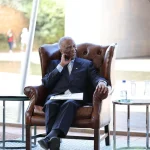
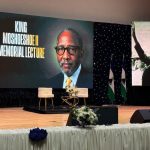
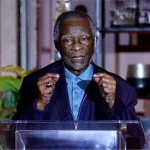
- This Is An Edited Version Of A Memorial Lecture In Honour Of Donald Kgalake Nkadimeng By Advocate Mojanku Gumbi
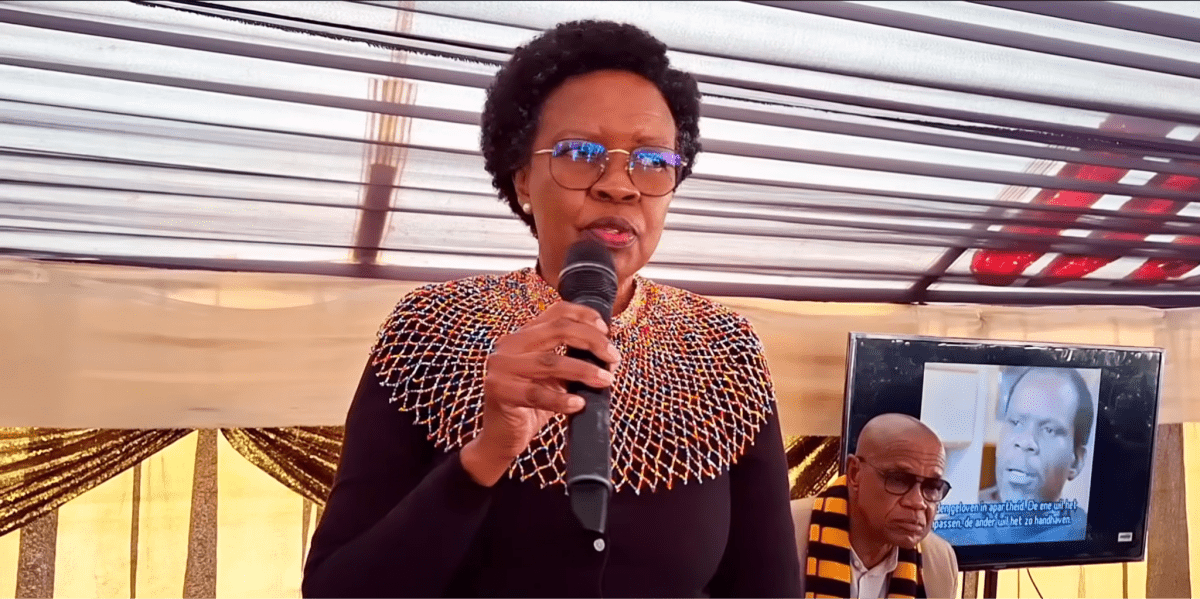
Mojanku Gumbi