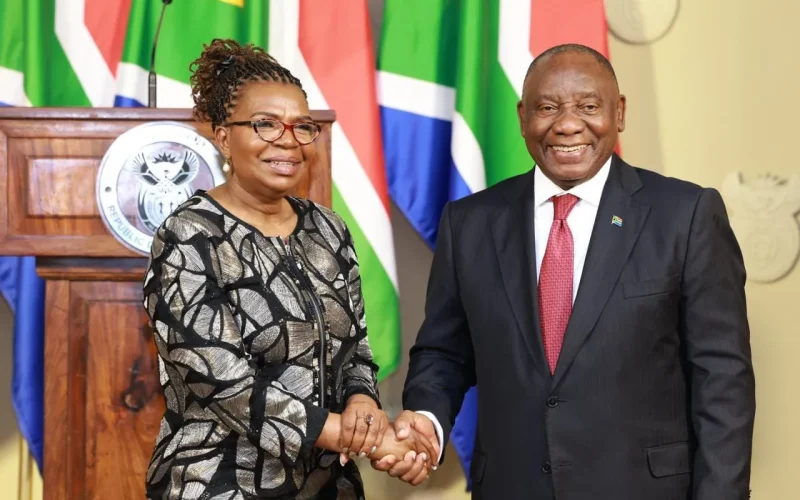
THERE are political mistakes, and then there are mistakes that tell a nation exactly how little its leadership has learned. President Cyril Ramaphosa’s decision to appoint Dina Pule as Minister of Social Development belongs unmistakably to the second category. It is not merely an unforced error. It is a self-inflicted wound, delivered at the worst possible moment, to a presidency and a governing party that can no longer survive the political bleeding.
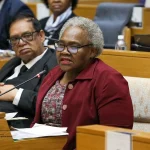
Let us be precise about what just happened, because precision is the first casualty when the ANC tries to manage a story like this one. Sisisi Tolashe was removed as Minister of Social Development on 14 May 2026 and marched out of the Union Buildings after a sustained campaign by opposition parties over allegations that two luxury SUVs, donated to the ANC Women’s League and registered in her children’s names, amounted to fraud and a violation of her duties to Parliament. Before that, her department was already reeling from reports that she had unlawfully installed a 22-year-old with a doctored CV as her acting chief of staff on a salary exceeding a million rand, and from the dismissal of a departmental spokesperson widely seen as punished for raising governance concerns. Criminal charges were laid. The Public Protector and Parliament’s Ethics Committee were both seized with complaints. The ANC itself referred her to its own disciplinary committee for damaging the party’s reputation.
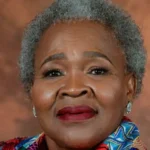
That is the backdrop. That is the wound the President needed to close. And his answer, after six weeks of vacancy and an acting minister holding the fort, was to hand the social welfare of the most vulnerable South Africans to a woman whose own ministerial career ended in one of the most thoroughly documented ethics scandals in the country’s democratic history.
Dina Pule is not a fresh face dimmed by old rumour. She is a politician whose conduct was formally investigated, formally adjudicated, and formally condemned by two separate constitutional processes. Parliament’s Joint Committee on Ethics and Members’ Interests found, after a lengthy inquiry, that she had concealed her relationship with businessman Phosane Mngqibisa and that he had improperly benefited to the tune of millions of rand in connection with the 2012 ICT Indaba, while the department covered his international travel. The committee further found that she had wilfully misled its own panel under oath. Separately, then-Public Protector Thuli Madonsela reached the same conclusion, finding her conduct unlawful and her testimony marked by persistent dishonesty, and recommending a criminal investigation into her dealings.
This was not a whisper campaign. It was not an unproven allegation hanging in the air the way so much does in South African politics. It was adjudicated. It was found, by Parliament and by the Public Protector, to be true. Pule left the communications portfolio in 2013 under exactly the kind of cloud that now hangs over the woman she is replacing, and when the ANC attempted to quietly return her to the National Assembly in 2014, public outrage forced her to withdraw.
Has the President Read the Room?
It is worth asking, plainly, whether Ramaphosa understands the country he is governing. South Africans are not tired of politics. They are not even, primarily, tired of poverty, though that exhaustion runs deep. They are tired, specifically and pointedly, of watching the same cast of compromised figures recycled through cabinet while the institutions meant to hold them accountable, the Madlanga Commission, the SIU, the NPA, work overtime trying to claw back what state capture and its aftershocks have cost the country. Every reshuffle is now read through that lens because the public has earned the right to read it that way.
Against that backdrop, appointing Pule is not a neutral personnel decision. It is a message, whether intended or not, and the message is unmistakable: that accountability has an expiry date, that reputational rehabilitation in the ANC requires nothing more than the passage of time and a faction willing to back you, and that the lessons of Dinagate, like the lessons of Tolashe’s SUVs, will be forgotten the moment a new portfolio needs filling.
Reporting on the internal process makes the failure worse, not better. This was not an emergency appointment forced on the President with no alternatives. The ANC Women’s League pushed hard for its own deputy secretary-general, but other names, Peace Mabe and Pemmy Majodina among them, were reportedly on the table at the ANC’s Top Six and Top Seven discussions. Ramaphosa had room to choose. He had, in nine provinces and a governing alliance of considerable depth, the option of a credible, capable, scandal-free woman to step into a portfolio that desperately needed a clean break. He chose factional appeasement instead. That is a decision he made with his eyes open, not one forced upon him by circumstance.
What makes this miscalculation genuinely dangerous, rather than merely embarrassing, is timing. Ramaphosa leads a Government of National Unity held together by a coalition that did not choose the ANC out of enthusiasm but out of arithmetic. His own internal position within the party is not unassailable. Every poll, every by-election result, every piece of ground-level reporting from this newsroom and others points to an ANC haemorrhaging support, much of it specifically over the perception that the party protects its own ahead of the public it claims to serve. This was the moment to demonstrate the opposite. Instead, the President has handed the DA, ActionSA, and every opposition party watching from the wings a ready-made talking point that requires no embellishment, because the facts speak clearly enough on their own.
The cruellest irony is that the appointment does nothing to repair the reputational damage Tolashe inflicted on the Department of Social Development, the very department South Africans depend on for SASSA grants and the welfare safety net that millions of the poorest citizens rely on month to month. It deepens it. The conversation that should have been about restoring confidence in grant administration and departmental governance has instead become a conversation about Pule’s own history, about how she survived the wilderness years after 2013, and about whether her elevation by the ANC Women’s League reflects factional reward rather than fitness for office.
That is not the focus a struggling presidency can afford to generate for itself. The question South Africans are now asking is not what Dina Pule intends to do for social welfare. It is how long before the next scandal lands, and how much credibility this presidency has left to absorb it when it does.
Ramaphosa came into this second term promising renewal, a clean break from the era his own party allowed to fester. With this appointment, he has instead offered proof of the opposite: that when the ANC needs to fill a portfolio, its bench of trusted names still runs through the same compromised territory it has occupied for over a decade. That is not a minor political miscalculation. It is a fatal one. Fatal to the credibility this presidency needs most and can least afford to keep spending.