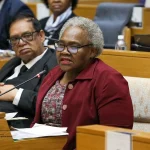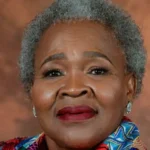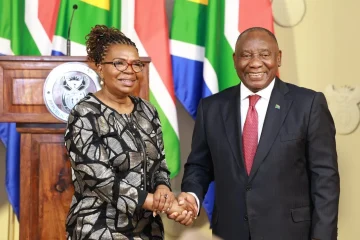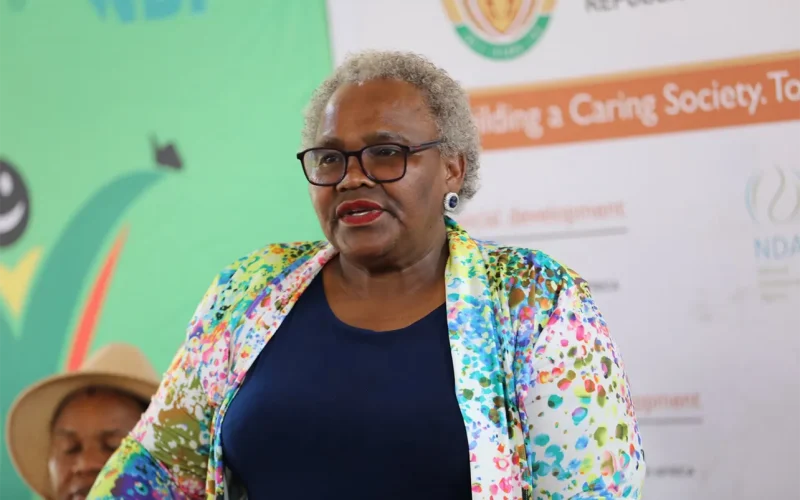
IN South African politics, survival is rarely about innocence. It is about weight. Political weight – the kind that bends institutional levers, softens presidential spines, and protects the powerful from the consequences ordinary citizens face every day. By that brutal measure, Social Development Minister Nokuzola Sisisi Tolashe has, until now, been very heavy indeed.
She is President of the ANC Women’s League, a formation that carries both historic prestige and contemporary factional muscle. She is a Cabinet minister in a Government of National Unity that Cyril Ramaphosa assembled with painstaking care. She is, in the language of movement politics, connected. And so, as scandal after scandal has cascaded through her department, the question that has stalked each new revelation is the same: how much is too much, even for her?
That question is now being asked with unprecedented urgency, as investigators, opposition parties, ethics watchdogs and, most pointedly, the President himself have all found reasons to confront Tolashe’s conduct. The answer Ramaphosa gives – or fails to give – will define not just one minister’s fate, but the credibility of accountability in the GNU.
The most explosive element of the current crisis involves two Chinese-manufactured BAIC Beijing X55 SUVs – one white, one yellow – collectively valued at close to R1 million, received from officials linked to the Chinese government. The vehicles, which attracted attention after photographs of them began circulating, triggered a parliamentary question from ActionSA MP Dereleen James in December 2025, asking the minister what had become of the cars.
Tolashe initially ignored the question – itself a breach of parliamentary rules requiring Cabinet members to respond within ten working days. When James resubmitted the question after Parliament resumed in 2026, Tolashe replied on 12 February, writing that she “deeply respects the Constitutional role of Parliament as the supreme body for accountability.” Her answer, however, told a different story.
She denied receiving the vehicles herself. The cars, she said, had been donated to the ANC Women’s League, which she leads, and there was therefore no need to declare them in the official register.
“The vehicles were donated to the ANC Women’s League. There was therefore no need to declare or record them in the official register,” -Minister Tolashe to Parliament, February 2026
There was one immediate and catastrophic problem with this explanation: neither the ANC nor the ANCWL knew what she was talking about. Senior officials in both structures told the media they had no knowledge of any such donation. The ANC, as Tolashe would well know, is legally required to declare all donations above a threshold to the Electoral Commission of South Africa. No such declaration was made.
Investigative reporting by the Daily Maverick then produced the most damning evidence of all. Vehicle registration records obtained from the South African National Traffic Information System showed that, as of 15 April 2024, both cars had been registered in the names of Tolashe’s children. The white SUV was registered to Nanilethu Tolashe, her son. The yellow SUV was registered to Kanyisa Tolashe, her daughter. The daughter subsequently sold her vehicle through the online marketplace Weelee on 28 October 2025 – a transfer that occurred in the weeks following Daily Maverick’s first major investigative series into the department, raising obvious questions about whether the disposal was motivated by the mounting public pressure.
The white SUV, records suggest, remains in Nanilethu Tolashe’s possession.
CRIMINAL CHARGES AND ETHICS COMPLAINTS
ActionSA moved swiftly. The party opened a criminal corruption case against Tolashe at a South African Police Service station. Simultaneously, it lodged a complaint with the Public Protector alleging breaches of the Executive Members’ Ethics Act, and submitted a formal complaint to Parliament’s Ethics Committee for violations of the Code of Conduct and the rules on the disclosure of members’ interests.
ActionSA MP Dereleen James said the evidence could not be explained away. “ActionSA has requested that President Ramaphosa immediately fire Social Development Minister Sisisi Tolashe for blatantly lying to Parliament and engaging in an elaborate cover-up,” James said. “ActionSA believes that the minister’s actions, which may well carry criminal implications, are simply unacceptable and warrant her immediate dismissal. If the President has any regard for the institution his appointed minister has so clearly disrespected, he must act without delay.”
The Democratic Alliance followed with its own complaint to the Public Protector, with DA spokesperson on Social Development, Nazley Sharif, arguing that the car scandal must be read alongside a separate pattern of conduct pointing to a minister who has consistently defied legal process, misled Parliament and protected her political allies at the expense of institutional integrity.
A PRESIDENT REBUKED BY HIS OWN LETTER
Long before the car scandal exploded, Tolashe had already drawn a remarkable rebuke from the President himself – a rebuke that, in any other political culture, might have ended a ministerial career on its own.
At the heart of that earlier crisis was the Director-General of Social Development, Peter Netshipale. Netshipale was appointed in March 2025, with Cabinet minutes confirming a one-year contract because he was already 64 – beyond the standard retirement threshold for public servants. Yet the minister issued him a five-year contract. When the DA’s Alexandra Abrahams raised this in a parliamentary question in May 2025, Tolashe replied that the contract was for five years, describing it as “in line with prevailing prescripts.”
The ministry later described the contract discrepancy as a “clerical error.” Then Tolashe executed a remarkable about-turn, charging Netshipale himself – in a letter that began circulating among senior department staff – with “Gross Dishonesty” for having “wilfully” signed a five-year contract. She warned that his failure to take responsibility could result in dismissal “to protect the dignity of her office.”
This internal incoherence was not lost on President Ramaphosa. In a letter to Tolashe, the President made clear that she had acted without authority. Under the Public Service Act, it is the President, not the minister, who is responsible for the career incidents of directors-general, including appointment, suspension and disciplinary proceedings. Ramaphosa’s letter stated explicitly that the initiation of both the recruitment process to replace Netshipale and the disciplinary steps against him required presidential delegation, and that none had been granted.
“The initiation of the disciplinary steps against the DG and the process for filling the position require my delegation. Failure to follow the correct process may lead to procedural flaws, which may be challenged, ” President Ramaphosa to Minister Tolashe
The DG vacancy advertisement, which had been posted in the Public Service Vacancy Circular on 30 January 2026, was subsequently withdrawn. An acting DG was appointed. The DA described the sequence as a clear failure to follow due legal process, compounded by the minister’s conflicting accounts of the events at every turn.
A DEPARTMENT IN TURMOIL: THE FULL CATALOGUE
The Netshipale and car sagas did not arise in a vacuum. They form the peak of a much longer accumulation that has turned the Department of Social Development into one of the most scandal-ridden in the GNU.
In August 2025, the Sunday Times exposed that the department had spent just over R3 million on a trip to the United Nations Commission on the Status of Women in New York in March of that year, with delegates staying at one of Manhattan’s most expensive hotels. Within days of the report’s publication, department spokesperson Lumka Oliphant was suspended – a move Oliphant characterised as direct retaliation for being accused of leaking information. The department maintained that Oliphant was under investigation for mismanagement.
In September 2025, the Daily Maverick revealed that Tolashe’s Chief of Staff was a 22-year-old woman named Lesedi Mabiletja – the niece, through her mother’s brother, of Tolashe’s special adviser, Ngwako Kgatla. A chief of staff position sits on the third-highest salary band in government, earning close to R1.4 million per year. Mabiletja’s sole formal qualification was a part-time Diploma in Information Technology from Rosebank College in Polokwane. Her only listed work experience was a marketing role at the same college and volunteer work in a deputy minister’s office – work she claimed spanned more than three years, despite the deputy minister having died in September 2021.
Mabiletja was quietly removed from the chief of staff position following the Daily Maverick report, placed on precautionary suspension on full pay, and later resigned in January 2026 – her six-month acting contract due to expire in any event. She was never subjected to a disciplinary hearing.
Kgatla himself had previously faced three counts of gross misconduct at the Department of Women, Youth and Persons with Disabilities – also under Tolashe — for simultaneously drawing salaries from a second government entity without disclosure. Despite a full documentary case being compiled against him, no action was taken after Tolashe moved departments, and he followed her. City Press reported that Kgatla was being “shielded” from accountability. The department denied this.
The former chief of staff, Zanele Simmons – who was fired via email on 3 October 2025 – went to the Labour Court arguing that her dismissal was illegal and politically motivated, and that she had been scapegoated for decisions made by the minister. Simmons alleged that a memorandum had been sent to Tolashe indicating that Mabiletja did not meet the qualifications for her position, and that Tolashe had ignored it.
THE RAMAPHOSA DILEMMA: WEIGHT AGAINST ACCOUNTABILITY
The question confronting Cyril Ramaphosa is one with no comfortable exit. It arrives in a political context already raw with cabinet accountability tensions. Former Higher Education Minister Nobuhle Nkabane was swiftly dismissed after mishandling appointments in her portfolio. Police Minister Senzo Mchunu was placed on special leave following his disbandment of the Political Killings Task Team. Both cases generated intense political pressure. Both resulted in presidential action.
Yet Tolashe is not Nkabane or Mchunu. She is President of the ANC Women’s League – a formation with the institutional memory and political reach to make any ANC president hesitate. She carries, in the movement’s internal calculus, weight that translates directly into votes at party structures, influence over women’s caucuses, and the kind of factional loyalty that makes reshuffles complicated.
That weight, however, cuts both ways. The GNU’s legitimacy rests, in part, on demonstrating that the accountability frameworks it has promised are not selectively applied – that the ANC Women’s League presidency does not function as a shield that a Cabinet portfolio cannot. The DA, ActionSA, and civic voices are united in their argument that consistency demands the President act. A minister who is the subject of a criminal corruption case, multiple ethics complaints, a direct presidential rebuke for unlawfully initiating proceedings against a Director-General, and credible investigative evidence that she misled Parliament about foreign gifts – that minister, her critics argue, should not still be in her post.
The political arithmetic is uncomfortable but legible. South Africa heads toward local government elections in 2026. The image of a president who protects the connected while firing the less powerful will not be lost on an electorate whose patience with elite impunity has been exhausted across decades.
Ramaphosa’s presidency has repeatedly defined itself in terms of its commitment to ethical governance and the Zondo Commission’s accountability agenda. Each delayed response to ministerial misconduct tests that self-definition. The Tolashe case is now doing more than test it – it is publicly dismantling it, piece by piece, in the parliamentary record, in the courts, and in the traffic registration database of a country that never forgets who drives what.
WHAT THE LAW REQUIRES
Legally, the situation is unambiguous. Members of the Executive are bound by the Executive Members’ Ethics Act and the Code of Ethical Conduct and Disclosure of Members’ Interests. The receipt of gifts from foreign officials must be declared. Parliamentary questions must be answered truthfully. The failure to do either – and evidence that vehicles passed directly to family members while Parliament was told they went to a political party that denies receiving them – constitutes, on its face, exactly the kind of conduct those instruments were designed to address.
The Public Service Act is equally clear that directors-general are presidential appointees, and that any minister wishing to initiate disciplinary proceedings or recruitment for a DG vacancy must do so with explicit presidential delegation. Tolashe did neither. The President rebuked her in writing. The advertisement was withdrawn. But the minister remains in post.
The Public Protector, the Ethics Committee, and the criminal justice system now each have matters relating to Tolashe before them. The question is whether any of these processes will conclude before the 2026 elections – and whether the President will wait for them to do so, or act on the already-established public record.
A TEST THE GNU CANNOT AFFORD TO FAIL
South Africa’s Government of National Unity was formed on a promise that its breadth would produce both stability and accountability – that the inclusion of multiple parties would create the checks that single-party rule had failed to deliver. That promise is being stress-tested in real time.
The Department of Social Development is not a peripheral portfolio. With a budget of R294 billion and responsibility for the payment of social grants that sustain millions of South Africans living below the poverty line, it is one of the most consequential organs of state in the country. Its dysfunction has a human cost that no political calculation can obscure.
Every suspension that bypasses due process, every nepotistic appointment, every luxury vehicle that disappears into a minister’s family’s garage while Parliament is told it went elsewhere – each incident is a direct deduction from the social compact the state owes those most dependent on it.
Sisisi Tolashe carries significant political weight. That much is not in dispute. The question is whether the office she holds – and the people it exists to serve – can afford for that weight to keep shielding her from consequences that any other public servant would long since have faced.
President Ramaphosa knows the answer. South Africa is waiting to see if he will act on it.