TWELVE days after the United States and Israel launched strikes on Iranian territory, the conflict that many governments and analysts assumed would be short, surgical, and containable has become something else entirely: a multi-front, multi-actor war that is metastasising across the region with no visible off-ramp.
On Wednesday, the twelfth day of hostilities, the combatants renewed bombardments across Israel, Lebanon and the Gulf states – the second consecutive day of what military observers are describing as some of the heaviest exchanges in the conflict so far. Iran launched fresh missile barrages that drove millions of Israelis into bomb shelters in the pre-dawn darkness, intercepted by air defence systems but demonstrating that Tehran retains meaningful strike capacity despite nearly two weeks of sustained assault.
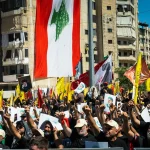
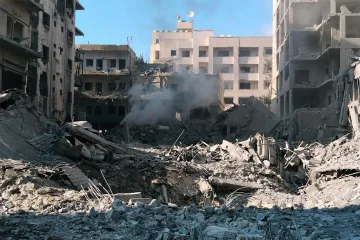
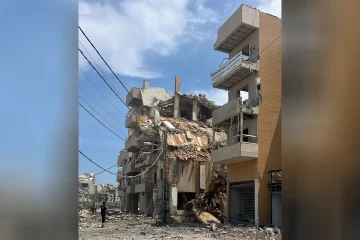
Israel simultaneously struck central Beirut, targeting infrastructure linked to Hezbollah – the Iran-backed armed movement that has been firing into northern Israel in solidarity with Tehran. The conflict is no longer bilateral. It is a regional system with its own momentum.
The Hormuz Chokehold: Real, and Getting Worse
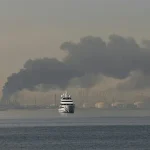
The most consequential strategic battleground is not on any land front – it is the Strait of Hormuz, the narrow maritime passage through which roughly one-fifth of the world’s fossil energy supply transits daily. Iran’s Islamic Revolutionary Guard Corps has vowed to block all oil shipments from the Gulf unless US and Israeli attacks cease, a threat it is now actively prosecuting.
On Wednesday, a cargo vessel was struck by an unknown projectile in the strait, forcing a crew evacuation and emergency assistance request. A second incident was reported off the UAE coast, where a container ship sustained damage from a suspected projectile. The United Kingdom Maritime Trade Operations confirmed both incidents. US Central Command, for its part, reported that 16 Iranian mine-laying vessels had been “eliminated” in the area on Tuesday – a figure that underscores how actively the waterway is being contested.
The market impact has been immediate and volatile. After a major crude oil price surge on Monday, prices fell back somewhat on Wednesday as investors bet that President Donald Trump would move to end the war quickly. The International Energy Agency has reportedly proposed the largest emergency oil reserve release in its history to stabilise markets further. But the IRGC’s vow to interdict shipments remains operative. The gap between financial market sentiment and ground-level reality in the Strait is, at this point, dangerously wide.
Tehran’s Internal Calculus: Crackdown at Home, War Abroad
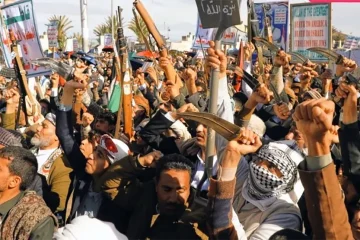
Rarely discussed in coverage of the battlefield is what is happening inside Iran – and that story is as significant as any missile barrage. The country that went to war on 28 February under Supreme Leader Ali Khamenei began Day 12 under his son, Mojtaba Khamenei, a hardliner elevated to succeed his father after the elder Khamenei was killed on the first day of the conflict. Large-scale state-organised rallies have been staged in support of the new supreme leader. A funeral procession for high-ranking military commanders killed early in the war was held in Tehran.
But the government’s fear of its own population is palpable. Iran has a history of mass protest – its security forces killed thousands of people suppressing anti-government demonstrations in the period leading up to this war. Many ordinary Iranians openly celebrated when the elder Khamenei was killed. President Trump publicly exhorted Iranian citizens to seize the moment and rise up against their government.
Tehran’s response has been pre-emptive and unambiguous. Police chief Ahmadreza Radan warned on state television that anyone who took to the streets “at the enemy’s request” would be treated as an enemy combatant, not a protester. “All our security forces have their fingers on the trigger,” Radan said. The Intelligence Ministry announced the arrest of dozens of individuals, including a foreign national, on espionage charges. The message to the population is total: this is not a moment for domestic dissent. Whether that message holds — particularly as the civilian death toll mounts – remains one of the conflict’s most volatile unknowns.
The Human Cost: Numbers That Demand Accounting
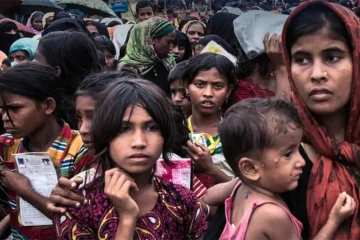
Iran’s UN Ambassador Amir Saeid Iravani placed the civilian toll at more than 1,300 killed since strikes began, with nearly 8,000 homes destroyed and over 1,600 commercial and service premises damaged or demolished, alongside dozens of medical, educational and energy infrastructure facilities. These figures have not been independently verified, but they are formally on record before the United Nations.
In Lebanon, scores have been killed in Israeli strikes targeting Hezbollah. Iranian strikes on Israel itself have killed at least 11 people. The US military has confirmed seven American soldiers killed in the theatre and approximately 140 wounded. These are not abstractions – they are the human architecture of a war that financial markets are already looking past, even as it continues to escalate.
Iran’s Open Call for Regional Intelligence Assistance
One development that has received insufficient attention: Iran’s armed forces spokesman Abolfazl Shekarchi publicly called on Wednesday for regional countries and Muslim-majority states to help identify what he described as US and Israeli “hiding places” – so that Iranian strikes can be made more precise and civilian harm minimised. The framing is that Iran is attempting to be a responsible military actor; the substance is an open solicitation for foreign intelligence cooperation against US and Israeli targets.
This is a significant escalatory signal. It suggests Iran is operating under real targeting constraints – but it also signals that Tehran is actively courting a broader coalition of intelligence-sharing partners. Whether any regional state will respond substantively to that solicitation is a matter of considerable consequence for where this conflict goes next.
What This Actually Means
Three threads run through all of Wednesday’s developments and deserve to be named plainly.
First: Iran has not collapsed. Its missile programme is still operational. Its security apparatus is functioning. Its new supreme leader is consolidating authority. Observers and investors betting on a quick Iranian capitulation are not reading the same battlefield that the combatants are fighting on.
Second: The global energy system is under active threat, not a hypothetical threat. Two ships have been hit in or near the Strait of Hormuz in a single day. The IRGC is laying mines. The IEA is proposing an unprecedented reserve release. None of this is noise — it is signal.
Third: The political conditions for de-escalation remain absent. Trump has threatened to strike Iran harder over Hormuz interference. The IRGC has threatened to continue mining. Iran’s new supreme leader has no political incentive to negotiate from a position of perceived weakness on Day 12. The gap between what markets are pricing in and what the war’s logic actually requires is the central analytical risk of this moment.