FAR from the glare of courtroom cameras and the political theatre that has come to define South Africa’s anti-corruption conversation, a different kind of battle is being waged inside the Presidency. It is unglamorous, iterative, and largely invisible to the public – but those closest to it insist it is working.
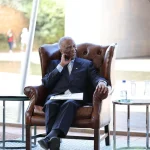
Jonathan Timm, a senior official in the South African Presidency’s anti-corruption coordination function, laid out the architecture of this effort at an Institute for Security Studies seminar in Johannesburg, describing a set of interlocking mechanisms that together constitute what may be the most coherent systemic anti-corruption framework the country has ever assembled.
The picture that emerges is one of a state that has learnt, painfully and slowly, that spectacle without systems changes nothing – and is now, with quiet determination, building the systems.
THE ZONDO TRACKER: 60 ACTIONS, 60% DONE
The starting point for accountability is the President’s formal response to the State Capture Commission, chaired by Chief Justice Raymond Zondo. The Commission’s sweeping recommendations – spanning criminal prosecutions, asset recovery, disciplinary processes and institutional reform – were translated into 60 discrete, trackable actions, each monitored under the leadership of Director-General Phindile Baleni.
The results are striking: 60% of those 60 actions have been completed or are substantially complete. Progress is tracked through the Accountability Tracker – not a Presidency instrument, but a civil society-led tool developed under the leadership of the Institute for Security Studies in partnership with other organisations. It is a live, publicly oriented mechanism designed to hold the government to account from the outside, and it has become an indispensable reference point for measuring implementation.
Crucially, the 60 actions do not focus only on prosecutions and recoveries – the high-profile outcomes the public tends to watch for. They include the structural and procedural reforms that Zondo identified as the preconditions for preventing a repeat of state capture. It is in this less visible territory – control environments, data governance, HR systems – where much of the remaining 40% of work is concentrated.
“We are at 60% completion on the 60 actions arising from the Zondo Commission. The remaining work is structural – and that is the work that lasts.”
CLOSING THE REVOLVING DOOR: THE CENTRAL REGISTER
One of the most consequential – and least publicised – anti-corruption interventions currently being finalised is the Central Register for dismissals and resignations with disciplinary cases pending. The Register directly confronts one of the most corrosive patterns in South African public administration: the recycling of corrupt or delinquent officials between government spheres.
For years, an official dismissed from a national department for fraud or misconduct could walk into a provincial department or municipality the following month, their record invisible to the new employer. The result was a revolving door that allowed compromised individuals to re-enter the civil service – sometimes in more senior roles – with impunity.
The Central Register, built on existing DPSA infrastructure, closes that door. Any recruiting authority across all three spheres of government can now input an ID number and receive an immediate, online response indicating whether that individual has been dismissed or resigned while facing a disciplinary case. The Register currently holds more than 12,000 records. Regulations requiring all appointing authorities to consult it before any appointment have completed the full consultation process with COGTA and SALGA and now await the signature of the Minister of Public Service and Administration.
The practical effect will be significant: no government entity will be able to claim ignorance of a candidate’s record. Failure to consult the Register will itself constitute an administrative failure.
“Over 12,000 dismissed or delinquent officials are now on the Central Register. No government department – national, provincial or local – can appoint anyone without checking it first.”
TRACKING THE SIU: FROM INVESTIGATION TO CONSEQUENCE
The Special Investigating Unit is among South Africa’s most powerful anti-corruption instruments. But the strength of any investigative body is only as durable as the systems that ensure its findings are acted upon. That link – between investigation and consequence – has historically been the weakest point in the accountability chain.
The Presidency has spent three years building a granular tracking mechanism for SIU recommendations, bringing together the Presidency, DPME, the NPA, the SIU itself, and the State IT Agency in a shared data and monitoring architecture. The mechanism tracks four categories: criminal referrals to the NPA; disciplinary referrals to accounting officers; administrative actions, including supplier restrictions and professional regulatory referrals; and systemic control environment recommendations.
What makes the initiative distinctive is its methodology. Rather than outsourcing the solution to a technology vendor – the pattern that has produced expensive, underperforming systems across government – the Presidency adopted an iterative, in-house approach, working with existing state-owned IT capabilities and the officials who will ultimately own the system.
“We’ve followed an approach that says what is available within the state system and how can we adapt IT and how can we work iteratively,” Timm explained, contrasting this with the procurement-and-outsource model, where “those that have to use the system are neglected when it comes to the implementation.” The proof of concept phase is complete. The project has entered its alpha phase, expanding the range of referrals tracked while focusing on institutionalisation – the people, processes and organisational cultures required to make the system self-sustaining.
THE GAME CHANGER: DIGITAL INFRASTRUCTURE
Undergirding all of these initiatives – and representing what Timm described as an opportunity South Africa has never had before – is the Presidency’s digital transformation roadmap, My Mzansi. At its core is a commitment to digital public infrastructure: foundational, interoperable, state-owned data systems that replace the fragmented, siloed, often corruptible architecture of the past.
Four interventions define the current push. First, a single trusted digital services portal – a unified citizen-government interface incorporating HR systems and payment infrastructure to eliminate fragmentation historically exploited for corruption. Second, a digital identity system anchored at the Department of Home Affairs, creating a single authoritative source of truth for identity verification across all sectors. Third, Mzansi Exchange – a government data exchange platform from National Treasury and the Presidency’s Digital Services Unit that enables authorised data sharing across institutions. Fourth, and potentially most significant, a digital payments infrastructure that will allow the state to track, analyse and audit all government payments in near real time.
The implications for procurement fraud, ghost employees and irregular expenditure are profound. The ability to detect anomalous payment patterns – payments to entities sharing addresses, payments outside normal hours, duplicates, payments to individuals on the Central Register – moves anti-corruption from reactive to anticipatory.
“Digital public infrastructure is a game changer. A single trusted digital identity, a unified data exchange, trackable digital payments – these are the foundations that make corruption structurally harder.”
A SYSTEM, NOT A SPECTACLE
Timm was candid about the non-linearity of the process. “Upstream, yes, in terms of prevention, detection, investigation, prosecution – yes, these are upstream,” he acknowledged, while cautioning against assuming the value chain operates in a neat sequence. “What is possible last year is not possible this year. So, when you do something upstream now, it might be very tentative, but you are creating an awareness and conditions that you would be able to leverage in a few years from now.”
South Africa’s anti-corruption story has, for too long, been told almost exclusively through its most dramatic chapters – the verdicts, the perp walks, the damning commission findings. The work being done quietly inside the Presidency suggests that the most important chapters may yet be the ones written in system documentation, data governance protocols, and lines of code. Unglamorous. And absolutely essential.
Jovial Rantao is Editor-in-Chief of The African Mirror.