ON an October day in 1988, a comrade of mine who was part of our leadership echelon in the underground in Swaziland sent an urgent message requesting to see me. As it was often the case with the treacherous underground working conditions in that country, we agreed to meet under the cover of darkness on the evening of the same day at a venue in Mbabane. I primed my pistol and holstered it securely on my belt. I put a few hand grenades in a holding panel in the inside of the driver’s door and set out on a drive to the evening rendezvous. As pre-agreed, the comrade emerged out of the shadows, opened the front passenger door of my car and quickly slid into the passenger seat.
We both looked around, scanning the environment for any possible surveillance or for any suspicious movement as we proceeded to exchange comradely greetings. She immediately got to the point of why she had requested the urgent appointment. She told me that Zandi, also called Zandile (Phila Portia Ndwandwe), was nowhere to be found. Zandi was Phila’s nom de guerre, and she was a crucial part of our underground structure in Swaziland. Importantly, she was one of the leading figures attached to what had become a beleaguered Natal Machinery.
The previous day, one of the comrades had driven Ndwandwe to the George Hotel in Manzini, where she met people who behaved like her acquaintances. After happily greeting them, she had left together with them in their car. Ndwandwe had told the driver who had accompanied her to the venue not to worry about her and that she would meet him later.
When my comrade finished delivering the unnerving news to me, I immediately felt like our very rendezvous was under surveillance. We looked at each other and again scanned the dark environment around us as we exchanged views on what could have happened. Two immediate thoughts came into our conversation: Ndwandwe had been lured away and kidnapped by people she knew, or she had defected to the enemy. My comrade further told me that Ndwandwe had nothing in her possession when she went for the appointment except for the clothes she was wearing at the time and a small handbag.
When we met in my car, it was already more than twenty-four hours since Ndwandwe’s disappearance. That was worryingly a long spell of time in underground military and combat work (MCW) where one member’s very life and death depended on the next member’s undivided loyalty to the cause. What gave us a glimmer of hope that she had not defected was that there was no immediate noticeable enemy follow-up in terms of the information she had about our underground structures; there had been no raids on houses that she knew about in Swaziland and no reported arrests of unit members she serviced inside South Africa. Nonetheless, we took the safe route and agreed to give immediate instructions to all units that Ndwandwe knew about, both inside the country and in Swaziland, to change codes of communication, to vacate houses and get rid of the cars that they had been using in coordinating operations with her.
The two of us also had to immediately embark on survival adjustments of our own. We reasserted to each other the need to take extra care, she opened the passenger door and slid out into the night.
Ndwandwe’s disappearance was very hard news to swallow. I had not met a more congenial and down-to-earth underground operative in my work in Swaziland. She was a warmly reassuring comrade to work with and that is partly why I could not seriously countenance that she had defected. At the time of her disappearance, her baby Thabani was only two months old. For her to defect and leave behind such a young baby did not make much logic. My commiserations went to the innocent baby and to Bheki Mabuza, the father of the baby and the man who had driven the car that clandestinely picked me up from the Mozambique border and drove me in the dead of night into the heart of Swaziland to join underground structures which I now oversaw.
Although I was more inclined to believe that Ndwandwe had been hoodwinked and then kidnapped by Askaris or underground operatives she serviced inside South Africa, I did not completely rule out defection. Over many years of struggle, I had learnt that the human mind is like a thick and dark forest that can also be inhabited by unknown apparitions and wild beasts. Which one of those animals would leap into the open at any given time depends on the threshold of an individual’s frailties or the outer limits of their fortitude and integrity. It is always foolhardy to assume that the human mind is knowable; it is extremely naïve to assume that it can be studied like a book and be passed magna cum laude. During the struggle, I learnt always to leave room for disappointment. Over the decades, we had managed to unmask enemy spies even in the most uncharacteristic individuals. Therefore, I developed a simple dictum for myself: believe with your heart but trust with your mind!
As soon as my comrade shut the car door behind her and melted into what had now turned into a suffocating evening, something else happened to me. I began to experience palpable panic attacks; it dawned on me that Ndwandwe knew my underground hideout in one of the suburbs of Mbabane. A few months before her disappearance, several comrades in the Natal Machinery to which she belonged had been withdrawn to Lusaka and Angola for security questioning. Both at headquarters in Lusaka and amongst us in Swaziland, there were strong suspicions that enemy agents within us were informing the apartheid regime about operatives and planned operations in the Swaziland and inside the country, especially in Natal. The Natal Machinery seemed to be the most beleaguered of all our underground outfits in Swaziland.
The recall of some of these operatives resulted in a shortage of personnel in our underground structures, forcing us to multitask. It was in those circumstances when we were compelled to share some key operational resources, including hideouts, contrary to strict prescripts of underground work. Under the circumstances we had little choice because, doing nothing would have resulted in the work coming to a standstill.
Apart from apartheid spies that had infiltrated our ranks, collaboration between the apartheid police and their Swazi counterparts was at a very high level. We were under siege from all quarters – enemy agents from within our ranks, Swazi police collaborators and the South African police with their death squads.
Following the attainment of political liberation in South Africa, apartheid police members from the Port Natal Security Branch testified at the Ndwandwe amnesty hearings organised through the Truth and Reconciliation Commission (TRC) which took place from 9 to 19 November 1998. They confessed that they were involved in her abduction and murder. The group included Andrew Taylor, Hendrik Botha, Jakobus Forster, Lawrence Wassermann, Salmon du Preez and Johannes Steyn. They further testified that after Ndwandwe’s abduction, they took her back to South Africa where she was interrogated and left naked for 10 days. She was then killed execution-style at the Elandskop farm in KwaZulu-Natal. This farm was often used as a security branch safe-house. The members also unanimously testified that, after 10 full days of her resistance to torture and refusal to turn into a collaborator and Askari, she was struck with a baton on her head before she was shot in the head whilst kneeling naked on the ground. Brutality and savagery unsurpassed!
They then prepared a shallow grave at that Elandskop farm as they disposed of her clothes. They covered her naked body with lime, plastic bags and refuse in order to create the impression her grave was a dumping site. They were already trying to forestall an investigation that they predicted might take place in the future. At the time of the exhumation, a blue plastic bag was found around the waist of her remains, and one of her murderers testified that she had worn it as a ‘panty’ to uphold her female dignity.
Following the exhumation, the TRC handed the remains to her family after she had been missing for about 10 years. The reburial took place on 12 March 1997 and it had the honour of being addressed by President Nelson Mandela.
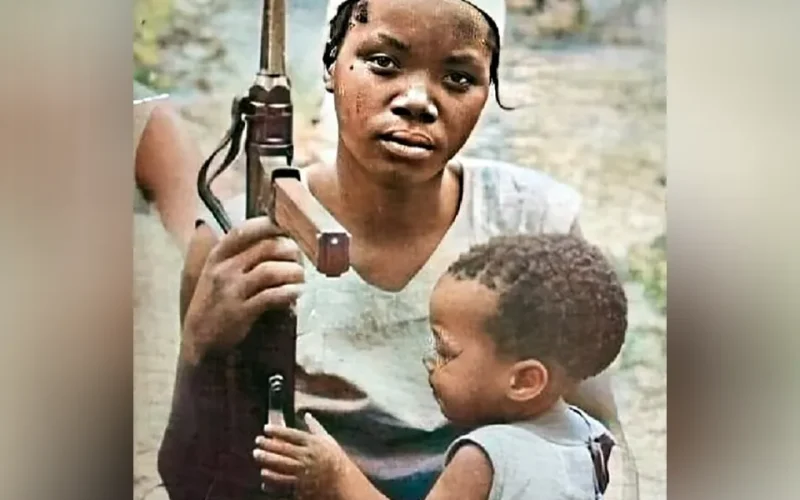
Ndwandwe is one of the most outstanding female guerrilla figures in the history of South Africa. In 2003, she received the Order of Mendi for Bravery in Silver for demonstrating bravery and valour and for sacrificing her life for her comrades in the struggle for a democratic South Africa.
Ndwandwe is one of a few fighters for freedom who can proudly recite the following words:
‘The dearest possession of any person is life. It is given only once, and it must not be lived only to feel tortured by regrets for wasted years or to know the burning shame of a mean and petty past; so live that when dying you have the right to say: all my life, all my strength was given to the finest cause in the world – the fight for the liberation of humankind’. (Nikolai Ostrovsky -How the Steel Was Tempered).
Repeating the memory of Phila Portia Ndwandwe (Zandi/Zandile) hopefully, is an antidote against forgetting the sacrifices that were made, and against those who today try to betray the cause of freedom she died for.